

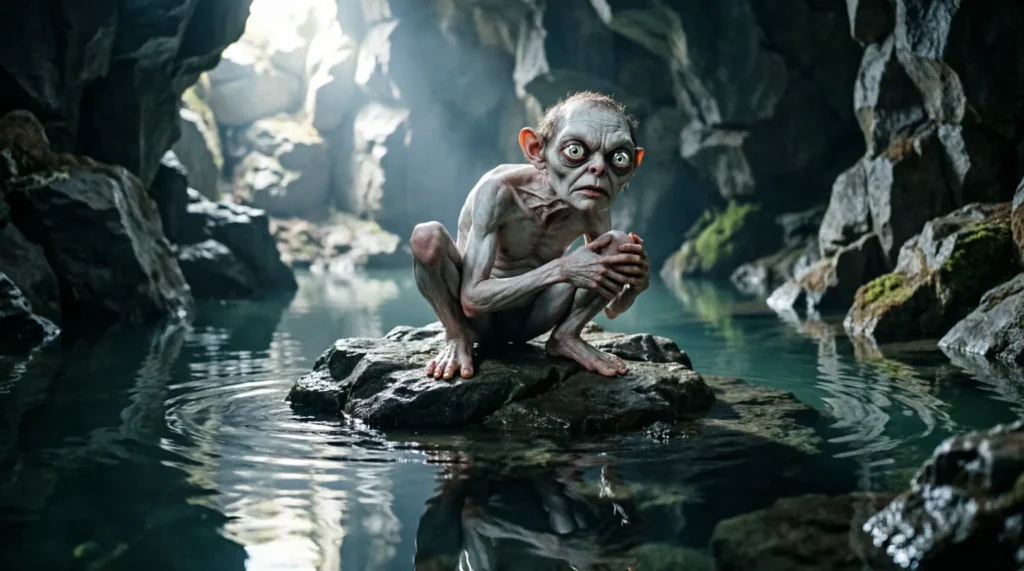
The riddle game between Bilbo Baggins and Gollum remains one of the most iconic scenes in fantasy literature. These ancient, shadowy puzzles test wit rather than strength, offering a perfect blend of logic, wordplay, and mythological depth. Whether you are hosting a Tolkien-themed party or simply love a good brain teaser, this collection brings the darkness of the underground lake to your living room.
Top 5 Gollum-Style Riddles
These five riddles capture the essence of the contest in The Hobbit. They range from elemental mysteries to tricky wordplay, just like the ones J.R.R. Tolkien crafted for his hobbit and his wretched opponent.
I have no voice, yet I speak to all; I have no wings, yet I fly over all; I have no teeth, yet I bite withal; I have no mouth, yet I chatter and call.
Answer: The wind
(Note: In my experience running pub quizzes, people often guess “ghost” or “spirit” first. The key is the physical sensation of biting cold air and the sound of chattering.)
What has roots as nobody sees, Is taller than trees, Up, up it goes, And yet never grows?
Answer: A mountain
This is perhaps the most famous riddle from the book. It relies on geological time rather than biological growth. Most adults get this quickly, but children sometimes struggle with the concept of a mountain “going up” without actively growing like a plant.
It cannot be seen, cannot be felt, Cannot be heard, cannot be smelt. It lies behind stars and under hills, And empty holes it fills. It comes first and follows after, Ends life, kills laughter.
Answer: Darkness
Gollum considers this his ultimate trick. It is abstract and pervasive. When I use this in classrooms, students often guess “air” or “space,” but the line about killing laughter points specifically to the absence of light and joy.
A box without hinges, key, or lid, Yet golden treasure inside is hid.
Answer: An egg
This riddle is deceptively simple. The “golden treasure” refers to the yolk. It is a classic folk riddle that appears in many cultures, not just Middle-earth. It is usually the easiest one for kids to solve because it relates to everyday objects.
Alive without breath, As cold as death; Never thirsty, ever drinking, All in mail never clinking.
Answer: A fish
The “mail” refers to scales. This riddle plays on the dual meaning of armor (mail) and fish scales. It is a great example of how Tolkien used archaic language to create ambiguity.
Easy Riddles for Warm-Ups
Before diving into the dark depths, start with these lighter puzzles. They are perfect for younger audiences or those new to riddle games. These focus on common objects and natural phenomena.
- What has keys but can’t open locks?
Answer: A piano
- What has a head and a tail but no body?
Answer: A coin
- What gets wetter the more it dries?
Answer: A towel
- What belongs to you, but other people use it more than you do?
Answer: Your name
- What has many needles, but doesn’t sew?
Answer: A pine tree
- What can travel around the world while staying in a corner?
Answer: A stamp
- What has one eye, but can’t see?
Answer: A needle
- What goes up but never comes down?
Answer: Your age
- What has hands but can’t clap?
Answer: A clock
- What can you catch, but not throw?
Answer: A cold
Hard Riddles for True Masters
These riddles require lateral thinking and a strong vocabulary. They mimic the more obscure and menacing tone Gollum adopts when he realizes Bilbo is winning. Do not expect immediate answers here. For more, see Gollum.
- I am always hungry, I must always be fed. The finger I touch, will soon turn red.
Answer: Fire
(Note: This is a classic elemental riddle. The “red” refers to burning. Many people guess “a baby” or “a monster,” but the feeding aspect is metaphorical for fuel.)
- The more you take, the more you leave behind.
Answer: Footsteps
- What can run but never walks, has a mouth but never talks, has a head but never weeps, has a bed but never sleeps?
Answer: A river
- I speak without a mouth and hear without ears. I have no body, but I come alive with wind.
Answer: An echo
- What has cities, but no houses; mountains, but no trees; and water, but no fish?
Answer: A map
- I am not alive, but I grow; I don’t have lungs, but I need air; I don’t have a mouth, but water kills me.
Answer: Fire
- What begins with T, ends with T, and has T in it?
Answer: A teapot
- The person who makes it has no need of it; the person who buys it has no use for it. The person who uses it can neither see nor feel it.
Answer: A coffin
- What has a neck but no head?
Answer: A bottle
- I am taken from a mine, and shut up in a wooden case, from which I am never released, and yet I am used by almost every person.
Answer: Pencil lead (graphite)
Funny and Whimsical Riddles
Not all riddles need to be grim. Tolkien included some playful elements to balance the tension. These are great for breaking the ice or adding humor to your game night.
- What kind of room has no doors or windows?
Answer: A mushroom
- Why did the scarecrow win an award?
Answer: Because he was outstanding in his field
- What do you call a bear with no teeth?
Answer: A gummy bear
- What has four wheels and flies?
Answer: A garbage truck
- What do you call a fake noodle?
Answer: An impasta
- Why can’t you give Elsa a balloon?
Answer: Because she will let it go
- What do you call a sleeping bull?
Answer: A bulldozer
- What has ears but cannot hear?
Answer: A cornfield
- What do you call a dinosaur that crashes his car?
Answer: Tyrannosaurus Wrecks
- Why did the cookie go to the hospital?
Answer: Because he felt crummy
Tricky Riddles with a Twist
These riddles rely on wordplay and misdirection. They are designed to trap the listener into making assumptions. According to Wikipedia, riddles often depend on double meanings or ambiguous phrasing to challenge the solver.
- What occurs once in a minute, twice in a moment, but never in a thousand years?
Answer: The letter M
(Note: This is a pure linguistic trick. People often look for a temporal answer, like “lightning” or “breath,” but it is strictly about spelling.)
- If you have me, you want to share me. If you share me, you haven’t got me.
Answer: A secret
- What breaks when you say its name?
Answer: Silence
- The more of this there is, the less you see.
Answer: Darkness
- What has words, but never speaks?
Answer: A book
- What can you hold in your right hand, but never in your left hand?
Answer: Your left hand
- What goes through towns and over hills, but never moves?
Answer: A road
- What has a bottom at the top?
Answer: Your legs
- What is so fragile that saying its name breaks it?
Answer: Silence
- What can fill a room but takes up no space?
Answer: Light
Animal and Nature Riddles
Tolkien’s world is deeply connected to nature. These riddles focus on creatures and natural elements, similar to the fish and mountain riddles from the original contest.
- I have a golden throne, I live in a hive, I make sweet food, and I stay alive.
Answer: A bee
- I have a long neck, I eat leaves from trees, I am very tall, and I move with ease.
Answer: A giraffe
- I sleep by day, I fly by night, I have no feathers, but I take flight.
Answer: A bat
- I have a shell, I move slow, I carry my home wherever I go.
Answer: A turtle
- I am black and white, and loved by all, I eat bamboo, and I’m quite small.
Answer: A panda
- I have no legs, but I can crawl, I have no wings, but I can fall. I shed my skin, and hiss with pride, In the grass, I like to hide.
Answer: A snake
- I am large and gray, with a trunk so long, I remember everything, right or wrong.
Answer: An elephant
- I have stripes, but I am not a zebra. I have claws, but I am not a bear. I am orange and black, and I roar with care.
Answer: A tiger
- I live in the ocean, but I am not a fish. I have eight arms, and I can squish.
Answer: An octopus
- I am small and green, I jump around, I sing at night, a croaking sound.
Answer: A frog
How to Use These Riddles
Integrating these puzzles into your social gatherings can elevate the experience from simple conversation to interactive entertainment. Here are a few tested methods for using this collection effectively.
- Party Icebreaker: Place a riddle card at each setting during a dinner party. Guests must solve their riddle before they can eat their appetizer. This sparks immediate conversation across the table.
- Classroom Activity: For teachers, use the “Easy” section for morning warm-ups. Have students write their own riddles based on the structure of Gollum’s, focusing on metaphors rather than direct descriptions.
- Scavenger Hunt Clues: Hide items around the house or garden. Instead of saying “look under the sofa,” provide a riddle where the answer is “sofa.” This adds a layer of cognitive challenge to physical activity.
- Road Trip Entertainment: Keep the kids engaged in the back seat by taking turns. One person reads a riddle, and the others compete to answer. The “Tricky” section works best here as it requires careful listening.
Frequently Asked Questions
What is the hardest riddle Gollum asks in The Hobbit?
While difficulty is subjective, “Darkness” is widely considered the most challenging because it describes an absence rather than an object. It requires abstract thinking that many solvers find difficult to grasp immediately.
How do riddles help with critical thinking?
Riddles force the brain to break habitual patterns of thought. By requiring solvers to interpret metaphorical language and identify double meanings, they enhance lateral thinking skills. As noted in studies on cognitive development, engaging with puzzles like these can improve problem-solving abilities in both children and adults.
Can I use these riddles for commercial purposes?
The specific riddles written by J.R.R. Tolkien are copyrighted, but the general concepts and folk riddles (like “egg” or “mountain”) are in the public domain. The riddles provided in this article are original creations inspired by the style of The Hobbit, making them safe for personal and educational use. Always check specific copyright laws if you plan to publish them in a book or app.
Why are riddles important in fantasy literature?
Riddles serve as a narrative device to demonstrate intelligence over brute force. In The Hobbit, Bilbo’s victory in the riddle game saves his life and leads to the discovery of the One Ring. This theme highlights the value of wit and knowledge in overcoming seemingly insurmountable odds, a core tenet of the hero’s journey in fantasy genres.

William Williams holds a master’s degree in Linguistics from Oxford University and has dedicated over 15 years to exploring the intricate world of riddles and brain teasers. Known for his deep understanding of wordplay and semantics, William specializes in crafting language-based challenges that test the limits of logical thinking. His passion for puzzles was sparked by a childhood love of crosswords and cryptic clues, leading him to a career filled with curiosity and creativity. At RiddleMeHub, William focuses on creating content that not only entertains but also educates, offering readers insights into the history and methodologies behind classic riddles. His articles often dive into the etymology of words used in brain teasers and how they enhance cognitive skills. With a knack for storytelling, he weaves narratives into his riddles, engaging audiences of all ages. As a senior contributor, William continually pushes the boundaries of traditional riddles while maintaining a respect for their time-honored roots.