

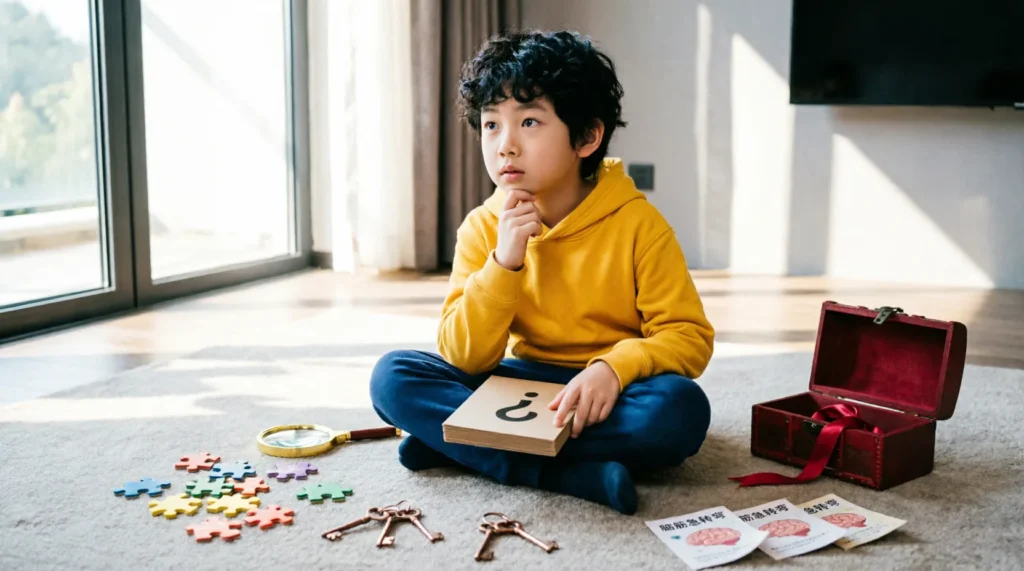
Riddles are the perfect bridge between play and critical thinking, offering a low-stakes way for eight-year-olds to practice logic, vocabulary, and lateral thinking. At this age, children are moving past simple nursery rhymes and are ready for puzzles that require them to look at language from a new angle. This collection is curated specifically for that developmental sweet spot, balancing challenge with accessibility to keep young minds engaged without causing frustration.
Top 5 Good Riddles for 8 Year Olds
These five riddles represent the gold standard for this age group. They are frequently requested in classrooms and family game nights because they strike the right balance between “aha!” moments and genuine puzzlement.
I have a neck but no head. I have two arms but no hands. What am I? Answer: A shirt
When I run this one with kids, the wrong guess is always “a snake” or “a tree.” It forces them to think about clothing anatomy rather than just biology.
What has to be broken before you can use it? Answer: An egg
This is a classic for a reason. It relies on a very concrete, physical action that every eight-year-old understands, making it an excellent confidence-builder early in a riddle session.
I’m tall when I’m young, and I’m short when I’m old. What am I? Answer: A candle
This riddle introduces the concept of change over time in a tangible way. It is often solved quickly by kids who have helped with birthday cakes, showing how real-world experience aids puzzle-solving.
What month of the year has 28 days? Answer: All of them
This is a trick question that tests attention to detail rather than calendar memorization. Most adults pause on this one too, which makes it a great equalizer in mixed-age groups.
What has keys but can’t open locks? Answer: A piano
This riddle plays on homonyms and multiple meanings of words. It encourages children to think beyond the most common definition of “keys,” fostering semantic flexibility.
Easy Riddles to Build Confidence
Starting with easier riddles helps warm up the brain and establishes a rhythm of success. These puzzles rely on direct observation and basic vocabulary, ensuring that even reluctant participants can join in.
What has legs but cannot walk? Answer: A table
What has one eye but can’t see? Answer: A needle
What goes up but never comes down? Answer: Your age
This is a personal favorite for birthday parties. It connects the abstract concept of time to the child’s own life, making the answer feel immediate and relevant.
What has many teeth but cannot bite? Answer: A comb
What gets wet while drying? Answer: A towel
This paradoxical phrasing is simple enough for an eight-year-old to grasp. It teaches them that actions can have reciprocal effects, a key logical concept.
What has a face and two hands but no arms or legs? Answer: A clock
What belongs to you but is used more by others? Answer: Your name
This riddle often sparks a brief philosophical discussion among kids, which is a bonus for parents and teachers looking to extend the learning moment.
Funny Riddles for Giggles
Humor is a powerful memory aid. When a riddle ends in a laugh, the neural pathway associated with that logic puzzle is strengthened. These riddles lean into silliness and unexpected twists.
Why did the cookie go to the doctor? Answer: Because he felt crummy
What do you call a fake noodle? Answer: An Impasta
This pun works well because it requires knowledge of both food and the word “imposter,” stretching their vocabulary in a playful way.
What do you call a bear with no teeth? Answer: A gummy bear
What kind of room has no doors or windows? Answer: A mushroom
This is a visual pun that relies on breaking the word “mushroom” into “mush” and “room.” It is a staple in my repertoire because it always gets a groan followed by a smile.
What do you call a sleeping bull? Answer: A bulldozer
Why did the student eat his homework? Answer: Because the teacher said it was a piece of cake
What has ears but cannot hear? Answer: Corn
Tricky Riddles That Require Lateral Thinking
These riddles are designed to trip up the literal thinker. They require the solver to step back and consider the context or the wording itself, rather than just the objects described. According to Wikipedia, riddles often rely on metaphorical language that obscures the literal meaning, requiring the solver to decode the imagery.
What can you catch but not throw? Answer: A cold
This is a linguistic trap. The word “catch” has different meanings in sports versus health, and eight-year-olds are just beginning to navigate these nuances.
What has a head and a tail but no body? Answer: A coin
I have cities, but no houses. I have mountains, but no trees. I have water, but no fish. What am I? Answer: A map
This is arguably the best riddle for teaching representation. It forces the child to distinguish between an object and its depiction, a crucial cognitive skill.
What begins with T, ends with T, and has T in it? Answer: A teapot
This riddle plays on the sound of the letter “T” versus the word “tea.” It is a auditory puzzle as much as a visual one.
What can travel all around the world without leaving its corner? Answer: A stamp
This requires historical or observational knowledge about how mail works. If the child hasn’t seen a physical letter mailed, this one might be tough, making it a good teaching opportunity.
What has a thumb and four fingers but is not alive? Answer: A glove
Math and Logic Riddles
Integrating math into riddles removes the anxiety often associated with worksheets. These puzzles use numbers and sequences but frame them as mysteries to be solved rather than problems to be calculated.
If there are three apples and you take away two, how many do you have? Answer: Two
This is a classic trick. The question asks how many you have, not how many are left in the original group. It tests reading comprehension as much as arithmetic.
How many months have 28 days? Answer: 12 (All of them)
Repeating this concept in a different format reinforces the logic. It shows that “having 28 days” does not mean “having only 28 days.”
What number do you get when you multiply all the numbers on a telephone keypad? Answer: Zero
This requires knowing that zero is on the keypad. Once they realize zero is included, the multiplication result becomes obvious. It teaches the property of zero in multiplication.
If you divide 30 by half and add 10, what do you get? Answer: 70
Dividing by half is the same as multiplying by two. This is a harder one, suitable for eight-year-olds who are comfortable with basic operations and ready for a challenge.
I am an odd number. Take away one letter and I become even. What number am I? Answer: Seven
This blends spelling and math. It is a cross-disciplinary puzzle that appeals to kids who enjoy wordplay as much as numbers.
How many sides does a circle have? Answer: Two (Inside and outside)
This is a geometric trick question. While mathematically a circle has infinite points or one continuous side, in the context of riddles, the “inside and outside” answer is the standard playful response that challenges spatial definitions.
Animal Riddles
Animals are a perennial favorite topic for eight-year-olds. These riddles use characteristic traits of animals to create puzzles that are both educational and entertaining.
What animal sleeps with one eye open? Answer: A dolphin
This fact is often surprising to kids. Dolphins sleep with half their brain at a time to keep breathing, which manifests as one eye open. It is a great gateway to discussing marine biology.
What has a shell but is not a turtle? Answer: A snail
What bird can lift the most weight relative to its size? Answer: An ant (Wait, that’s an insect!) — Actually, the correct riddle answer is often a trick, but let’s stick to: What has wings but cannot fly? Answer: An ostrich (or a penguin)
I chose ostrich here as it is a common land-based example that kids recognize.
What animal is always found in the middle of the ocean? Answer: The letter ‘e’
This is a word-play riddle disguised as a biology question. It catches many people off guard because it shifts domains entirely.
What has a trunk but is not an elephant? Answer: A car (or a tree)
Accepting both answers is good practice. It shows that metaphors can apply to multiple objects. In my experience, kids usually guess “car” first due to familiarity with vehicles.
What insect has the best hearing? Answer: A cricket
Crickets have their ears on their front legs. This bizarre fact makes the riddle memorable and serves as a fun trivia nugget.
How to Use These Riddles
Riddles are versatile tools that can be integrated into various daily routines to make learning feel like play. Here are some practical ways to deploy this collection.
Classroom Warm-ups: Start the day with one riddle on the board. It engages students immediately and transitions them from home mode to school mode. Allow five minutes for discussion before revealing the answer.
Road Trip Entertainment: Riddles are ideal for long car rides because they require no props. Keep a list handy in the glove compartment. When boredom strikes, pull out a “tricky” riddle to spark debate among siblings.
Scavenger Hunt Clues: Use the answer to a riddle as the location for the next clue. For example, if the answer is “fridge,” hide the next clue inside the refrigerator. This adds a layer of physical activity to the mental challenge.
Bedtime Wind-down: Instead of a story, try a gentle riddle. It slows down the pace and focuses the mind on a single, solvable problem, which can be calming before sleep. Avoid the “hard” category here; stick to the “easy” or “funny” sections to ensure a positive end to the day.
Frequently Asked Questions
What makes a riddle appropriate for an 8-year-old? A good riddle for this age group should rely on concrete nouns and familiar concepts like animals, household items, or basic school subjects. The logic should be linear but slightly obscured by wordplay. Avoid abstract concepts or cultural references that require adult-level life experience. The vocabulary should be within their reading level, though listening comprehension can handle slightly higher complexity.
How do I help a child who is stuck on a riddle? Instead of giving the answer, offer a hint that narrows the category. For example, if they are stuck on “What has keys but can’t open locks?”, ask, “Where do you find keys that make music?” This guides their thinking without solving the puzzle for them. Encourage them to think about homonyms or double meanings.
Are riddles beneficial for cognitive development? Yes. Riddles promote flexible thinking, vocabulary expansion, and patience. They teach children that there can be multiple interpretations of a single statement. According to general educational principles supported by resources on time and calendars, understanding cyclical and linear time is a key developmental milestone for this age, and riddles about time (like the candle or age riddles) reinforce these concepts in a engaging way.
Can riddles help with reading skills? Absolutely. Solving riddles requires careful reading and attention to detail. Children must parse each word to understand the constraints of the puzzle. This close reading practice translates directly to better comprehension in academic texts. It also encourages them to read aloud and discuss language, fostering a love for words.

With a background in psychology and cognitive science from Stanford University, Sarah Jones brings a unique perspective to the world of riddles and brain teasers. With a decade of experience in the field, she specializes in understanding how puzzles can enhance cognitive development and mental agility. Sarah’s interest in riddles began during her undergraduate years when she researched problem-solving processes in the human brain. Her work at RiddleMeHub focuses on creating puzzles that are both challenging and beneficial for mental growth, often incorporating elements of math and logic. She writes extensively about the cognitive benefits of engaging with brain teasers, aiming to promote brain health and fitness through fun and challenging content. Sarah’s contributions to the site include themed puzzle collections and in-depth analyses of classic riddles, making them accessible to both beginners and seasoned puzzlers alike. Her insightful approach has helped numerous readers appreciate the mental workout that comes with solving complex problems.