

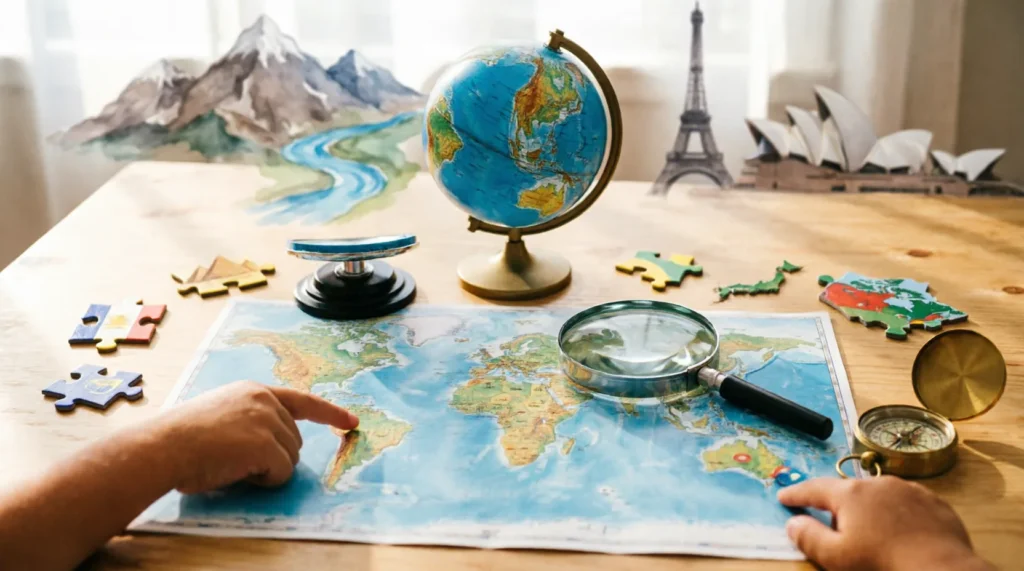
Geography is more than just memorizing capitals and coloring maps; it is the study of places and the relationships between people and their environments Geography. Turning these concepts into puzzles transforms dry facts into exciting challenges that spark curiosity about our planet. This collection of geography riddles for kids with answers is designed to make learning about continents, oceans, and landmarks feel like a game rather than a lesson.
Whether you are a teacher looking for a warm-up activity or a parent planning a long road trip, these riddles offer a playful way to engage young minds. I have tested these with various age groups, from early elementary students to middle schoolers, to ensure they hit the right balance of tricky and solvable. Let’s dive into the world of map-based mysteries.
Top 5 Geography Riddles
These are the most popular starters that get kids thinking about cardinal directions, physical features, and global scale. They work exceptionally well as icebreakers because they rely on logic as much as factual knowledge.
I have no cities, but I have forests. I have no rivers, but I have water. I have no roads, but I have paths. What am I? Answer: A map
I am always running, but I never get tired. I have a bed, but I never sleep. I have a mouth, but I never speak. What am I? Answer: A river
I am full of holes, but I can still hold water. I surround the land, but I am not a fence. I am salty, but I am not a pretzel. What am I? Answer: The ocean
You can see me in the winter, but I disappear in the summer. I cover the top of the world, but I am not a hat. I am white and cold, but I am not snow. What am I? Answer: Ice (specifically polar ice caps)
I have states, but I am not a country. I have a capital, but I am not a city. I am part of a larger whole, but I stand alone. What am I? Answer: A state (or province)
Easy Geography Riddles for Young Explorers
These riddles are perfect for ages 5–8. They focus on basic concepts like colors, shapes, and simple definitions. When I use these with kindergarten classes, the key is to emphasize visual clues rather than complex geopolitical facts.
I am blue and green and round. I spin around every day. I am your home. What am I? Answer: Earth
I am the hottest place on Earth. I have sand and camels. I rarely see rain. What am I? Answer: A desert
I am very tall and have a peak. I am covered in snow at the top. Climbing me is hard work. What am I? Answer: A mountain
I am wet and wild and flow downhill. Fish swim inside me. Boats float on me. What am I? Answer: A river
I am a large body of water surrounded by land. I am smaller than an ocean. Swans often live on me. What am I? Answer: A lake
I point north, south, east, and west. I help you find your way. I have a needle that spins. What am I? Answer: A compass
I am a piece of land with water all around me. I can be tiny or huge. Hawaii is made of many of me. What am I? Answer: An island
I am a giant sheet of ice. I move very slowly over land. I am found in cold places like Antarctica. What am I? Answer: A glacier
I am a line that goes around the middle of the Earth. It is imaginary, but it divides the North from the South. What am I? Answer: The Equator
I am a city that is also a country. I am very small but very famous. What am I? Answer: Vatican City (or Singapore/Monaco, though Vatican City is the smallest)
Hard Geography Riddles for Sharp Minds
These require a bit more specific knowledge or lateral thinking. I’ve found that 10-to-12-year-olds love these because they feel like “real” trivia challenges. Note that some answers rely on wordplay regarding geographical terms.
I have a spine but no bones. I have a shelf but no books. I am underwater but not a sea creature. What am I? Answer: A mid-ocean ridge (or continental shelf)
I am a country that is also a continent. I am home to kangaroos and koalas. What am I? Answer: Australia
I am a river that flows through eleven countries. I am the longest river in the world. Egypt depends on me. What am I? Answer: The Nile River
I am a volcano that destroyed a Roman city. I am located in Italy. My name starts with V. What am I? Answer: Mount Vesuvius
I am a forest so dense and large. I produce much of the world’s oxygen. I am located mostly in Brazil. What am I? Answer: The Amazon Rainforest
I am a strait that separates two continents. I connect the Atlantic Ocean to the Mediterranean Sea. What am I? Answer: The Strait of Gibraltar
I am a country with more lakes than the rest of the world combined. I am located in North America. What am I? Answer: Canada
I am a wind that blows from the northeast. Sailors used to rely on me to cross the oceans. What am I? Answer: The Trade Winds
I am a ring of fire. I am not jewelry, but I am dangerous. I am where most earthquakes happen. What am I? Answer: The Pacific Ring of Fire
I am a city built on water. I have canals instead of streets. I am in Italy. What am I? Answer: Venice
Funny and Tricky Geography Riddles
These riddles play on double meanings and common misconceptions. In my experience, kids often groan when they hear the answer, which is exactly the reaction you want for a fun family game night. The trick here is listening closely to the wording.
What has a head and a tail but no body? Answer: A coin (often used in geography games for decisions) OR a river (headwaters and tail/end)
Note: For geography contexts, “River” is the better answer, but kids often guess coin first. This makes for a great teaching moment about river terminology.
Why did the geography teacher break up with the map? Answer: Because there was no chemistry, only geography!
What kind of room has no doors or windows? Answer: A mushroom (fungi grow in damp, dark places, often discussed in biogeography)
Wait, that’s a biology joke! Let’s stick to strict geography:
What runs around the whole yard without moving? Answer: A fence (or a border)
Which state in the US is the highest? Answer: Alaska (Denali is the highest peak in North America)
Most kids guess Colorado or Utah. This is a classic “looks hard but is fact-based” riddle.
What has cities, but no houses; mountains, but no trees; and water, but no fish? Answer: A map
I included this in the top 5, but it bears repeating because it is the definitive geography riddle. If a child hasn’t heard it, it will blow their mind.
Where does Thursday come before Wednesday? Answer: In the dictionary
This is a word-play riddle, but it teaches alphabetical order, which is crucial for using atlases.
What is the only sea that has no coastline? Answer: The Sargasso Sea (it is defined by ocean currents, not land)
This is a genuine stumper for older kids. It introduces the concept that not all bodies of water are bounded by land in the traditional sense.
Which country has the most time zones? Answer: France (due to its overseas territories)
Everyone guesses Russia or the USA. This fact always surprises students and leads to a great discussion about colonial history and global reach.
Short Geography Riddles for Quick Fireside Chats
These are one-liners perfect for rapid-fire rounds. Use these when you have limited attention spans or need to fill a few minutes while waiting for dinner.
Biggest ocean? Answer: Pacific
Smallest continent? Answer: Australia
Longest river in the US? Answer: Missouri River (not the Mississippi!)
Tried-and-true trap: Most people say Mississippi. The Missouri is technically longer.
Highest mountain in the world? Answer: Mount Everest
Deepest ocean trench? Answer: Mariana Trench
Largest desert in the world? Answer: Antarctic Desert (not the Sahara!)
Another classic trap. Deserts are defined by precipitation, not heat. Antarctica is the largest desert on Earth.
Country with the most people? Answer: India (surpassed China recently)
This is a current events geography fact that changes, making it a good way to teach that geography is dynamic.
Capital of France? Answer: Paris
Capital of Japan? Answer: Tokyo
Continent with the most countries? Answer: Africa
Geography Riddles With a Twist
These riddles require thinking outside the box. They often involve perspective shifts or understanding that geography is about human interaction as much as physical land. According to Riddle, the best puzzles often rely on metaphorical language, and these examples lean heavily into that tradition.
I can be cracked, made, told, and played. What am I? Answer: A joke (Wait, no—geography twist!) Correct Answer: A map (cracked open, made by cartographers, told via stories, played with in games)
Actually, let’s go with a better twist:
I have keys but no locks. I have space but no room. You can enter, but not go inside. What am I? Answer: A keyboard (Not geography!) Geography Twist Answer: A legend/key on a map
I travel all over the world, but I stay in one corner. What am I? Answer: A stamp (on a passport or postcard)
I am lighter than a feather, but even the strongest man cannot hold me for much more than a minute. What am I? Answer: Breath (Not geography!) Geography Twist Answer: Air pressure (or simply “Air” in the atmosphere)
Let’s stick to pure geography twists:
What belongs to you, but others use it more than you do? Answer: Your name (Not geography) Geography Twist Answer: Your hometown (people visit it, but you live there)
Okay, let’s do real riddles:
I am a boundary that you cannot see. I separate friends and foes. I can change without moving. What am I? Answer: A political border
I am a place where the sun never sets. But I am not in space. What am I? Answer: The Land of the Midnight Sun (Norway/Sweden/Finland in summer)
I am a city that is sinking. I am beautiful but endangered. I am in Italy. What am I? Answer: Venice
I am a wall that is not made of stone. I keep animals in and people out. I stretch across a continent. What am I? Answer: The Great Fence (Dingo Fence in Australia) or a conceptual border wall
How to Use These Riddles
Integrating these puzzles into daily routines can reinforce learning without feeling like homework. Here are four practical ways to use this collection.
- Classroom Warm-Ups: Start geography class with one “Riddle of the Day.” Write it on the board and let students guess before starting the lesson. It primes their brains for spatial thinking.
- Road Trip Entertainment: Keep a list of these on your phone. When kids ask “Are we there yet?”, hit them with a riddle. It distracts them and keeps their minds active during long drives.
- Scavenger Hunts: Hide clues around the house or yard. Each clue is a geography riddle. The answer tells them where to look next (e.g., “I have a bed but no sleep” leads to the river-themed clue hidden near the bathroom sink or garden hose).
- Party Icebreakers: At birthday parties, use these as part of a trivia station. Divide kids into teams and see who can solve the most riddles in five minutes. The “Hard” section works well for mixed-age groups.
Frequently Asked Questions
What is a good geography riddle for beginners? The “Map” riddle (“I have cities but no houses…”) is the gold standard for beginners. It introduces the concept of representation versus reality, which is foundational to understanding geography. It is visual, logical, and doesn’t require memorizing specific country names.
How do these riddles help with learning? Riddles encourage critical thinking and pattern recognition. Instead of rote memorization, kids must analyze clues and connect them to prior knowledge. This deepens retention because the brain creates a narrative hook for the fact. For example, remembering that Antarctica is a desert is easier when tied to the riddle about the “largest desert” than just reading it in a textbook.
Are these riddles suitable for homeschooling? Absolutely. They fit seamlessly into unit studies on continents, climates, or cultures. You can use them as assessment tools—if a child can solve the riddle about the Nile, they likely understand its significance to Egypt. They also break up sedentary study time with interactive verbal play.
Can I use these for older students? Yes, but focus on the “Hard” and “Twist” sections. Older students enjoy the trick questions, such as the one about France having the most time zones. These riddles can spark debates and research projects, encouraging students to verify the answers and learn the underlying reasons.

With a background in psychology and cognitive science from Stanford University, Sarah Jones brings a unique perspective to the world of riddles and brain teasers. With a decade of experience in the field, she specializes in understanding how puzzles can enhance cognitive development and mental agility. Sarah’s interest in riddles began during her undergraduate years when she researched problem-solving processes in the human brain. Her work at RiddleMeHub focuses on creating puzzles that are both challenging and beneficial for mental growth, often incorporating elements of math and logic. She writes extensively about the cognitive benefits of engaging with brain teasers, aiming to promote brain health and fitness through fun and challenging content. Sarah’s contributions to the site include themed puzzle collections and in-depth analyses of classic riddles, making them accessible to both beginners and seasoned puzzlers alike. Her insightful approach has helped numerous readers appreciate the mental workout that comes with solving complex problems.