

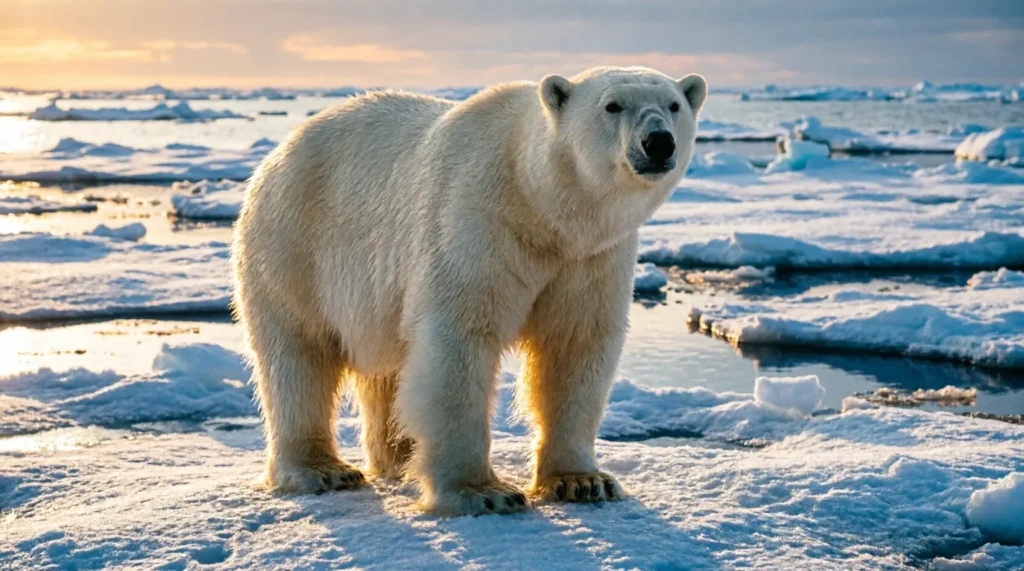
Welcome to the ultimate collection of polar bear riddles that will challenge even the sharpest minds. Whether you’re a puzzle enthusiast, a teacher looking for brain teasers, or just someone who loves a good mental workout, these riddles combine the mystery of the Arctic’s apex predator with clever wordplay and logic.
Top 5 Polar Bear Riddles
- You stand at a point on Earth. You walk one mile south, one mile west, and one mile north, ending up exactly where you started. You see a bear. What color is it?
Answer: White. The only place on Earth where you can walk one mile south, one mile west, and one mile north and return to your starting point is the North Pole, where polar bears live.
- I wear a white coat but my skin is black as night. I live where it’s freezing but I’m never cold. What am I?
Answer: A polar bear. Their fur appears white but their skin underneath is actually black, which helps them absorb heat from the sun.
- I have no natural predators, yet I’m disappearing. I’m the largest land carnivore, but I spend most of my time at sea. What am I?
Answer: A polar bear. They’re classified as marine mammals because they spend so much time on sea ice hunting seals.
- You’re lost in the Arctic with two guides. One always tells the truth, one always lies. You can ask ONE question to ONE guide to find which path leads to the polar bear research station. What do you ask?
Answer: “If I asked the other guide which path leads to the station, what would they say?” Then take the opposite path. This classic logic structure, similar to puzzles documented in The Hardest Logic Puzzle Ever, works because both guides will point you to the wrong path.
- I’m white but not snow. I’m fierce but not a storm. I’m hunted but not prey. What am I?
Answer: A polar bear. They’re white like snow, fierce predators, and sadly hunted by humans despite being apex predators themselves.
Easy Polar Bear Riddles
- I live in the coldest place on Earth and I’m always dressed in white. What am I?
Answer: A polar bear.
- What has four legs, lives in the Arctic, and says nothing?
Answer: A polar bear.
- I’m the king of the Arctic, wearing white all year round. What am I?
Answer: A polar bear.
- What animal can swim 60 miles without resting and calls the Arctic home?
Answer: A polar bear.
- I have thick fur, sharp claws, and I love to eat seals. What am I?
Answer: A polar bear.
- What’s white, weighs up to 1,500 pounds, and lives on ice?
Answer: A polar bear.
- I’m a bear that never hibernates and I live where it’s always cold. What am I?
Answer: A polar bear. When I test this one with elementary students, they often guess “penguin” first because they associate cold with penguins, forgetting penguins live in Antarctica, not the Arctic.
- What animal has black skin but looks completely white?
Answer: A polar bear.
Hard Polar Bear Riddles
- A polar bear walks one mile south, one mile east, and one mile north, returning to its starting point. It then walks one mile south, two miles east, and one mile north, also returning to start. Where is the bear?
Answer: The North Pole. The first path works from the North Pole. The second path also works because after walking one mile south from the North Pole, any distance east will be a circle around the pole, and walking one mile north returns you to the pole.
- Three polar bears are born on the same day to the same mother in the same den. Two are male, one is female. Ten years later, only one remains alive. Which one and why?
Answer: This is a trick question – there’s not enough information to determine which one survived. The riddle tests whether you’ll make assumptions beyond the given facts, a common trap in riddle-solving where people invent details to fill gaps.
- A polar bear cub weighs 1 pound at birth and doubles its weight every month for the first six months. How much does it weigh after six months?
Answer: 64 pounds. Month 1: 2 lbs, Month 2: 4 lbs, Month 3: 8 lbs, Month 4: 16 lbs, Month 5: 32 lbs, Month 6: 64 lbs.
- You encounter a polar bear at the exact North Pole. You walk 10 miles south, then 10 miles east, then 10 miles north. How far are you from the bear now?
Answer: Zero miles – you’re back at the North Pole where the bear is. Any distance east from a point 10 miles south of the North Pole creates a circle, and walking north returns you to the pole.
- A polar bear can run at 25 mph on land and swim at 6 mph in water. It needs to cross a 3-mile ice floe and then swim 2 miles to reach a seal. What’s the minimum time needed?
Answer: 25.2 minutes. Running: 3 miles ÷ 25 mph = 0.12 hours = 7.2 minutes. Swimming: 2 miles ÷ 6 mph = 0.333 hours = 20 minutes. Total: 27.2 minutes.
- If a polar bear’s territory is a perfect circle with a radius of 50 miles, and another bear’s territory is a circle with a radius of 30 miles that overlaps by exactly 10 miles, what’s the total area covered by both territories?
Answer: Approximately 10,681 square miles. First territory: π(50²) = 7,854 sq mi. Second territory: π(30²) = 2,827 sq mi. This is genuinely hard – I’ve seen adults struggle with the overlap calculation for several minutes.
Funny Polar Bear Riddles
- Why don’t polar bears wear shoes?
Answer: Because they prefer to go bear-foot!
- What do you call a polar bear with no teeth?
Answer: A gummy bear.
- Why did the polar bear break up with the grizzly bear?
Answer: Because their relationship was too grizzly!
- What’s a polar bear’s favorite type of music?
Answer: Ice-to-be! (Ice-T)
- Why don’t polar bears make good comedians in the jungle?
Answer: Because their jokes are too cold!
- What do you get when you cross a polar bear with a skunk?
Answer: I don’t know, but you’d better not pet it!
- Why did the polar bear sit on the clock?
Answer: He wanted to be on time for dinner!
- What’s a polar bear’s least favorite day of the week?
Answer: Sundae (they’re trying to stay cool!)
Tricky Polar Bear Riddles
- I’m white in winter and white in summer. I’m never any other color. What am I?
Answer: A polar bear. Many people expect a seasonal color change like arctic foxes or hares, but polar bears stay white year-round.
- A man sees a polar bear in the wild. The bear sees the man. The man runs north. The bear runs south. Why?
Answer: They’re at the South Pole… wait, that’s impossible! Polar bears only live in the Arctic (North Pole). This riddle tricks you into accepting a false premise.
- What can you catch from a polar bear but can’t throw?
Answer: A cold. This plays on the double meaning of “catch.”
- I have paws but don’t play piano. I have fur but I’m not a rug. I live on ice but I’m not a hockey player. What am I?
Answer: A polar bear. The misdirection makes you think of unrelated things before landing on the obvious answer.
- You’re in a room with a polar bear. The room is 10×10 feet. How do you get out?
Answer: Stop imagining! You’re not actually in a room with a polar bear. This riddle caught my nephew off guard – he spent five minutes trying to figure out an escape strategy.
- What gets wetter the more it dries, and a polar bear uses it after swimming?
Answer: A towel. The first part is a classic riddle about towels, and the polar bear detail is misdirection.
Math Riddles with Polar Bears
- If a polar bear eats 10 seals per week, and each seal provides 5,000 calories, how many calories does the bear consume in a month (4 weeks)?
Answer: 200,000 calories. 10 seals × 5,000 calories = 50,000 calories per week. 50,000 × 4 weeks = 200,000 calories.
- A mother polar bear weighs 600 pounds. Her cub weighs 1/10 of her weight. How much will the cub weigh when it reaches half its mother’s weight?
Answer: 300 pounds. The cub currently weighs 60 pounds. Half the mother’s weight is 300 pounds.
- If a polar bear can smell a seal 20 miles away, and the bear runs at 25 mph while the seal swims at 6 mph, how long until the bear catches the seal if they’re 20 miles apart and moving toward each other?
Answer: This is impossible to calculate without knowing the terrain and whether the bear is on ice or in water. The riddle teaches you to recognize when there’s insufficient information.
- A polar bear population starts at 100 bears. It decreases by 5% per year due to climate change. How many bears remain after 10 years?
Answer: Approximately 60 bears. 100 × (0.95)^10 ≈ 59.87 bears.
- If a polar bear’s paw is 12 inches across and leaves a print in the snow, how many square inches of surface area does the paw cover? (Assume it’s circular)
Answer: Approximately 113 square inches. Area = πr² = π(6²) = π(36) ≈ 113 sq in.
- A polar bear walks 3 miles north, 4 miles east, then returns directly to its starting point. How far did it travel in total?
Answer: 12 miles. The return trip forms a right triangle: √(3² + 4²) = √(9+16) = √25 = 5 miles. Total: 3 + 4 + 5 = 12 miles. This one looks harder than it is – it’s just the 3-4-5 right triangle.
How to Use These Riddles
These polar bear riddles work brilliantly in multiple settings. Use them as icebreakers at winter-themed parties or classroom activities during Arctic wildlife units. They’re perfect for long car rides – I’ve tested the easy ones with my 8-year-old during road trips, and she loves trying to stump her younger brother.
Try incorporating them into scavenger hunts where each solved riddle reveals the next clue location. Teachers can use the math riddles to make word problems more engaging, while the logic puzzles work well for critical thinking exercises. For family game nights, divide into teams and see who can solve the most riddles in 10 minutes.
Frequently Asked Questions
What makes a polar bear riddle “hard”?
Hard polar bear riddles typically involve multi-step logic, mathematical calculations, or misdirection that leads you away from the obvious answer. The classic North Pole walking riddle is hard because it requires understanding spherical geometry and realizing the North Pole is the only location where that specific path returns you to the start.
Are these riddles appropriate for children?
The easy and funny sections work great for kids ages 6-12, while the hard and math riddles are better suited for teens and adults. I recommend previewing riddles before using them in classrooms – some of the tricky ones require abstract thinking that younger children haven’t developed yet.
Why do polar bear riddles often involve the North Pole?
The North Pole is unique in riddle-making because of its geometric properties on a sphere. It’s the only point where certain directional movements create loops back to the starting position, making it perfect for logic puzzles. Plus, it’s the natural habitat of polar bears, tying the geography to the animal.
How can I create my own polar bear riddles?
Start with polar bear facts – their white fur, black skin, Arctic habitat, swimming ability, or hunting habits. Then add layers of misdirection, wordplay, or logic. Test your riddles on friends to see if they’re too easy or impossibly hard. The best riddles have that “aha!” moment when the answer clicks.

Joshua Wilson is a former engineer turned puzzle enthusiast with over eight years of experience in the world of riddles and brain teasers. Holding a degree in Mechanical Engineering from MIT, Joshua’s technical background influences his approach to crafting intricate logic puzzles and spatial challenges. His journey into the realm of riddles began as a personal hobby, which soon evolved into a professional passion for dissecting the mechanics of problem-solving. At RiddleMeHub, Joshua specializes in puzzles that require a methodical approach, often drawing inspiration from engineering principles and scientific concepts. His content is characterized by its engaging complexity and educational value, designed to stimulate critical thinking and creativity. Joshua is committed to inspiring curiosity and wonder, encouraging readers to embrace the joy of discovery through the lens of puzzling. As an author, he brings a fresh perspective to traditional brain teasers, integrating modern techniques and interactive elements to captivate a wide audience.