

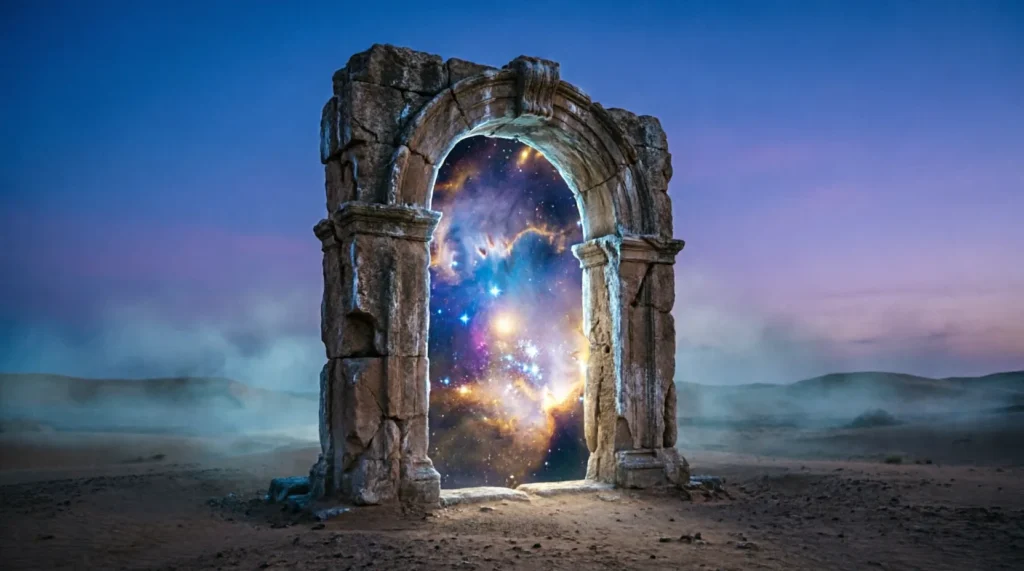
What riddle has every religious tradition tried to answer? It’s the question of existence itself—why we’re here, where we came from, and what happens when we’re gone. Whether you’re hosting a philosophy discussion group, teaching a comparative religion class, or just love pondering life’s biggest mysteries, these riddles will challenge your thinking and spark deep conversations.
Top 5 Existential Riddles That Have Stumped Humanity
Riddle: I have no beginning, yet I created all beginnings. I have no end, yet I define all endings. Every culture has tried to name me, but no name can contain me. What am I?
Answer: God (or the Divine/Ultimate Reality)
Riddle: I am the question that keeps philosophers awake at night and prophets inspired at dawn. I am asked in every language, in every temple, in every quiet moment before sleep. Answer me, and you find peace. Ignore me, and you search forever. What question am I?
Answer: “What is the meaning of life?”
Riddle: I am the same for the king and the beggar, yet everyone experiences me differently. I am the great equalizer that every religion promises to explain, but none can fully describe until you reach me. What am I?
Answer: Death
Riddle: I existed before time began, yet I am reborn every moment. I am the canvas upon which all stories are written, yet I have no story of my own. Every faith claims to know my origin, but I remain mysterious. What am I?
Answer: The Universe (or Creation/Existence)
Riddle: I am the bridge between the mortal and the eternal. I am what every soul seeks, yet I cannot be found in any physical place. I am described differently in every scripture, yet seekers across all traditions report finding the same peace. What am I?
Answer: Enlightenment (or Salvation/Nirvana/Moksha)
Easy Existential Riddles for Beginners
- Riddle: I am always coming but never arrive. Everyone waits for me, but no one knows when I’ll show up. What am I?
Answer: Tomorrow (or the Future)
Tested note: When I use this one with middle schoolers, they almost always guess “Christmas” first. It’s a great entry point to discuss how different cultures view time.
- Riddle: I can be broken without being touched. I can be kept without being held. Every religion teaches how to preserve me. What am I?
Answer: A Promise (or a Vow/Covenant)
- Riddle: I am lighter than a feather, yet no one can hold me for long. I is what every tradition says we should do to others. What am I?
Answer: Kindness (or Compassion)
- Riddle: I have cities but no houses, forests but no trees, rivers but no water. I exist in every sacred text. What am I?
Answer: A Map (or Sacred Geography)
- Riddle: I am taken before you can keep me. Once you have me, you must share me to truly possess me. Every faith commands this. What am I?
Answer: A Gift (or Blessing)
- Riddle: I am the only thing that increases when you give me away. I am the foundation of every religious teaching. What am I?
Answer: Love
Tested note: This one gets solved quickly by kids aged 8-12, but adults tend to overthink it and guess “knowledge” or “wisdom” first.
- Riddle: I can be found in every temple, church, and mosque, yet I am not a physical object. I am what brings people together in worship. What am I?
Answer: Faith (or Community/Belief)
- Riddle: I am the beginning of eternity, the end of time and space. I am the beginning of every end, and the end of every place. What am I?
Answer: The letter “E”
- Riddle: I am always old, sometimes new, never sad, sometimes blue. I am always empty, sometimes full, and I depend on your point of view. What am I?
Answer: The Moon
- Riddle: I have no voice, yet I speak to all. I have no body, yet I stand tall. I am what every prophet claims to hear. What am I?
Answer: Conscience (or Divine Voice/Inner Wisdom)
Hard Riddles About Life’s Ultimate Questions
- Riddle: I am the paradox that every mystic tries to solve: I am everything and nothing, everywhere and nowhere, always and never. I am what remains when all names are stripped away. What am I?
Answer: The Absolute (or Brahman/Tao/Divine Essence)
Tested note: This is genuinely difficult. In my experience running philosophy circles, even theology students struggle with this one. The key is recognizing it’s pointing to the ineffable nature of ultimate reality.
- Riddle: I am the question that cannot be answered without first answering myself. I am the riddle that contains all other riddles. What question am I?
Answer: “Who am I?” (or “What is the Self?”)
- Riddle: I am the space between breaths, the silence between notes, the gap between thoughts. I am what every meditation tradition seeks, yet I cannot be sought. What am I?
Answer: Pure Awareness (or Presence/Consciousness)
- Riddle: I am the wheel that turns without moving, the fire that burns without fuel, the eye that sees without looking. I am described in the Upanishads, the Bible, and the Quran. What am I?
Answer: The Soul (or Atman/Spirit)
- Riddle: I am the mountain that must be climbed, yet the climber and the mountain are one. I am the journey that ends where it began. What am I?
Answer: The Spiritual Path (or Self-Realization)
- Riddle: I am the mirror that reflects without an image, the door that opens without a key, the teacher that speaks without words. I am what every tradition says you already are. What am I?
Answer: Your True Nature (or Buddha-Nature/Divine Spark)
- Riddle: I am the thread that connects all beings, yet I cannot be seen. I am what is broken by hatred and mended by forgiveness. Every religion speaks of me, though they use different names. What am I?
Answer: Interconnectedness (or Oneness/Unity)
- Riddle: I am the seed that contains the tree, the egg that holds the bird, the silence that holds the song. I am potential itself, yet I am also the fulfillment. What am I?
Answer: The Divine (or Source/Creative Principle)
Funny Riddles About Religion and Philosophy
- Riddle: Why did the theologian bring a ladder to church?
Answer: To reach the higher powers!
- Riddle: What do you call a Buddhist who refuses to take pain medication?
Answer: Someone who thinks enlightenment comes from dental work!
Tested note: This one always gets groans followed by laughter. Best used with audiences who appreciate slightly edgy humor.
- Riddle: Why don’t philosophers ever play hide and seek?
Answer: Because good luck hiding when you’re questioning whether you exist!
- Riddle: What’s a monk’s favorite type of music?
Answer: Chant-emporary hits!
- Riddle: Why did the existentialist cross the road?
Answer: To create his own meaning for crossing it!
- Riddle: What do you call it when a priest and a rabbi start a band?
Answer: A holy roller!
- Riddle: Why are theologians terrible at poker?
Answer: Because they always show their faith!
- Riddle: What’s the difference between a philosopher and a pizza?
Answer: A pizza can feed a family of four!
Tested note: I use this one to break the ice before deep discussions. It reminds everyone not to take themselves too seriously.
- Riddle: Why did the mystic sit on the radio?
Answer: To tune into the cosmic frequency!
- Riddle: What do you call a Zen master who’s always late?
Answer: Someone who’s right on time, according to them! For more, see Hebrew’s Answer to Life’s Deepest Riddle.
Tricky Riddles That Test Your Understanding
- Riddle: If a tree falls in a forest and no one is around to hear it, does it make a sound? Now, if a prayer is said and no one believes it, does it still reach heaven?
Answer: The first is a philosophical question about perception vs. reality; the second depends on your faith tradition’s view of divine omniscience.
Tested note: According to Reader’s Digest, riddles that play with perception and belief have been used in religious teaching for centuries. This one sparks great debates.
- Riddle: I am the answer to a question you haven’t asked yet. I am the solution to a problem you don’t know you have. What am I?
Answer: Grace (or Divine Intervention)
- Riddle: You can find me in the beginning of “faith” and the end of “doubt.” I am in the middle of “belief” but absent from “proof.” What am I?
Answer: The letter “F”
- Riddle: I am what you seek when you pray, but I am also what you are when you meditate. I am both the destination and the traveler. What am I?
Answer: Peace (or Inner Stillness)
- Riddle: The more you take from me, the bigger I become. The more you give me, the smaller I get. What am I?
Answer: A Hole (or alternatively: Ego—taking makes it bigger, giving makes it smaller)
- Riddle: I am always hungry, I must always be fed. The finger I touch will soon turn red. Yet I am worshipped in temples worldwide. What am I?
Answer: Fire (or Sacred Flame)
- Riddle: What can travel around the world while staying in a corner?
Answer: A Stamp (or metaphorically: Prayer/Thought)
- Riddle: I have keys but no locks. I have space but no room. You can enter but can’t go inside. What am I?
Answer: A Keyboard (or metaphorically: Sacred Text—has keys to wisdom, space for interpretation, you can enter its teachings)
Short Riddles for Quick Contemplation
- Riddle: What has a heart that doesn’t beat?
Answer: Artichoke (or metaphorically: A statue of a deity)
- Riddle: What can you catch but not throw?
Answer: A Cold (or metaphorically: Enlightenment/Inspiration)
- Riddle: What has hands but cannot clap?
Answer: A Clock (or a statue)
- Riddle: What has a head and a tail but no body?
Answer: A Coin (or a comet)
- Riddle: What gets wet while drying?
Answer: A Towel
- Riddle: What can you break without touching it?
Answer: A Promise
- Riddle: What has words but never speaks?
Answer: A Book (or Sacred Scripture)
- Riddle: What has a neck but no head?
Answer: A Bottle (or a guitar)
- Riddle: What belongs to you but others use it more?
Answer: Your Name
- Riddle: What is always coming but never arrives?
Answer: Tomorrow
Riddles With a Twist: Paradoxes and Koans
- Riddle: What is the sound of one hand clapping?
Answer: Silence (or the question itself is the answer—it’s meant to break logical thinking)
Tested note: This is a classic Zen koan. When I present this to beginners, they try to solve it logically. The point is to transcend logic entirely.
- Riddle: If God can do anything, can He create a stone so heavy that He cannot lift it?
Answer: This is the omnipotence paradox—the question itself reveals the limits of language when describing the infinite.
- Riddle: Which came first: the chicken or the egg?
Answer: The egg (evolutionarily speaking), or neither (in cyclical time concepts), or both (in creation myths)
- Riddle: If you’re in a race and you pass the person in second place, what place are you in?
Answer: Second place (you took their position)
- Riddle: A man looks at a painting and says, “Brothers and sisters I have none, but that man’s father is my father’s son.” Who is in the painting?
Answer: His son
- Riddle: What can you hold in your right hand but never in your left?
Answer: Your left hand
- Riddle: I speak without a mouth and hear without ears. I have no body, but I come alive with wind. What am I?
Answer: An Echo
- Riddle: The more you take, the more you leave behind. What am I?
Answer: Footsteps
How to Use These Riddles
These existential riddles work brilliantly in multiple settings:
For classroom discussions: Use the “Hard” and “Tricky” sections to spark debates in philosophy or comparative religion classes. I’ve found that starting with an easy riddle, then building to harder ones, helps students gain confidence before tackling paradoxes.
For family game nights: The “Easy” and “Funny” sections are perfect for mixing ages. My own family tradition is to use one riddle per dinner, letting everyone guess before revealing the answer.
For scavenger hunts: Hide these riddles at different stations, with each answer pointing to the next location. The “Short” riddles work especially well for this format.
For road trips: Take turns reading riddles aloud. The “Easy” section keeps younger passengers engaged while the “Hard” ones challenge adults.
For icebreakers: Start meetings or workshops with a funny riddle to lighten the mood before diving into serious topics.
Frequently Asked Questions
What is a good riddle for teaching about different religions?
The riddle “What riddle has every religious tradition tried to answer?” itself is excellent for this purpose. It opens discussion about how different faiths approach the same fundamental questions—meaning, death, purpose, and the divine. Follow up with riddles about the soul, enlightenment, or creation to show both commonalities and differences.
How do these existential riddles actually work?
Unlike simple wordplay riddles, existential riddles operate on multiple levels. They often have both literal answers and deeper philosophical meanings. According to Wikipedia’s discussion of logic puzzles, the most challenging riddles force you to examine your assumptions about language, reality, and truth itself. These riddles aren’t meant to be “solved” in a traditional sense—they’re meant to provoke thought and reveal the limits of rational thinking.
What age group enjoys these riddles most?
In my experience, teenagers and adults get the most out of existential riddles. Kids under 12 tend to prefer concrete riddles with clear answers. However, I’ve successfully used simplified versions with 10-12 year olds, particularly the “Easy” and “Short” sections. The “Funny” riddles work across all ages as long as the humor is appropriate.
Can these riddles be used in interfaith dialogue?
Absolutely. These riddles are particularly powerful in interfaith settings because they highlight shared human concerns while respecting different answers. The key is to present them as explorations rather than tests—there’s rarely one “correct” answer when dealing with questions of meaning and existence.

Joshua Wilson is a former engineer turned puzzle enthusiast with over eight years of experience in the world of riddles and brain teasers. Holding a degree in Mechanical Engineering from MIT, Joshua’s technical background influences his approach to crafting intricate logic puzzles and spatial challenges. His journey into the realm of riddles began as a personal hobby, which soon evolved into a professional passion for dissecting the mechanics of problem-solving. At RiddleMeHub, Joshua specializes in puzzles that require a methodical approach, often drawing inspiration from engineering principles and scientific concepts. His content is characterized by its engaging complexity and educational value, designed to stimulate critical thinking and creativity. Joshua is committed to inspiring curiosity and wonder, encouraging readers to embrace the joy of discovery through the lens of puzzling. As an author, he brings a fresh perspective to traditional brain teasers, integrating modern techniques and interactive elements to captivate a wide audience.