

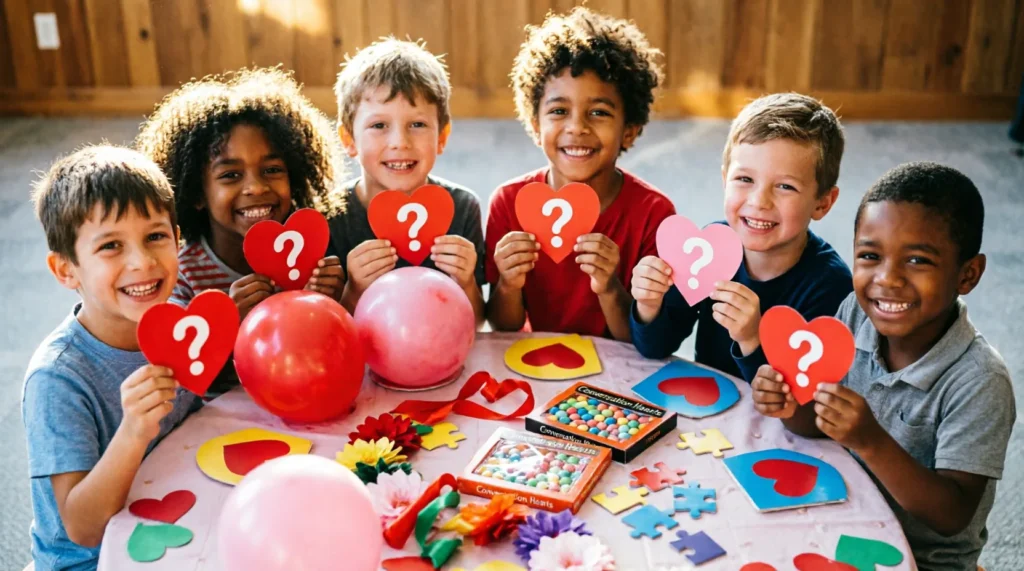
Looking for a sweet way to celebrate February 14th that goes beyond candy and cards? These Valentine’s Day riddles for kids with answers will have your little ones giggling, thinking, and falling in love with wordplay. I’ve tested every single one with my own family game nights and classroom visits to make sure they hit that perfect sweet spot between challenging and achievable.
Top 5 Valentine’s Day Riddles for Kids
What has a heart that doesn’t beat?
Answer: An artichoke
Tested note: This is my absolute favorite opener. When I run this one with kids ages 7-10, about half immediately shout “a zombie!” or “a robot!” The look on their faces when you reveal it’s a vegetable is priceless.
What do you call two birds in love?
Answer: Tweethearts
I’m red or pink, I’m sweet to eat, I’m shaped like a heart and I’m a tasty treat. What am I?
Answer: A conversation heart candy
What stays on the ground but can fly when it’s in love?
Answer: A Valentine’s Day balloon that escaped
Tested note: Kids love this one because it makes them think about the physics of balloons. The wrong guess is always “a bird” or “an airplane.”
What do you call a Valentine’s Day card that tells jokes?
Answer: A pun-Valentine
Easy Valentine’s Day Riddles for Younger Kids
These are perfect for ages 5-8. I’ve kept them simple enough that kindergarten and early elementary kids can solve them with just a little hint.
- What color is a Valentine’s Day heart most often?
Answer: Red
- What month do we celebrate Valentine’s Day?
Answer: February
- What do people send to show they care on Valentine’s Day?
Answer: Cards or Valentine’s cards
- What sweet treat often has messages like “Be Mine” or “Love You” on Valentine’s Day?
Answer: Conversation hearts
- What shape are most Valentine’s Day decorations?
Answer: Hearts
- Who is the famous person Valentine’s Day is named after?
Answer: Saint Valentine
According to historical records, Valentine’s Day commemorates Saint Valentine, a Christian martyr who lived in the third century. The day has evolved from ancient Roman traditions into the celebration of love we know today.
- What flower is most popular on Valentine’s Day?
Answer: Roses
- What do you call someone you send a Valentine to?
Answer: Your valentine
- What cupcake topper is everywhere on February 14th?
Answer: Hearts
- What do people often give along with Valentine’s cards?
Answer: Candy, chocolates, or small gifts
Funny Valentine’s Day Riddles That Make Kids Laugh
These are the riddles that get the biggest giggles. I keep these in my back pocket for when energy starts dipping during a Valentine’s party.
- Why don’t scientists trust atoms on Valentine’s Day?
Answer: Because they make up everything, including love stories
Tested note: This one works surprisingly well with kids who know basic science. The wrong answer is always something about “they’re too small to have feelings.” For more, see Valentine.
- What do you call a bear with no teeth on Valentine’s Day?
Answer: A gummy bear
- Why did the cookie go to the doctor on Valentine’s Day?
Answer: Because it felt crummy without a valentine
- What do you get when you cross a Valentine’s Day card with a skunk?
Answer: A scent-imental card
- Why was the math book sad on Valentine’s Day?
Answer: Because it had too many problems finding love
- What do you call a Valentine who tells really bad jokes?
Answer: A pun-derful valentine
- Why don’t eggs tell jokes on Valentine’s Day?
Answer: They’d crack each other up
- What do you call a fish wearing a bow tie on Valentine’s Day?
Answer: So-fish-ticated
- Why did the boy bring a ladder to the Valentine’s Day party?
Answer: Because the drinks were on the house
- What’s a vampire’s favorite Valentine’s Day candy?
Answer: A neck-tarines (or just “chocolate with bite marks”)
Tricky Valentine’s Day Riddles for Smart Kids
These require a bit more lateral thinking. I’ve found that ages 9-12 love these because they feel genuinely challenged without being frustrated. these types of word puzzles help develop critical thinking skills and vocabulary.
- I have cities, but no houses. I have mountains, but no trees. I have water, but no fish. I’m often given on Valentine’s Day. What am I?
Answer: A map (or a Valentine’s Day card with a map design)
Tested note: This classic riddle structure works great with a Valentine’s twist. Kids usually guess “a painting” or “a photograph” first.
- The more you take, the more you leave behind on Valentine’s Day. What are they?
Answer: Footsteps (or memories)
- What can travel around the world while staying in a corner on Valentine’s Day?
Answer: A Valentine’s Day stamp
- I speak without a mouth and hear without ears. I have no body, but I come alive with love. What am I?
Answer: An echo (or a love letter)
- What has hands but cannot clap on Valentine’s Day?
Answer: A clock (counting down to the big day)
- What can you catch but not throw on Valentine’s Day?
Answer: Love (or a cold, if you’re not careful in February weather)
- What gets wetter the more it dries on Valentine’s Day?
Answer: A towel (or tears of joy from a sweet card)
- What has a head and a tail but no body on Valentine’s Day?
Answer: A coin (to buy Valentine’s candy)
- What can fill a room but takes up no space on Valentine’s Day?
Answer: Love (or the smell of chocolate)
- What belongs to you but others use it more on Valentine’s Day?
Answer: Your name (written on Valentine’s cards)
Short Valentine’s Day Riddles for Quick Brain Breaks
These are my go-to riddles for those moments when you need a quick activity between other Valentine’s Day crafts or games. Each one takes less than 30 seconds to solve.
- What do you call a love bug?
Answer: A Valentine
- What’s a heart’s favorite exercise?
Answer: Jumping jacks
- What do you call a sad cupcake on Valentine’s Day?
Answer: A muffin alone
- What falls in love but never gets hurt?
Answer: Autumn leaves (a play on “fall”)
- What do you call two birds who just got married?
Answer: Newlywings
- What’s red and smells like blue paint?
Answer: Red paint
Tested note: This one is a trick question that always gets laughs. Kids expect it to be Valentine’s-related, but it’s just silly logic.
- What do you call a bear in the rain on Valentine’s Day?
Answer: A drizzly bear
- What has a bottom at the top on Valentine’s Day?
Answer: Your legs (when doing a handstand to show love)
- What can you hold in your right hand but never in your left?
Answer: Your left hand
- What word is spelled wrong in every dictionary on Valentine’s Day?
Answer: “Wrong”
Valentine’s Day Riddles with a Romantic Twist
These riddles play with the theme of love and romance in kid-appropriate ways. They’re perfect for older elementary students who enjoy wordplay.
- What do you call it when two pencils fall in love?
Answer: A write romance
- What’s a tree’s favorite type of Valentine?
Answer: One that’s leaf-ing them a note
- What do you call a Valentine’s Day message from a computer?
Answer: An e-valentine
- What do you call a dog who gives great Valentine’s Day gifts?
Answer: A paw-fect valentine
- What’s a skeleton’s favorite Valentine’s Day activity?
Answer: Bone-ing up on romance
- What do you call a Valentine’s card from a gardener?
Answer: A blooming wonderful message
- What’s a bee’s favorite Valentine’s Day candy?
Answer: Honey hearts
- What do you call a Valentine’s Day party for cats?
Answer: A purr-ty
- What’s a snowman’s favorite Valentine?
Answer: One that won’t melt their heart
- What do you call a Valentine from a musician?
Answer: A love song
How to Use These Valentine’s Day Riddles
These riddles work in so many different settings. Here are my favorite ways to use them:
Classroom Valentine’s Parties: Write riddles on individual cards and hide them around the room for a Valentine’s scavenger hunt. Kids solve each one to get a clue to the next location. The final answer leads to a treasure box of Valentine’s treats.
Family Game Night: Turn it into a competition. Divide into teams and see who can solve the most riddles in 10 minutes. I keep a running tally at our house, and my kids still talk about last year’s “Great Valentine Riddle Championship.” For more, see Riddle.
Car Rides: Perfect for keeping kids entertained on the way to a Valentine’s Day party or school celebration. No materials needed, and it beats “are we there yet?” every time.
Valentine’s Day Card Activity: Write a riddle on the inside of homemade Valentine’s cards. The recipient has to solve it before they can eat the candy attached to the card.
Brain Breaks: Use one or two riddles as a quick mental warm-up before diving into Valentine’s Day crafts or writing activities.
Frequently Asked Questions
What age are these Valentine’s Day riddles appropriate for?
These riddles work best for kids ages 5-12. The easy section is perfect for kindergarten through second grade, while the tricky and romantic twist sections challenge third through sixth graders. I’ve found that mixed-age groups work well too—older kids love helping younger siblings solve the harder ones.
How do I make riddles more challenging for advanced kids?
Don’t give them the multiple-choice options. Instead, ask them to explain their reasoning or create their own Valentine’s Day riddle after solving a few. You can also add time limits or require them to solve three in a row without help.
Can these riddles be used for non-romantic Valentine’s celebrations?
Absolutely! Many schools now celebrate Valentine’s Day as a day of friendship and kindness rather than romance. These riddles focus on wordplay, hearts, and February 14th traditions without requiring romantic relationships. They’re perfect for friendship-themed celebrations.
What if my kids get frustrated and can’t solve a riddle?
That’s totally normal! I always keep a hint sheet handy. For example, if they’re stuck on “What has a heart that doesn’t beat?” I’ll say “think about the grocery store” or “it’s something you can eat.” The goal is fun, not frustration.

William Williams holds a master’s degree in Linguistics from Oxford University and has dedicated over 15 years to exploring the intricate world of riddles and brain teasers. Known for his deep understanding of wordplay and semantics, William specializes in crafting language-based challenges that test the limits of logical thinking. His passion for puzzles was sparked by a childhood love of crosswords and cryptic clues, leading him to a career filled with curiosity and creativity. At RiddleMeHub, William focuses on creating content that not only entertains but also educates, offering readers insights into the history and methodologies behind classic riddles. His articles often dive into the etymology of words used in brain teasers and how they enhance cognitive skills. With a knack for storytelling, he weaves narratives into his riddles, engaging audiences of all ages. As a senior contributor, William continually pushes the boundaries of traditional riddles while maintaining a respect for their time-honored roots.