

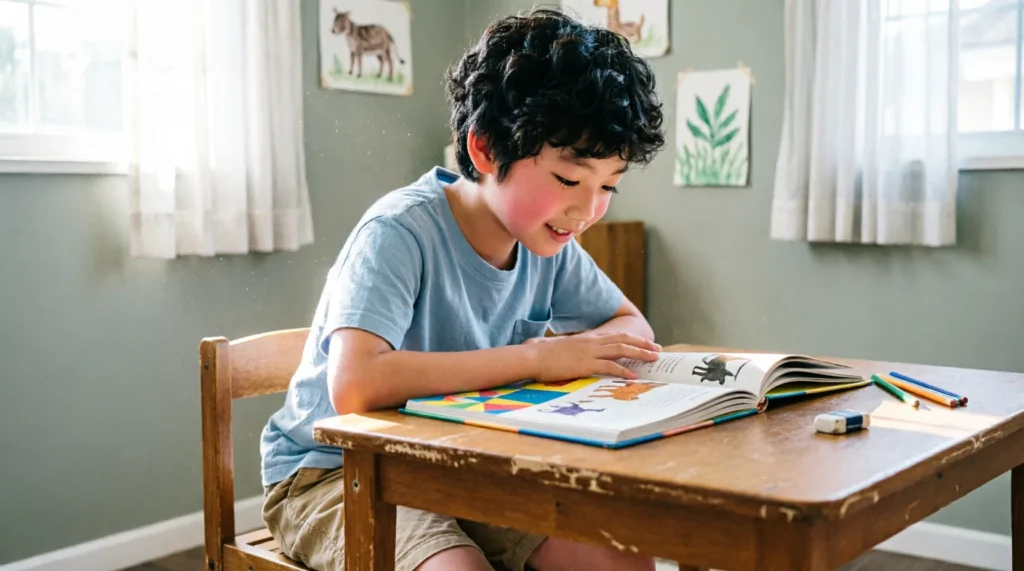
Finding the perfect brain-teasers for a fourth grader means striking a delicate balance between silly wordplay and genuine logic challenges. At nine years old, kids are transitioning from simple knock-knock jokes to actual lateral thinking puzzles. I have spent countless family game nights and rainy afternoons testing these exact riddles to see which ones make nine-year-olds groan, laugh, or shout the correct answer across the room. Grab a pencil and keep score, because this massive collection is guaranteed to stump your favorite elementary schooler while secretly sharpening their reading comprehension skills.
Top 5 Riddles for 9 Year Olds
- I speak without a mouth and hear without ears. I have no body, but I come alive with wind. What am I?
Answer: An echo.
Tested in the wild: When I run this one with kids, the wrong guess is always “a ghost” or “the wind itself.” Nine-year-olds usually need a hint about shouting in a canyon to get it.
- The more you take, the more you leave behind. What am I?
Answer: Footsteps.
- I have cities, but no houses. I have mountains, but no trees. I have water, but no fish. What am I?
Answer: A map.
Tested in the wild: This is a classic. My 9-year-old nephew solved this in ten seconds because he just played a geography board game, but his friends stared blankly until I pointed at the wall.
- What has to be broken before you can use it?
Answer: An egg.
- I am tall when I am young, and I am short when I am old. What am I?
Answer: A candle.
Easy Riddles to Build Confidence
- What has hands but cannot clap?
Answer: A clock.
- What can you catch, but not throw?
Answer: A cold.
- What has a head and a tail but no body?
Answer: A coin.
- What gets wetter the more it dries?
Answer: A towel.
- Where does Friday come before Thursday?
Answer: In the dictionary.
Tested in the wild: Fourth graders love this one because it feels like a trick question. The “alphabet” guess usually comes out first, which is technically correct but “the dictionary” is the classic punchline.
- What has many keys but can’t open a single lock?
Answer: A piano.
- What has one eye but cannot see?
Answer: A needle.
- What belongs to you, but other people use it more than you do?
Answer: Your name.
- What goes up but never comes down?
Answer: Your age.
- What has a thumb and four fingers, but is not alive?
Answer: A glove.
Hard Riddles That Make Them Think
According to the historical definition of a Riddle, a good puzzle often relies on a double meaning or a sudden shift in perspective to reach the solution. Nine-year-olds are at the perfect cognitive age to start grasping these abstract leaps, moving past literal interpretations to find the hidden logic.
- I am not alive, but I grow; I don’t have lungs, but I need air; I don’t have a mouth, but water kills me. What am I?
Answer: Fire.
- What can travel all around the world without leaving its corner?
Answer: A stamp.
- I have branches, but no fruit, trunk or leaves. What am I?
Answer: A bank.
Tested in the wild: Nine-year-olds almost always yell “a dead tree!” It takes a solid minute of steering them toward money and buildings before the “aha” moment hits.
- What is full of holes but still holds water?
Answer: A sponge.
- Forward I am heavy, but backward I am not. What am I?
Answer: The word “ton”.
- I shave every day, but my beard stays the same. What am I?
Answer: A barber.
- People make me, save me, change me, and spend me. What am I?
Answer: Money.
- What can you hold in your right hand, but never in your left hand?
Answer: Your left elbow.
Tested in the wild: Kids will literally sit there trying to pass their left elbow to their right hand for a full two minutes before realizing the anatomical trick.
- I am always coming, but never arrive. What am I?
Answer: Tomorrow.
- What has 13 hearts, but no other organs?
Answer: A deck of cards.
Funny Riddles Guaranteed to Get a Giggle
- What do you call a bear with no teeth?
Answer: A gummy bear.
- Why did the math book look so sad?
Answer: Because it had too many problems.
- What do you call a fake noodle?
Answer: An impasta.
- Why can’t you give Elsa a balloon?
Answer: Because she will let it go.
Tested in the wild: This one is a massive hit with the Disney crowd, though some older kids groan at the pop-culture reference. Still, it reliably breaks the ice during parties.
- What do you call cheese that isn’t yours?
Answer: Nacho cheese.
- How do you make a tissue dance?
Answer: You put a little boogie in it.
- What do you call a pig that does karate?
Answer: A pork chop.
- Why do bees have sticky hair?
Answer: Because they use honeycombs.
- What do you call a dinosaur that is sleeping?
Answer: A dino-snore!
- Why did the cookie go to the hospital?
Answer: Because he felt crummy.
Tricky Wordplay Riddles
When you open a traditional physical Book, you expect a linear story or a set of facts. But riddle books use words to hide information in plain sight, forcing the reader to jump between literal and figurative meanings. These tricky wordplay puzzles demand that kids look at the spelling and structure of language, not just the definitions.
- What word is spelled wrong in the dictionary?
Answer: Wrong.
- What occurs once in a minute, twice in a moment, but never in a thousand years?
Answer: The letter “M”.
- I am an odd number. Take away a letter and I become even. What number am I?
Answer: Seven.
Tested in the wild: Kids will stare at the math of this for ages. The trick is telling them to stop doing subtraction and start spelling the numbers out loud.
- What five-letter word becomes shorter when you add two letters to it?
Answer: Short.
- What begins with T, ends with T, and has T in it?
Answer: A teapot.
- If you have me, you want to share me. If you share me, you don’t have me. What am I?
Answer: A secret.
- What English word has three consecutive double letters?
Answer: Bookkeeper.
Tested in the wild: This is brutally hard for fourth graders. I usually have to write “book” on a piece of paper and ask them what job someone does with books to get them to the answer.
- What word looks the same upside down?
Answer: NOON.
- Take off my skin and I won’t cry, but you might! What am I?
Answer: An onion.
- What has a bottom at the top?
Answer: Your legs.
Animal Riddles for the Creature Lovers
- I wear a tuxedo but I am not a waiter. I waddle but I am not a duck. What am I?
Answer: A penguin.
- I am known for my leaping, my pouch is my home, I carry my baby wherever I roam. What am I?
Answer: A kangaroo.
- I have a long neck but I don’t wear a scarf. I eat leaves from tall trees. What am I?
Answer: A giraffe.
- I sleep upside down and I use sound to see. What am I?
Answer: A bat.
- I build dams in the river and I have a flat tail. What am I?
Answer: A beaver.
- I change colors to blend in, with eyes that look every which way. What am I?
Answer: A chameleon.
Tested in the wild: When reading this from a riddle book, kids usually guess “octopus” first because of the color-changing trait. You have to remind them about the crazy swiveling eyes to get them to the reptile aisle.
- I am a large mammal with black and white stripes. What am I?
Answer: A zebra.
- I have eight legs and I spin webs to catch my dinner. What am I?
Answer: A spider.
- I carry my house on my back and leave a silvery trail. What am I?
Answer: A snail.
- I am the fastest land animal and I have spots. What am I?
Answer: A cheetah.
How to use these riddles
Taking a list of brain-teasers off the screen and into the real world is where the magic truly happens. Memorizing a few of these allows you to pull them out at a moment’s notice, but having them written down opens up a world of interactive games. Here are a few tested ways to use this exact collection during your next family event, school day, or weekend getaway:
- Party Icebreaker: Write the riddles on small slips of colorful paper and hide them inside plastic eggs or folded origami boxes. Hand them out as kids arrive, and let them trade answers with each other to win a small prize. It gets them talking immediately without the awkwardness of forced introductions.
- Classroom Morning Work: Put one riddle on the whiteboard every single morning. It gets their brains warming up before the heavy math lesson begins, and it rewards early arrivals with a fun logic challenge while you take attendance.
- Scavenger Hunt Clues: Use the answers as the physical locations for the next clue in a house-wide hunt. If the answer is “a clock,” the next clue is taped to the grandfather clock in the hallway. If the answer is “a sponge,” they have to run to the kitchen sink and look under the faucet.
- Road Trip Survival: Keep this list saved on your phone or print it out for the passenger seat. When the inevitable “are we there yet” chorus starts from the backseat, fire off a riddle. The driver gets to judge if the guess is close enough to earn a piece of gum or a DJ privilege for the next song.
- Dinner Table Ritual: Make it a rule that whoever sets the table gets to ask the family one riddle from the book before anyone is allowed to take their first bite. It completely eliminates the silent staring at plates and sparks actual conversation.
Frequently Asked Questions
What is a good riddle for a 9 year old? A great riddle for this specific age group relies on lateral thinking rather than obscure trivia or advanced vocabulary. Nine-year-olds are actively developing abstract reasoning, so puzzles that play with double meanings, homophones, or physical properties (like the “towel” or “candle” riddles) hit the absolute sweet spot. They are challenging enough to cause a momentary pause, but logical enough that the child feels a massive rush of dopamine when they finally figure it out without adult help.
How do these riddles work to build logic? Riddles actively force the brain to break out of rigid, linear thinking patterns. When a child hears “I have cities but no houses,” their brain initially searches for a magical, abandoned, or ruined place. Solving it requires them to reframe the word “city” as a symbol or a two-dimensional representation, which is a foundational cognitive skill for higher-level reading comprehension, algebraic thinking, and scientific hypothesis testing.
Why do kids get frustrated with tricky riddles? Frustration usually happens when a child takes the premise of the riddle far too literally. As a puzzle-master, your job isn’t to just give the answer away when they pout, but to gently guide their perspective. If they are stuck on the “branches” riddle, ask them, “What else has branches that isn’t a plant?” Guiding them to the answer through a series of narrowing questions is much more satisfying and educational than just handing the solution over on a silver platter.
Can I use these in a classroom setting? Absolutely. These are completely clean, school-appropriate, and require zero prep or special materials. They are perfect for transition times, like the chaotic five minutes right before recess or lunch, when you need to hold their attention without starting a heavy new lesson. You can also use them as a reward system: if the class transitions quietly from reading to math, they get to hear a “mystery riddle” and the first person to solve it gets to lead the line to the cafeteria.

Joshua Wilson is a former engineer turned puzzle enthusiast with over eight years of experience in the world of riddles and brain teasers. Holding a degree in Mechanical Engineering from MIT, Joshua’s technical background influences his approach to crafting intricate logic puzzles and spatial challenges. His journey into the realm of riddles began as a personal hobby, which soon evolved into a professional passion for dissecting the mechanics of problem-solving. At RiddleMeHub, Joshua specializes in puzzles that require a methodical approach, often drawing inspiration from engineering principles and scientific concepts. His content is characterized by its engaging complexity and educational value, designed to stimulate critical thinking and creativity. Joshua is committed to inspiring curiosity and wonder, encouraging readers to embrace the joy of discovery through the lens of puzzling. As an author, he brings a fresh perspective to traditional brain teasers, integrating modern techniques and interactive elements to captivate a wide audience.