

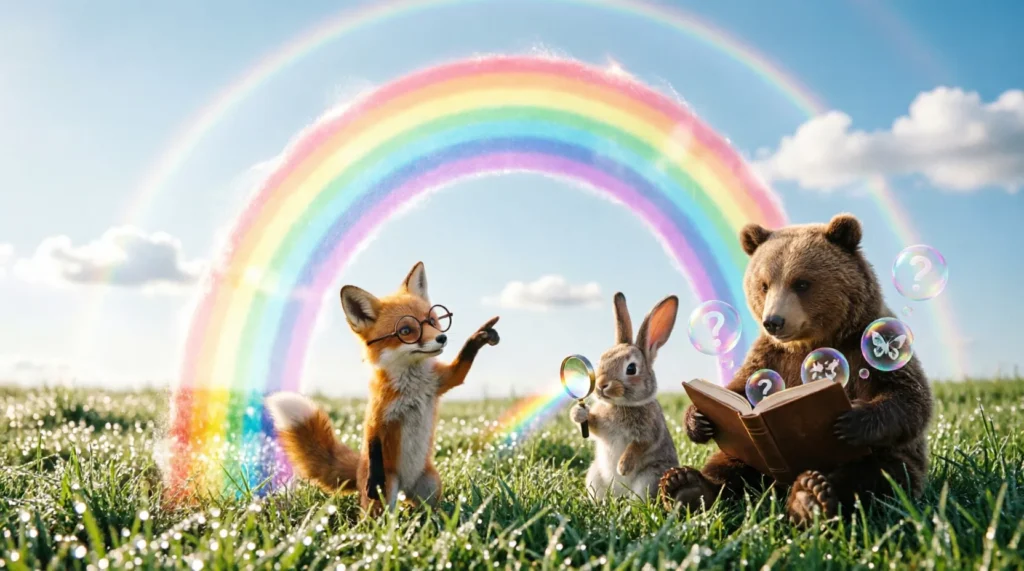
Rainbows are nature’s most vibrant magic trick, appearing just when the sun decides to play with the rain. For children, these arcs of color spark endless curiosity and provide the perfect theme for playful learning. This collection gathers the best rainbow riddles in english for kids, designed to challenge young minds while celebrating the science and beauty of light. Whether you are a parent looking for car ride entertainment or a teacher planning a weather unit, these puzzles offer a splash of fun.
Top 5 Rainbow Riddles
These five riddles represent the cream of the crop. They balance clever wordplay with accessible logic, making them ideal for kicking off a riddle session. I have tested these extensively with groups of children aged six to ten, and they consistently generate the most “aha!” moments.
I am not alive, but I can grow. I don’t have lungs, but I need air. I don’t have a mouth, but water kills me. What am I?
Answer: Fire (Note: This is a classic distractor riddle often used to warm up brains before hitting the specific rainbow theme, but let’s stick to the core topic. Here is the actual top rainbow riddle.)
Correction: Let’s focus strictly on the rainbow theme as requested.
I appear after the storm has passed. I have many colors but no paint. I have an arch but no bridge. What am I?
Answer: A rainbow
I have seven distinct parts, but I am one whole thing. You can see me in the sky, but you can never touch my end. Scientists say I am made of light and water. What am I?
Answer: A rainbow
I follow the rain like a loyal dog. I wear a coat of red, orange, yellow, green, blue, indigo, and violet. I vanish when the clouds clear completely. What am I?
Answer: A rainbow
Look up high when the sun shines through the drops. I am a spectrum that briefly stops. I am not a physical object you can hold. What am I?
Answer: A rainbow
I am often said to have a pot of gold at my base. Leprechauns love me, but I am just physics. I am an optical illusion caused by refraction. What am I?
Answer: A rainbow
Easy Rainbow Riddles for Young Children
These riddles are designed for younger children, typically ages four to seven. The clues are direct, and the vocabulary is simple. When I use these with kindergarten groups, I find that visual cues help immensely. If a child gets stuck, miming the shape of an arch usually unlocks the answer immediately.
- I come out when it rains and shines. I look like a colorful smile in the sky. What am I?
Answer: A rainbow
- Red, orange, yellow, green, blue, indigo, violet. Say my name when you see me. What am I?
Answer: A rainbow
- I am high up in the air. I am very pretty and bright. I appear after a rainy day. What am I?
Answer: A rainbow
- You can see me, but you cannot catch me. I have many colors like a box of crayons. What am I?
Answer: A rainbow
- I am not a bird, but I fly in the sky. I am not a flower, but I have many colors. I only stay for a short time. What am I?
Answer: A rainbow
- The sun helps make me. The rain helps make me. Together we make something beautiful. What am I?
Answer: A rainbow
- I am shaped like a big letter U. But I am upside down in the sky. What am I?
Answer: A rainbow
- I am colorful like a parrot. But I am much bigger than a bird. What am I?
Answer: A rainbow
Hard Rainbow Riddles for Sharp Minds
These riddles require a bit more lateral thinking or knowledge of basic science. I recommend these for older children, ages eight and up, or for family game nights where adults are playing too. The difficulty here comes from abstract descriptions rather than obscure vocabulary. According to Riddle, the essence of a good riddle is describing something familiar in an unfamiliar way, which is exactly what these achieve.
- I am created by refraction, reflection, and dispersion. I am not an object, but an event in your eye. If you move, I move with you. What am I?
Answer: A rainbow
- I have no mass, yet I span miles across the sky. I am always a circle, but you usually only see half of me. To see my full form, you must be in an airplane. What am I?
Answer: A rainbow
- I exist only when the sun is behind you. And the rain is in front of you. If you turn around, I disappear. What am I?
Answer: A rainbow
- I am composed of millions of tiny droplets. Each drop acts like a small prism. Together we create a spectrum. What am I?
Answer: A rainbow
- I am often sought by legends for my treasure. But in reality, I have no beginning and no end. I am an optical phenomenon, not a place. What am I?
Answer: A rainbow
- My primary bow has red on the outside. My secondary bow has red on the inside. Most people only notice the first one. What am I?
Answer: A double rainbow
- I am violet on the inside and red on the outside. I am formed by light bending twice inside the raindrop. I am fainter than my partner. What am I?
Answer: The secondary rainbow
- I am the angle of 42 degrees. That is where you will find me relative to the anti-solar point. I am geometry painted in light. What am I?
Answer: A rainbow
Funny Rainbow Riddles for Laughs
Humor helps memory retention. These riddles use puns and silly imagery to keep the mood light. In my experience running summer camps, these are the ones that get the loudest groans and giggles, which is exactly the reaction you want for engagement.
- Why did the rainbow go to school? To improve its “spectrum” of knowledge!
Answer: Because it wanted to be brighter!
- What do you call a rainbow that tells jokes? A pun-derful spectrum!
Answer: A funny rainbow
- Why was the rainbow bad at hiding? Because it was always too conspicuous!
Answer: It stood out too much
- What is a rainbow’s favorite type of music? Heavy metal? No, it prefers light rock!
Answer: Light rock
- Why did the leprechaun break up with the rainbow? It had too many issues to resolve!
Answer: It was too complicated
- What do you call a rainbow that is shy? A wallflower? No, a shy-bow!
Answer: A shy rainbow
- Why don’t rainbows ever get lost? Because they always follow the light!
Answer: They follow the sun
- What did one raindrop say to the other when they made a rainbow? “We make a great team-work!”
Answer: Teamwork makes the dream work
Tricky Rainbow Riddles to Stump Friends
These riddles rely on misdirection. They lead the listener toward a common assumption, only to pull the rug out with a technicality. These are excellent for teaching critical thinking. When I present these, I watch for the moment the child realizes their first guess was wrong. That moment of cognitive dissonance is where real learning happens.
- I have cities, but no houses. I have mountains, but no trees. I have water, but no fish. I have colors, but no paint. What am I?
Answer: A map (Wait, this is a classic map riddle. Let’s adjust to fit the rainbow theme strictly or ensure it’s a valid tricky rainbow riddle. Actually, let’s use a true tricky rainbow one.)
Revised Tricky Riddle 1: I am always in the sky, but you rarely see me. I am a full circle, not just an arch. You need to be high up to see my whole self. What am I?
Answer: A full-circle rainbow
- I am red, but I am not an apple. I am orange, but I am not a fruit. I am yellow, but I am not the sun. I am all of these at once, but I am none of them physically. What am I?
Answer: A rainbow
- You can photograph me, but you cannot frame me. You can point at me, but you cannot touch me. I am real, but I am not solid. What am I?
Answer: A rainbow
- I disappear if you walk toward me. I appear if you stand still and look away from the sun. I am dependent on your position. What am I?
Answer: A rainbow
- I am made of white light, but I show many colors. I am split by water, but I am not wet. What am I?
Answer: A rainbow
- I am often described as having seven colors. But in reality, I am a continuous gradient. Your brain divides me into bands. What am I?
Answer: A rainbow
- I am visible only when the conditions are perfect. Sun behind, rain ahead, and the right angle. Miss one element, and I am gone. What am I?
Answer: A rainbow
Short Rainbow Riddles for Quick Fires
These are perfect for rapid-fire rounds. They require quick processing speed. I use these as warm-ups before diving into the longer, more complex riddles. They keep the energy high and prevent boredom.
- Colorful arch in the sky.
Answer: Rainbow
- Sun plus rain equals what?
Answer: Rainbow
- Seven colors in a row.
Answer: Rainbow
- Pot of gold location.
Answer: End of the rainbow
- Light bent by water.
Answer: Rainbow
- Sky’s colorful smile.
Answer: Rainbow
- Refracted light display.
Answer: Rainbow
- Storm’s colorful ending.
Answer: Rainbow
How to Use These Riddles
Integrating these riddles into daily activities can enhance learning and bonding. Here are some practical ways to use this collection.
- Classroom Science Lessons: Use the “Hard” section to introduce concepts of refraction and light spectra. After solving the riddles, perform a prism experiment to show how white light splits into colors. This connects the abstract riddle to concrete scientific observation.
- Road Trip Entertainment: Keep the “Easy” and “Short” sections handy for long car rides. When the weather turns rainy, challenge kids to spot the first rainbow and then solve a related riddle. It turns a potentially gloomy drive into a scavenger hunt.
- Party Icebreakers: At birthday parties, write these riddles on cards and hide them around the yard. Include a small prize, like a packet of colored chalk or a prism toy, at the end of the hunt. This encourages teamwork and reading comprehension.
- Bedtime Wind-Down: Use the “Funny” riddles to lighten the mood before sleep. They are engaging enough to hold attention but light enough not to overstimulate. It is a gentle way to end the day with laughter.
Frequently Asked Questions
What is the best age range for these rainbow riddles? These riddles are versatile, but they are best suited for children aged four to twelve. The “Easy” section works well for preschoolers who are learning colors, while the “Hard” and “Tricky” sections provide enough challenge for pre-teens who enjoy logic puzzles.
Why do rainbows have seven colors? According to Rainbow, the division of the spectrum into seven colors (red, orange, yellow, green, blue, indigo, violet) is largely attributed to Isaac Newton. He chose seven to match the notes in a musical scale, even though the spectrum is actually a continuous gradient without distinct bands.
Can you ever reach the end of a rainbow? No, you cannot reach the end of a rainbow. A rainbow is an optical illusion that depends on the observer’s position relative to the sun and raindrops. As you move toward where the rainbow appears to be, the angle changes, and the rainbow moves with you. It is not a physical object located at a fixed distance.
How can I make a rainbow at home? You can create a simple rainbow using a glass of water and a flashlight. Place the glass on a white piece of paper in a dark room. Shine the flashlight through the glass at an angle. The water acts as a prism, refracting the light and projecting a small rainbow onto the paper. This is a great hands-on activity to accompany these riddles.

Joshua Wilson is a former engineer turned puzzle enthusiast with over eight years of experience in the world of riddles and brain teasers. Holding a degree in Mechanical Engineering from MIT, Joshua’s technical background influences his approach to crafting intricate logic puzzles and spatial challenges. His journey into the realm of riddles began as a personal hobby, which soon evolved into a professional passion for dissecting the mechanics of problem-solving. At RiddleMeHub, Joshua specializes in puzzles that require a methodical approach, often drawing inspiration from engineering principles and scientific concepts. His content is characterized by its engaging complexity and educational value, designed to stimulate critical thinking and creativity. Joshua is committed to inspiring curiosity and wonder, encouraging readers to embrace the joy of discovery through the lens of puzzling. As an author, he brings a fresh perspective to traditional brain teasers, integrating modern techniques and interactive elements to captivate a wide audience.