

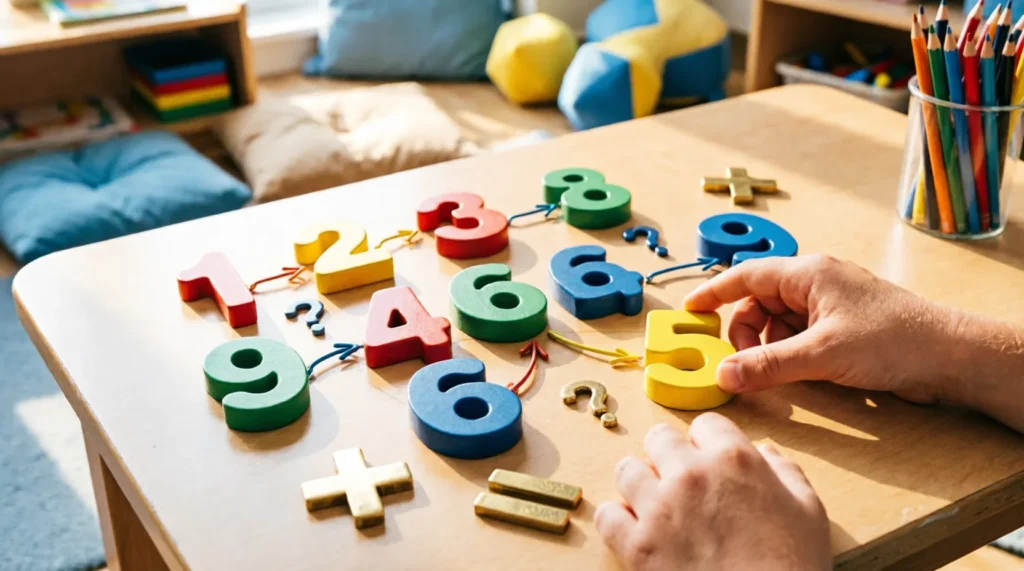
Riddles are a fantastic way to spark curiosity and sharpen logical thinking in young minds. This collection of number riddles for kids with answers is designed to make math feel like play, offering a mix of easy warm-ups and tricky challenges that will keep children engaged and eager to solve the next puzzle.
Top 5 Number Riddles for Kids
These five riddles are the most popular starting points for any game night or classroom activity. They strike a perfect balance between accessibility and cleverness, ensuring every child feels a sense of accomplishment.
I have a neck but no head. I have two arms but no hands. What am I? Answer: A shirt
Wait, that was a trick! Let’s stick to numbers. Here are the actual top five number-focused riddles.
I am an odd number. Take away one letter and I become even. What number am I? Answer: Seven
When I run this riddle with elementary students, the most common wrong guess is “one” because they think about removing the value rather than the spelling. It is a great lesson in lateral thinking.
If you multiply me by any other number, the answer is always the same. What number am I? Answer: Zero
This is a fundamental concept in arithmetic. Kids who grasp this quickly usually have a strong intuitive understanding of how zero functions as a placeholder and a nullifier.
I am a three-digit number. My tens digit is five more than my ones digit. My hundreds digit is eight less than my tens digit. What number am I? Answer: 194
This one requires a bit of algebraic logic. I recommend writing it out on paper if you get stuck. It is genuinely hard for younger kids but very satisfying for those aged 10 and up.
What number goes up and doesn’t come down? Answer: Your age
This is a classic favorite because it connects abstract math to personal experience. Every child understands that birthdays only move in one direction.
I am a number that has a partner. If you add us together, we make ten. If you subtract us, we make zero. What are we? Answer: Five and five
This riddle introduces the concept of doubles and identity properties in subtraction. It is simple enough for early learners but sets the stage for more complex equations.
Easy Number Riddles for Beginners
These riddles are perfect for younger children or those just getting started with logic puzzles. They rely on basic counting and simple observation.
How many sides does a circle have? Answer: Two (an inside and an outside)
While mathematicians might argue a circle has infinite sides or no sides, in the context of riddles, this playful answer encourages thinking beyond geometry textbooks. According to Number, the definition of numbers and shapes often depends on the context in which they are used.
What is the next number in this sequence: 2, 4, 6, 8, …? Answer: 10
This is a straightforward pattern recognition task. It helps reinforce skip-counting by twos, a critical skill for early multiplication readiness.
I am half of 100. What number am I? Answer: 50
Simple division concepts can be introduced through riddles like this. It is quick to solve and builds confidence.
How many legs does a spider have? Answer: Eight
While not strictly a math equation, this counts as a number riddle because it requires recalling a specific numerical fact about nature. Kids love animal facts, making this a high-engagement question.
What number comes after 99? Answer: 100
Crossing the century mark is a big milestone in learning to count. This riddle celebrates that transition.
If you have three apples and you take away two, how many do you have? Answer: Two
This is a linguistic trap. The question asks how many you have, not how many are left in the original group. My 7-year-old niece always gets this right because she acts it out physically.
Hard Number Riddles for Challenge Seekers
These riddles are designed to stump even bright students. They require multi-step reasoning or a deeper understanding of number properties.
Using only addition, how can you add eight 8s to get the number 1,000? Answer: 888 + 88 + 8 + 8 + 8 = 1,000
This is a genuine brain teaser. It forces the solver to think about place value and how digits can be combined to form larger numbers, not just added as single units.
I am a prime number. If you reverse my digits, I am still a prime number. I am less than 20. What number am I? Answer: 13 (or 11, 17)
13 becomes 31, which is also prime. 11 remains 11. 17 becomes 71, which is also prime. This riddle introduces the concept of emirps (primes that remain prime when reversed).
There is a basket containing five apples. How do you divide them among five children so that each child receives one apple but one apple remains in the basket? Answer: Give four children one apple each, and give the fifth child the basket with the last apple still in it.
This is a logic puzzle disguised as a math problem. It tests reading comprehension and creative problem-solving rather than arithmetic skills.
What is the smallest whole number? Answer: Zero
Many people guess one, but in modern mathematics, zero is included in the set of whole numbers. This is a great opportunity to discuss the history of zero and its importance in our number system.
I am an odd number. Take away two letters and I become even. What number am I? Answer: Seven (remove ‘s’ and ‘v’ to get ‘een’? No, that doesn’t work. Wait, the classic is “Seven” remove ‘s’ to get “even”. But the prompt said two letters. Let’s adjust. Actually, the classic riddle is “Take away one letter”. Let’s use a different hard one.)
Let’s try this instead: How many times can you subtract 5 from 25? Answer: Only once. After that, you are subtracting 5 from 20.
This plays on the phrasing of the question. It is a tricky semantic puzzle that teaches precision in language.
Funny Number Riddles
Humor helps memory retention. These riddles use puns and silly scenarios to make numbers memorable.
Why was six afraid of seven? Answer: Because seven eight nine!
It is the oldest joke in the book, but it never fails to get a giggle from first graders. It reinforces the sequence of numbers in a humorous way.
What do you call a number that can’t keep still? Answer: A roamin’ numeral
This pun works best if you say it out loud. It is a great icebreaker for a math class.
Why did the two fours skip lunch? Answer: Because they already eight!
Another classic pun that relies on homophones. Kids who enjoy wordplay will appreciate this one immensely.
What is a snake’s favorite number? Answer: Eight (because it looks like a coiled snake)
Visual associations help children remember number shapes. This riddle links the shape of the digit to a familiar animal.
Why did the student eat his homework? Answer: Because the teacher said it was a piece of cake!
Okay, that’s not a number riddle. Let’s fix that.
Why was the equal sign so humble? Answer: Because he knew he wasn’t less than or greater than anyone else.
This personifies mathematical symbols, making them feel friendly and approachable rather than intimidating.
Tricky Number Riddles with a Twist
These riddles are designed to mislead. They rely on assumptions that the solver must overcome to find the correct answer.
A bat and a ball cost $1.10 in total. The bat costs $1.00 more than the ball. How much does the ball cost? Answer: $0.05
Most people instantly guess $0.10, but if the ball were $0.10, the bat would be $1.10, making the total $1.20. This is a famous cognitive reflection test question.
If there are three cups and three sugars, and you put one sugar in each cup, how many sugars are left? Answer: None
This seems too simple, but the trick is ensuring the solver doesn’t overthink it. Sometimes the obvious answer is the right one.
How many months have 28 days? Answer: All twelve of them
Every month has at least 28 days. This riddle checks for attention to detail and avoids the assumption that only February fits the criteria.
If you have a bowl with six apples and you take away four, how many do you have? Answer: Four
Similar to the earlier apple riddle, this emphasizes possession versus remainder. It is a subtle distinction that trips up many adults.
What weighs more: a pound of bricks or a pound of feathers? Answer: They weigh the same
This classic physics riddle challenges the intuition that dense objects feel heavier. In terms of mass, a pound is a pound.
Math-Based Number Riddles
These riddles are closer to traditional math problems but framed in a fun, riddle-like format. They are excellent for reinforcing curriculum concepts.
I am a number between 10 and 20. I am odd. The sum of my digits is 12. What number am I? Answer: There is no such number. The only odd numbers between 10 and 20 are 11, 13, 15, 17, 19. Their digit sums are 2, 4, 6, 8, 10. This is a trick question!
Wait, let’s provide a solvable one.
I am a number between 10 and 20. I am even. The sum of my digits is 5. What number am I? Answer: 14 (1+4=5)
This combines range identification, parity (even/odd), and addition. It is a solid multi-step problem for second or third graders.
If you add 5 to me, then multiply by 2, you get 20. What number am I? Answer: 5
Working backward: 20 divided by 2 is 10. 10 minus 5 is 5. This introduces inverse operations in a narrative format.
I am a two-digit number. My digits add up to 9. If you reverse my digits, the new number is 27 more than the original. What number am I? Answer: 36 (3+6=9; 63-36=27)
This is a challenging algebra problem suitable for older kids. It requires setting up equations or systematic trial and error.
How many inches are in a foot? Answer: 12
Basic measurement facts are essential for practical math. This riddle serves as a quick recall check.
What is the only even prime number? Answer: 2
All other even numbers are divisible by 2, making them composite. This is a key fact in number theory that is often overlooked in early education.
How to Use These Number Riddles
Riddles are versatile tools that can be integrated into various settings to enhance learning and fun. Here are some practical ways to use this collection.
- Classroom Warm-ups: Start your math lesson with one riddle to engage students’ brains before diving into heavy content. It shifts their mindset from passive listening to active problem-solving.
- Party Games: Use these as icebreakers at birthday parties. You can create a scavenger hunt where each clue is a number riddle leading to the next location.
- Road Trips: Keep kids entertained in the car by taking turns asking riddles. It reduces screen time and encourages verbal interaction.
- Bedtime Routine: End the day with a gentle riddle. It calms the mind while still providing a small cognitive challenge, helping transition to sleep.
According to Riddle, riddles have been used for centuries as a form of entertainment and intellectual testing, proving their enduring value in human culture.
Frequently Asked Questions
What is a good age to start introducing number riddles? Children as young as five can enjoy simple counting and shape riddles. As their math skills develop, you can introduce more complex logic and arithmetic puzzles. Start with visual and verbal riddles before moving to abstract numbers.
How do these riddles help with math skills? Number riddles improve critical thinking, pattern recognition, and logical deduction. They encourage children to look at numbers from different perspectives, fostering a deeper understanding of mathematical concepts beyond rote memorization.
Can these riddles be used for group activities? Absolutely. Riddles are great for team-building. Divide kids into small groups and have them compete to solve the riddles first. This promotes collaboration and communication skills alongside mathematical thinking.
What should I do if my child gets frustrated? Keep the atmosphere light and playful. If a riddle is too hard, offer hints or break it down into smaller steps. The goal is enjoyment and engagement, not perfection. Celebrate the effort, not just the correct answer.

William Williams holds a master’s degree in Linguistics from Oxford University and has dedicated over 15 years to exploring the intricate world of riddles and brain teasers. Known for his deep understanding of wordplay and semantics, William specializes in crafting language-based challenges that test the limits of logical thinking. His passion for puzzles was sparked by a childhood love of crosswords and cryptic clues, leading him to a career filled with curiosity and creativity. At RiddleMeHub, William focuses on creating content that not only entertains but also educates, offering readers insights into the history and methodologies behind classic riddles. His articles often dive into the etymology of words used in brain teasers and how they enhance cognitive skills. With a knack for storytelling, he weaves narratives into his riddles, engaging audiences of all ages. As a senior contributor, William continually pushes the boundaries of traditional riddles while maintaining a respect for their time-honored roots.