

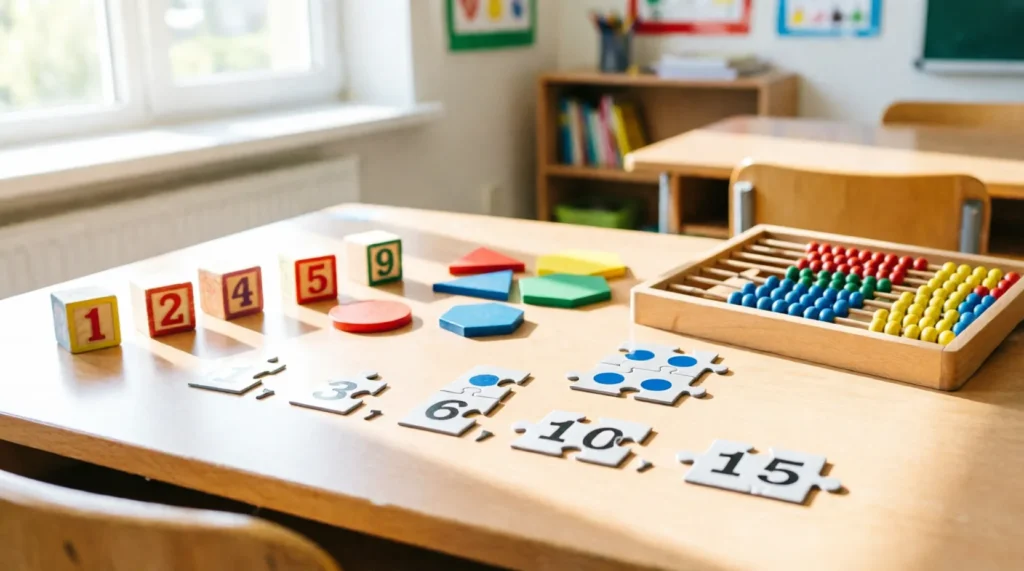
Math riddles are a fantastic way to bridge the gap between abstract numbers and real-world logic. For third graders, who are just mastering multiplication tables and beginning to understand fractions, these puzzles offer a low-stakes environment to practice critical thinking. I have curated this collection based on years of running family game nights and classroom warm-ups, ensuring every riddle is age-appropriate and genuinely engaging.
Top 5 Math Riddles with Answers Grade 3
These five riddles represent the perfect balance of challenge and accessibility for an eight or nine-year-old. They cover basic arithmetic, logical deduction, and pattern recognition.
I am a number. If you add me to myself, you get 10. If you multiply me by myself, you get 25. What number am I? Answer: 5
There are three apples in a basket. You take away two. How many apples do you have? Answer: 2 (You took two, so you have two. This one trips up kids who immediately subtract instead of reading carefully.)
I am an odd number. Take away one letter and I become even. What number am I? Answer: Seven (Remove the ‘s’ and it becomes ‘even’. This is a classic wordplay riddle that works well for third graders learning spelling patterns alongside math.)
If there are four sheep, two dogs, and one herdsman, how many feet are there? Answer: 26 (Sheep have 4 feet each: 4×4=16. Dogs have 4 feet each: 2×4=8. Humans have 2 feet: 1×2=2. Total: 16+8+2=26. I always remind students to remember the herdsman!)
How can you add eight 8s to get the number 1,000 using only addition? Answer: 888 + 88 + 8 + 8 + 8 = 1,000. This requires understanding place value, a key concept in third-grade curriculum.
Easy Warm-Up Riddles
These riddles are designed to build confidence. They rely on simple addition, subtraction, and basic counting skills. Use these to start a session or to help a student who might be feeling anxious about harder problems.
What weighs more: a pound of bricks or a pound of feathers? Answer: They weigh the same (one pound). This teaches the difference between weight and density without using complex terminology.
If you have a bowl with six apples and you take away four, how many do you have? Answer: 4. Again, the trick is in the wording. You possess the four you removed.
How many sides does a circle have? Answer: Zero (or two, if you count the inside and outside, but in standard geometry for grade 3, the answer is usually zero or “none”). I prefer accepting “zero” as it aligns with polygon definitions they are learning.
What is half of 20, plus 10? Answer: 20 (Half of 20 is 10, plus 10 equals 20).
If a rooster lays an egg on the roof of a slanted barn, which side will it roll down? Answer: Neither. Roosters don’t lay eggs. This is a logic check rather than a math problem, but it’s essential for teaching careful reading.
How many months have 28 days? Answer: All 12 of them. Every month has at least 28 days.
If you divide 30 by half and add 10, what do you get? Answer: 70 (Dividing by half is the same as multiplying by 2. 30 x 2 = 60. 60 + 10 = 70). This is often marked as “tricky” because kids hear “divide by half” and think “divide by 2.”
Tricky Logic Puzzles
These riddles require students to slow down and process the information step-by-step. In my experience, third graders often rush to an answer based on the first number they see. These puzzles punish haste and reward patience.
A farmer has 17 sheep. All but 9 die. How many are left? Answer: 9. “All but 9” means 9 survived. This phrasing is notoriously difficult for young readers.
Which is heavier: a ton of feathers or a ton of steel? Answer: They are equal. Both weigh a ton.
If you overtake the person in second place in a race, what place are you in? Answer: Second place. You took their spot, but the person in first is still ahead of you. I’ve seen countless kids shout “First!” before catching themselves.
How many times can you subtract 5 from 25? Answer: Once. After you subtract it once, the number is 20, not 25 anymore.
A bat and a ball cost $1.10 in total. The bat costs $1.00 more than the ball. How much does the ball cost? Answer: $0.05. (If the ball is $0.05, the bat is $1.05. Total is $1.10). Most adults get this wrong too, so don’t feel bad if your third grader struggles. It’s a famous cognitive reflection test.
If two’s company and three’s a crowd, what are four and five? Answer: 9. This is a simple addition disguised as a proverb.
Funny Math Riddles
Humor helps memory retention. When kids laugh at a punchline, they are more likely to remember the underlying mathematical concept. These are great for breaking the tension during a study session.
Why was 6 afraid of 7? Answer: Because 7, 8, 9! (Seven ate nine).
What do you call a number that can’t keep still? Answer: A roamin’ numeral.
Why did the student eat his homework? Answer: Because the teacher said it was a piece of cake.
What is a snake’s favorite subject in school? Answer: Hiss-tory. (Okay, this is a stretch for math, but it’s a fun break). Let’s try a better one: What do you call a snake who is good at math? Answer: A pi-thon.
Why did the triangle go to the beach? Answer: To catch some rays (radii). This introduces geometry vocabulary in a silly way.
What kind of tree fits in your hand? Answer: A palm tree. (Not strictly math, but involves counting leaves/fronds sometimes). Let’s stick to numbers: What number do you get if you multiply all the numbers on a telephone keypad? Answer: 0. Because the keypad includes the number 0, and anything multiplied by zero is zero.
Animal-Themed Counting Riddles
Third graders love animals. Using familiar creatures makes the abstract numbers feel more concrete. These riddles focus on legs, wings, and groups.
If a cat has 4 legs, a dog has 4 legs, and a spider has 8 legs, how many legs do 2 cats, 1 dog, and 1 spider have in total? Answer: 20. (2 cats = 8 legs. 1 dog = 4 legs. 1 spider = 8 legs. 8+4+8=20).
There are 5 birds in a tree. A hunter shoots one. How many are left in the tree? Answer: None. The rest flew away when they heard the shot. This tests real-world logic over pure subtraction.
A zookeeper has 10 lions. Half of them are female. How many male lions are there? Answer: 5. Assuming the other half are male.
If 3 cats catch 3 mice in 3 minutes, how long will it take 100 cats to catch 100 mice? Answer: 3 minutes. Each cat takes 3 minutes to catch one mouse. Working in parallel doesn’t change the time per unit. This is a hard concept for grade 3, so I usually explain it with acting it out.
How many legs does a horse have if you call its tail a leg? Answer: 4. Calling a tail a leg doesn’t make it one. This is a lesson in definition vs. labeling.
A frog falls into a 10-foot well. Each day he climbs up 3 feet, but each night he slides back 2 feet. How many days does it take him to get out? Answer: 8 days. On the first 7 days, he nets 1 foot per day (reaching 7 feet). On the 8th day, he climbs 3 feet from the 7-foot mark, reaching 10 feet and escaping before sliding back. This is a classic multi-step problem.
Hard Challenges for Advanced Learners
Some third graders are ready for a serious challenge. These riddles involve multi-step logic or larger numbers. According to Riddle, riddles have been used historically to test wisdom and wit, and these examples certainly test both.
I am a three-digit number. My tens digit is five more than my ones digit. My hundreds digit is eight less than my tens digit. What number am I? Answer: 194. (Ones = 4. Tens = 4+5=9. Hundreds = 9-8=1).
If you have 100 coins in a bag, and 10 of them are heads up, how can you divide them into two piles so that both piles have the same number of heads? (Note: You cannot see or feel which are heads). Answer: Take any 10 coins and put them in a separate pile. Flip all 10 coins in that new pile. Now both piles have the same number of heads. This is very advanced logic, perhaps better for 4th or 5th grade, but brilliant 3rd graders love the mystery.
How many squares are on a chessboard? Answer: 204. (Not just 64. There are 1×1, 2×2, 3×3, etc. squares). This might be too hard for most, but the answer is surprising. Let’s scale it down: How many squares are on a 2×2 grid? Answer: 5. (Four small 1×1 squares and one large 2×2 square).
What number comes next in this sequence: 1, 1, 2, 3, 5, 8, …? Answer: 13. This is the Fibonacci sequence. Each number is the sum of the two preceding ones.
If a clock strikes 6 times in 5 seconds, how long will it take to strike 12 times? Answer: 11 seconds. The time is measured between the strikes. 6 strikes have 5 intervals. So each interval is 1 second. 12 strikes have 11 intervals. 11 x 1 second = 11 seconds.
How to Use These Riddles
Integrating these puzzles into daily routines can transform math from a chore into a game. Here are a few proven strategies I use with my own family and in volunteer tutoring sessions.
- Morning Warm-Ups: Start the school day or homework session with one “Riddle of the Day.” It wakes up the brain without the pressure of a graded worksheet.
- Car Ride Entertainment: Long drives can be boring for kids. Take turns reading riddles aloud. The competitive element keeps them engaged.
- Scavenger Hunts: Hide clues around the house. Each clue is a math riddle. Solving it tells them where to look next. For example, “I have legs but cannot walk. I have a back but no spine. What am I?” (A chair).
- Party Icebreakers: At birthday parties, use these as part of a trivia contest. Kids love showing off their smarts to peers.
The educational system defines Grade levels to structure learning, but riddles allow children to operate above or below their assigned level based on interest and aptitude. A third grader might struggle with multiplication tables but excel at logical word puzzles, boosting their overall confidence in math.
Frequently Asked Questions
What is the best way to introduce math riddles to a reluctant learner? Start with the “Funny” or “Easy” sections. Avoid correcting them harshly if they get it wrong. Instead, say, “That’s a clever guess, but let’s look at this part again.” Make it a collaborative detective mission rather than a test.
Are these riddles suitable for children outside of grade 3? Absolutely. Second graders may need help reading the longer ones, while fourth and fifth graders might solve the “Easy” ones instantly but enjoy the “Hard” challenges. Adjust the selection based on the child’s comfort level with reading and logic.
How do math riddles help with standardized testing? They improve reading comprehension and critical thinking. Many test questions are essentially word problems that require filtering out irrelevant information—a skill directly practiced in riddles like the “rooster laying an egg” or the “pound of feathers” examples.
Can I use these riddles in a classroom setting? Yes, but ensure you have the answers ready! I recommend projecting the riddle on a board and giving students 2 minutes of silent thinking time before allowing discussion. This prevents the loudest voice from dominating the solution.

William Williams holds a master’s degree in Linguistics from Oxford University and has dedicated over 15 years to exploring the intricate world of riddles and brain teasers. Known for his deep understanding of wordplay and semantics, William specializes in crafting language-based challenges that test the limits of logical thinking. His passion for puzzles was sparked by a childhood love of crosswords and cryptic clues, leading him to a career filled with curiosity and creativity. At RiddleMeHub, William focuses on creating content that not only entertains but also educates, offering readers insights into the history and methodologies behind classic riddles. His articles often dive into the etymology of words used in brain teasers and how they enhance cognitive skills. With a knack for storytelling, he weaves narratives into his riddles, engaging audiences of all ages. As a senior contributor, William continually pushes the boundaries of traditional riddles while maintaining a respect for their time-honored roots.