

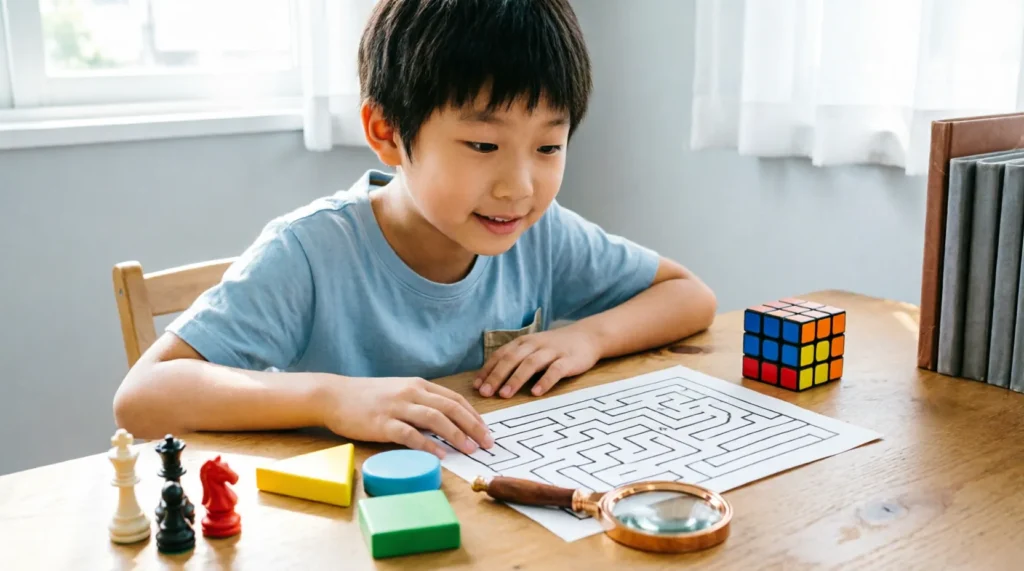
Ten-year-olds are at a perfect cognitive crossroads. They have moved past simple nursery rhymes but aren’t quite ready for the abstract philosophical puzzles that stump adults. This collection of logic riddles for 10 year olds is curated specifically for that sweet spot where deductive reasoning begins to click. These puzzles require more than just vocabulary; they demand attention to detail, pattern recognition, and the ability to filter out misleading information. Whether you are a parent looking for dinner table entertainment or a teacher seeking a warm-up activity, these riddles provide a structured way to exercise critical thinking skills without feeling like homework.
Top 5 Logic Riddles for 10 Year Olds
These five riddles represent the gold standard for this age group. They are frequently cited in educational settings because they teach specific logical concepts like lateral thinking and sequence analysis.
I speak without a mouth and hear without ears. I have no body, but I come alive with wind. What am I? Answer: An echo
The more of this there is, the less you see. What is it? Answer: Darkness
You see a boat filled with people. It has not sunk, but when you look again you don’t see a single person on the boat. Why? Answer: All the people were married. (This tests linguistic precision rather than visual logic.)
What has keys but can’t open locks? Answer: A piano
I have cities, but no houses. I have mountains, but no trees. I have water, but no fish. What am I? Answer: A map
Easy Logic Warm-Ups
Start here if your group is new to logical deduction. These riddles rely on common objects and straightforward associations. They build confidence before tackling the trickier puzzles later in the list.
What goes up but never comes down? Answer: Your age
What has to be broken before you can use it? Answer: An egg
I’m tall when I’m young, and I’m short when I’m old. What am I? Answer: A candle
What month of the year has 28 days? Answer: All of them (Every month has at least 28 days.)
What is full of holes but still holds water? Answer: A sponge
What question can you never answer yes to? Answer: Are you asleep yet?
What goes through towns and over hills but never moves? Answer: A road
Tricky Wordplay and Lateral Thinking
This section introduces ambiguity. According to Wikipedia, riddles often rely on double meanings or metaphorical language to misdirect the solver. For ten-year-olds, learning to pause and consider alternative definitions of common words is a crucial logical skill.
What has one eye but can’t see? Answer: A needle
What has many needles but doesn’t sew? Answer: A pine tree
What has a head and a tail but no body? Answer: A coin
What runs around the whole yard without moving? Answer: A fence
What has legs but doesn’t walk? Answer: A table
What has a neck but no head? Answer: A bottle
What has hands but can’t clap? Answer: A clock
Tester Note: When I run the “neck but no head” riddle with fourth graders, the most common wrong guess is “a snake.” It’s a great moment to discuss anatomical accuracy versus object description.
Math and Sequence Logic
Math riddles for this age group shouldn’t require complex calculus. Instead, they should focus on patterns, basic arithmetic, and spatial reasoning. These puzzles help children visualize numbers as objects rather than just abstract symbols.
If you have three apples and you take away two, how many do you have? Answer: Two (You took two, so you have two.)
How many sides does a circle have? Answer: Two (The inside and the outside.)
Which weighs more: a pound of bricks or a pound of feathers? Answer: Neither (They both weigh one pound.)
What number do you get when you multiply all the numbers on a telephone keypad? Answer: Zero (Because the keypad includes the number 0.)
If there are four apples and you take away three, how many do you have? Answer: Three
How many months have 28 days? Answer: 12 (All months have at least 28 days.)
What is the next number in the sequence: 2, 4, 8, 16, …? Answer: 32 (Each number is doubled.)
Tester Note: The telephone keypad riddle is a favorite because kids often start multiplying 1x2x3x4… and forget that zero exists on the pad. It teaches them to scan the entire dataset before calculating.
Hard Logic Challenges
These are the puzzles that will silence the room for a minute or two. They require holding multiple conditions in mind simultaneously. Use these to challenge the quick thinkers who breeze through the easy section.
A man is looking at a photograph of someone. His friend asks who it is. The man replies, “Brothers and sisters, I have none. But that man’s father is my father’s son.” Who is in the photograph? Answer: His son
You are running a race. You pass the person in second place. What place are you in now? Answer: Second place (You took their spot.)
A farmer has 17 sheep, and all but 9 die. How many are left? Answer: 9 (“All but 9” means 9 survived.)
What can travel around the world while staying in a corner? Answer: A stamp
I am not alive, but I grow; I don’t have lungs, but I need air; I don’t have a mouth, but water kills me. What am I? Answer: Fire
What belongs to you, but other people use it more than you do? Answer: Your name
If two’s company and three’s a crowd, what are four and five? Answer: Nine (4 + 5 = 9)
Tester Note: The race riddle is deceptively difficult. Most kids instinctively say “first place.” I always ask them to act it out physically in the living room to visualize why passing the second-place runner puts you in second, not first.
Animal and Nature Logic
Nature provides excellent frameworks for logical deduction because biological facts are consistent. These riddles combine general knowledge with logical constraints.
What animal can jump higher than a house? Answer: Any animal (Houses can’t jump.)
What has a bark but no bite? Answer: A tree
What flies without wings? Answer: Time (Or wind, depending on interpretation, but time is the classic logical answer.)
What has roots as nobody sees, Is taller than trees, Up, up it goes, And yet never grows? Answer: A mountain
What insect has the best hearing? Answer: A moth (They have ears on their wings.)
What bird lifts heavy things? Answer: A crane
What kind of room has no doors or windows? Answer: A mushroom
How to Use These Riddles
Simply reading riddles off a page is fun, but integrating them into activities maximizes their educational value. Here are four tested methods for using logic riddles for 10 year olds.
- The Dinner Table Tournament: Assign points for correct answers. Give extra points for explaining why an answer is correct. This encourages verbal articulation of logical steps.
- Classroom Warm-Ups: Write one riddle on the board each morning. Let students write their guesses on slip paper. Review the logic behind the answer during the first five minutes of class to engage brains before math or reading lessons.
- Scavenger Hunt Clues: Replace standard clues with riddles. For example, hide the next clue in the refrigerator and use the “I have keys but can’t open locks” riddle (modified to “I have light but no sun”) to lead them there.
- Road Trip Silence Breaker: When the car gets quiet, launch a riddle. The rule is: no shouting answers. Kids must raise a hand or wait for a designated “guessing turn” to prevent the loudest child from dominating the game.
Frequently Asked Questions
What makes a riddle good for a 10-year-old? A good riddle for this age group balances familiarity with novelty. The objects mentioned (apples, clocks, animals) should be known to them, but the relationship between the objects should require a shift in perspective. If the vocabulary is too obscure, it becomes a dictionary test rather than a logic puzzle.
How do logic riddles help brain development? Logic riddles strengthen working memory and inhibitory control. According to Wikipedia, logic involves the study of correct reasoning. By solving riddles, children practice suppressing their immediate, intuitive (but wrong) answer in favor of a analyzed, correct one. This builds neural pathways for critical thinking that apply to math and reading comprehension.
What if my child gets frustrated by hard riddles? Frustration is part of the learning process, but it should be managed. If a child is stuck, offer a “lifeline” hint rather than the answer. For example, in the “echo” riddle, you might say, “Think about sound bouncing off walls.” This keeps them engaged in the solving process without giving away the satisfaction of the final click.
Can these riddles be used for younger or older kids? Yes, with adjustments. For 7-8 year olds, stick to the “Easy” and “Animal” sections. For 11-12 year olds, focus on the “Hard” and “Math” sections, and encourage them to create their own riddles based on the structures provided here. Creating a riddle is often harder than solving one, as it requires reverse-engineering the logic.

With a background in psychology and cognitive science from Stanford University, Sarah Jones brings a unique perspective to the world of riddles and brain teasers. With a decade of experience in the field, she specializes in understanding how puzzles can enhance cognitive development and mental agility. Sarah’s interest in riddles began during her undergraduate years when she researched problem-solving processes in the human brain. Her work at RiddleMeHub focuses on creating puzzles that are both challenging and beneficial for mental growth, often incorporating elements of math and logic. She writes extensively about the cognitive benefits of engaging with brain teasers, aiming to promote brain health and fitness through fun and challenging content. Sarah’s contributions to the site include themed puzzle collections and in-depth analyses of classic riddles, making them accessible to both beginners and seasoned puzzlers alike. Her insightful approach has helped numerous readers appreciate the mental workout that comes with solving complex problems.