

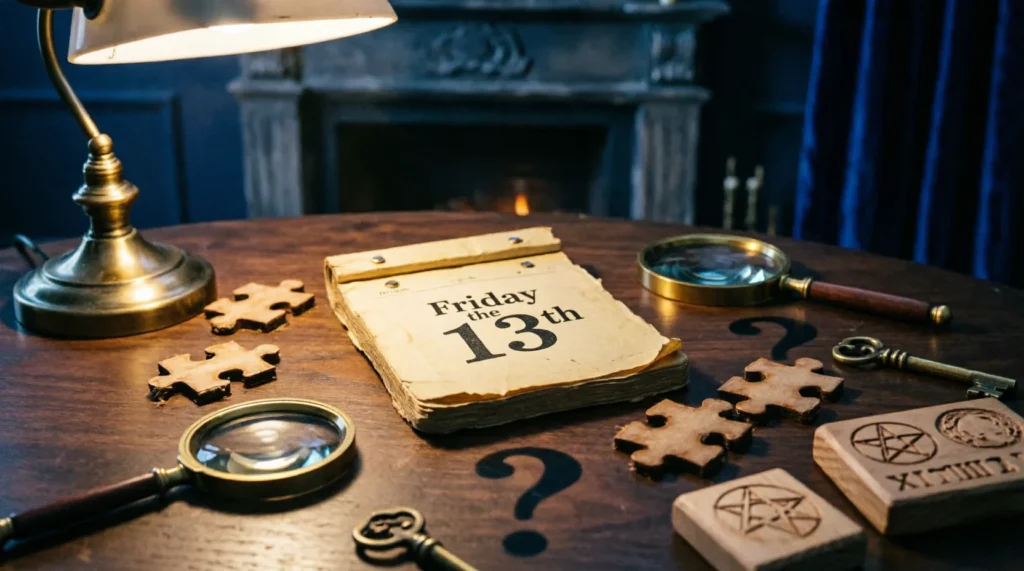
Friday the 13th is a date that triggers superstition in some and curiosity in others. Whether you are hosting a themed dinner party, looking for icebreakers for a horror movie marathon, or just want to test your lateral thinking skills with a dark twist, these riddles are designed to unsettle and entertain. This collection focuses on logic puzzles, wordplay, and spooky scenarios tailored specifically for adult minds that enjoy a challenge beyond simple children’s rhymes.
Top 5 Friday the 13th Riddles
Here are the five most popular and effective riddles to kick off your spooky session. These have been tested at various gatherings and consistently produce groans, laughs, and genuine moments of insight.
I walked into a room with a match, a kerosene lamp, a candle, and a fireplace. What did I light first?
Answer: The match.
A man is pushing his car along a road when he comes to a hotel. He shouts, “I’m bankrupt!” Why?
Answer: He is playing Monopoly.
What has keys but can’t open locks, has space but no room, and you can enter, but not go inside?
Answer: A keyboard.
The more you take, the more you leave behind. What am I?
Answer: Footsteps.
I speak without a mouth and hear without ears. I have no body, but I come alive with wind. What am I?
Answer: An echo.
Easy Warm-Up Riddles
These riddles are perfect for getting everyone comfortable. They rely on common knowledge and simple wordplay, making them accessible even if your guests are still warming up their brains. According to Wikipedia, riddles have been used throughout history as both entertainment and intellectual exercises, often serving as social lubricants in group settings.
- What has a head and a tail but no body?
Answer: A coin.
- What gets wet while drying?
Answer: A towel.
- What belongs to you, but other people use it more than you do?
Answer: Your name.
- What has many needles, but doesn’t sew?
Answer: A pine tree.
- What goes up but never comes down?
Answer: Your age.
- What has one eye, but can’t see?
Answer: A needle.
- What has hands but can’t clap?
Answer: A clock.
- What can you catch, but not throw?
Answer: A cold.
- What has a neck but no head?
Answer: A shirt.
- What has legs but doesn’t walk?
Answer: A table.
Hard Logic Puzzles for Sharp Minds
If your group includes puzzle enthusiasts or engineers, skip the warm-ups and go straight to these. These require deductive reasoning rather than just word association. I find that these stumps even the most confident solvers because they demand you ignore your initial assumptions.
- A man is found dead in a field with an unopened package next to him. There are no footprints around him. How did he die?
Answer: He jumped out of a plane, and his parachute (the package) failed to open.
- You are in a race and you pass the person in second place. What place are you in now?
Answer: Second place. (Most people instinctively say first, but you took the spot of the person who was second.)
- A doctor gives you three pills and tells you to take one every half hour. How long will the pills last?
Answer: One hour. (You take the first pill at minute 0, the second at minute 30, and the third at minute 60.)
- Two fathers and two sons go fishing. They each catch one fish, but they only bring home three fish. How is this possible?
Answer: There are only three people: a grandfather, his son, and his grandson. The son is both a father and a son.
- What word is spelled incorrectly in every dictionary?
Answer: Incorrectly.
- A man lives on the 10th floor of a building. Every day he takes the elevator down to the ground floor to go to work. When he returns, he takes the elevator to the 7th floor and walks up the stairs to the 10th floor, unless it is raining. Why?
Answer: He is short and can only reach the button for the 7th floor. When it is raining, he uses his umbrella to press the button for the 10th floor.
- You have a 3-gallon jug and a 5-gallon jug. How do you measure exactly 4 gallons?
Answer: Fill the 5-gallon jug. Pour from the 5-gallon jug into the 3-gallon jug until the 3-gallon jug is full. This leaves 2 gallons in the 5-gallon jug. Empty the 3-gallon jug. Pour the 2 gallons from the 5-gallon jug into the 3-gallon jug. Fill the 5-gallon jug again. Pour from the 5-gallon jug into the 3-gallon jug until it is full (which takes 1 gallon). This leaves exactly 4 gallons in the 5-gallon jug.
- A murderer is condemned to death. He has to choose between three rooms. The first is full of raging fires, the second is full of assassins with loaded guns, and the third is full of lions that haven’t eaten in three years. Which room is safest for him?
Answer: The third room. Lions that haven’t eaten in three years are dead.
Funny and Punny Brain Teasers
Humor is a great way to diffuse tension, especially on a day associated with bad luck. These riddles rely on puns and double meanings. When I run these at parties, the groans are usually louder than the cheers, which is exactly the desired effect.
- Why did the scarecrow win an award?
Answer: Because he was outstanding in his field.
- What do you call a fake noodle?
Answer: An impasta.
- Why don’t skeletons fight each other?
Answer: They don’t have the guts.
- What do you call a bear with no teeth?
Answer: A gummy bear.
- Why did the bicycle fall over?
Answer: Because it was two-tired.
- What do you call a dog that does magic tricks?
Answer: A labracadabrador.
- Why did the golfer bring two pairs of pants?
Answer: In case he got a hole in one.
- What do you call a fish wearing a bowtie?
Answer: Sofishticated.
- Why did the math book look sad?
Answer: Because it had too many problems.
- What do you call a sleeping bull?
Answer: A bulldozer.
Tricky Wordplay and Lateral Thinking
These riddles are designed to trap your brain into following a logical path that leads to the wrong answer. They require you to step back and look at the wording very carefully. The frustration here is part of the fun, so encourage your guests to listen closely.
- How many months have 28 days?
Answer: All 12 of them. (Every month has at least 28 days.)
- If you have me, you want to share me. If you share me, you haven’t kept me. What am I?
Answer: A secret.
- What can travel all around the world without leaving its corner?
Answer: A stamp.
- What has a bottom at the top?
Answer: Your legs.
- What breaks when you say its name?
Answer: Silence.
- What has a thumb and four fingers but is not alive?
Answer: A glove.
- What goes through cities and fields, but never moves?
Answer: A road.
- What has a heart that doesn’t beat?
Answer: An artichoke.
- What can fill a room but takes up no space?
Answer: Light.
- What is always coming but never arrives?
Answer: Tomorrow.
Short and Snappy Riddles
Sometimes you need a quick hit of mental stimulation. These are ideal for rapid-fire rounds or for keeping the energy high during a lull in conversation. They are short enough to remember easily but clever enough to make people think.
- What has a ring but no finger?
Answer: A telephone.
- What has a bank but no money?
Answer: A river.
- What has a face but no eyes?
Answer: A clock.
- What has a spine but no bones?
Answer: A book.
- What has a head but no brain?
Answer: A pin.
- What has a mouth but doesn’t eat?
Answer: A river.
- What has a bed but doesn’t sleep?
Answer: A river.
- What has a neck but no head?
Answer: A bottle.
- What has a key but no locks?
Answer: A piano.
- What has a sole but no shoes?
Answer: A foot.
How to Use These Riddles
Integrating these riddles into your Friday the 13th activities can elevate the experience from a simple gathering to an engaging event. Here are a few practical ways to deploy them effectively.
- Dinner Party Icebreakers: Place a printed card with one riddle at each place setting. Guests must solve it before they can start eating. It creates immediate conversation and helps shy guests engage.
- Scavenger Hunt Clues: Use the riddles as clues leading to the next location. For example, hide the next clue near a “coin” (for the head and tail riddle) or under a “towel” (for the wet/drying riddle).
- Pub Quiz Rounds: If you are hosting a trivia night, dedicate a round to “Spooky Logic.” Read the riddle aloud and give teams 60 seconds to write down their answers. Award bonus points for speed.
- Road Trip Entertainment: Keep a list of these riddles handy for long drives. They are excellent for keeping passengers awake and engaged without requiring any props or screens.
- Classroom Critical Thinking: For teachers, these riddles can serve as warm-up activities to teach lateral thinking. Discussing why the answer is correct helps students understand the importance of precise language and assumption-checking. As noted in historical contexts, riddles have long been used to teach critical thinking skills in educational settings Wikipedia.
Frequently Asked Questions
What is a good riddle for adults who think they are too smart for riddles?
Try the “Monopoly” riddle or the “Parachute” riddle. These require situational awareness rather than just wordplay. Adults often overthink simple scenarios, assuming there must be a complex linguistic trick, when the answer is actually a straightforward real-world situation described ambiguously.
How do these riddles help with brain health?
Solving riddles engages multiple cognitive functions, including memory, pattern recognition, and logical deduction. While they are not a cure-all, regular engagement with puzzles can help maintain mental agility. The key is variety; mixing wordplay with logic puzzles ensures different parts of the brain are activated.
Why is Friday the 13th considered unlucky?
The superstition likely stems from a combination of Christian tradition (the Last Supper had 13 attendees, and Jesus was crucified on a Friday) and Norse mythology (Loki, the 13th guest at a banquet, brought chaos). However, from a rational perspective, it is simply a day like any other, making it a perfect theme for playful skepticism and fun.
Can I use these riddles for children?
Many of the “Easy” and “Short” riddles are suitable for children aged 8 and up. However, avoid the “Hard Logic” section for younger kids, as the abstract reasoning required may lead to frustration. Always gauge the group’s age and interest level before selecting the difficulty tier.

Joshua Wilson is a former engineer turned puzzle enthusiast with over eight years of experience in the world of riddles and brain teasers. Holding a degree in Mechanical Engineering from MIT, Joshua’s technical background influences his approach to crafting intricate logic puzzles and spatial challenges. His journey into the realm of riddles began as a personal hobby, which soon evolved into a professional passion for dissecting the mechanics of problem-solving. At RiddleMeHub, Joshua specializes in puzzles that require a methodical approach, often drawing inspiration from engineering principles and scientific concepts. His content is characterized by its engaging complexity and educational value, designed to stimulate critical thinking and creativity. Joshua is committed to inspiring curiosity and wonder, encouraging readers to embrace the joy of discovery through the lens of puzzling. As an author, he brings a fresh perspective to traditional brain teasers, integrating modern techniques and interactive elements to captivate a wide audience.