

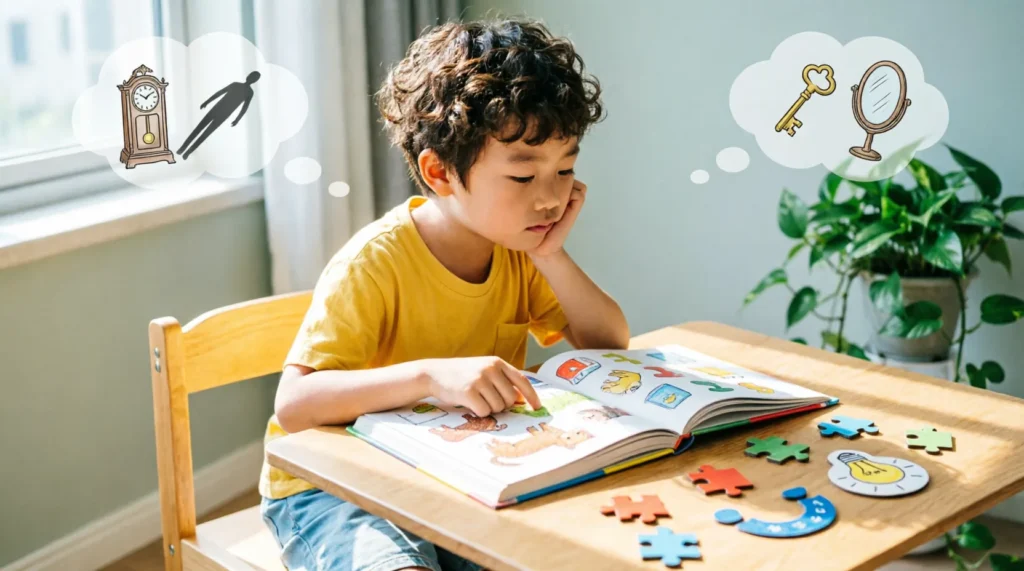
Riddles are a timeless way to engage young minds, blending language play with logical deduction. This collection of english riddles for kids with answers is designed to be scanned quickly, whether you are a parent looking for a quiet-time activity or a teacher planning a brain-break. Every riddle below includes the answer immediately following it, so you can keep the game moving without flipping pages or searching online.
Top 5 English Riddles for Kids
These five riddles represent the perfect balance of accessibility and challenge for children aged 6 to 12. They cover common themes like nature, objects, and wordplay, making them ideal starting points for any riddle session.
I have a neck but no head. I have two arms but no hands. What am I? Answer: A shirt
What has to be broken before you can use it? Answer: An egg
I’m tall when I’m young, and I’m short when I’m old. What am I? Answer: A candle
What has many keys but can’t open a single lock? Answer: A piano
What goes up but never comes down? Answer: Your age
Easy Riddles for Young Beginners
If you are introducing riddles to children under seven, start with these straightforward puzzles. They rely on concrete observations rather than abstract logic. When I test these with kindergarteners, the “wrong guess” is often literal—they might say a real key for the piano riddle if they haven’t made the connection to musical instruments yet.
What has legs but cannot walk? Answer: A table
What has one eye but cannot see? Answer: A needle
What has a face and two hands but no arms or legs? Answer: A clock
What gets wet while drying? Answer: A towel
What has a thumb and four fingers but is not alive? Answer: A glove
What room do ghosts avoid? Answer: The living room
What has a bottom at the top? Answer: Your legs
What belongs to you but is used more by others? Answer: Your name
Funny Riddles to Keep Them Laughing
Humor is a powerful tool for memory retention. These riddles use puns and silly imagery to keep the mood light. Kids love the surprise element here, especially when the answer is something absurd or unexpected.
Why did the cookie go to the doctor? Answer: Because he felt crummy
What do you call a fake noodle? Answer: An impasta
What do you call a bear with no teeth? Answer: A gummy bear
Why did the student eat his homework? Answer: Because the teacher said it was a piece of cake
What do you call a dog that does magic tricks? Answer: A labracadabrador
Where do cows go for entertainment? Answer: The moo-vies
What do you call a sleeping bull? Answer: A bulldozer
Why did the banana go to the doctor? Answer: It wasn’t peeling well
Tricky Riddles That Require Lateral Thinking
These riddles are deceptively simple. They often trap adults as much as children because they require you to ignore the obvious interpretation of the words. In my experience, nine-year-olds often solve these faster than adults because they are less likely to overthink the linguistic traps.
The more you take, the more you leave behind. What are they? Answer: Footsteps
What can travel all around the world without leaving its corner? Answer: A stamp
What has cities but no houses, mountains but no trees, and water but no fish? Answer: A map
What begins with T, ends with T, and has T in it? Answer: A teapot
What can you catch but not throw? Answer: A cold
What has a head and a tail but no body? Answer: A coin
What is full of holes but still holds water? Answer: A sponge
What goes through towns and over hills but never moves? Answer: A road
Animal Riddles for Nature Lovers
Animals are a perennial favorite topic for children. These riddles focus on distinctive physical traits or behaviors. According to Wikipedia, the English language has a vast vocabulary for animal characteristics, which makes these riddles excellent for building descriptive language skills.
I have a long neck and spots all over. I eat leaves from tall trees. What am I? Answer: A giraffe
I am black and white and look like a horse. What am I? Answer: A zebra
I have a shell on my back and move very slowly. What am I? Answer: A turtle
I live in the ocean and have eight arms. What am I? Answer: An octopus
I am known for my stripes and love to eat bamboo. What am I? Answer: A panda
I fly at night and sleep upside down. What am I? Answer: A bat
I have a trunk but I am not a car. What am I? Answer: An elephant
I change my color to blend in with my surroundings. What am I? Answer: A chameleon
Short Riddles for Quick Brain Breaks
Sometimes you only have thirty seconds to spare. These one-liners are perfect for transition times, such as waiting in line or sitting in the car. They require minimal setup and deliver instant gratification upon solving.
What has a ring but no finger? Answer: A telephone
What has a bank but no money? Answer: A river
What has a bed but never sleeps? Answer: A river
What has a mouth but never talks? Answer: A river
What has a head but never weeps? Answer: A lettuce
What has a spine but no bones? Answer: A book
What has a heart that doesn’t beat? Answer: An artichoke
What has a sole but is not a shoe? Answer: A foot
Math and Logic Riddles for Sharp Minds
For children who enjoy numbers and patterns, these riddles provide a gentle introduction to logical reasoning. They do not require complex calculation, but they do require careful listening. I find that these work best when read aloud slowly, allowing the child to visualize the scenario.
If there are three apples and you take away two, how many do you have? Answer: Two (the ones you took)
How many sides does a circle have? Answer: Two (inside and outside)
What number becomes bigger when you turn it upside down? Answer: Six (becomes nine)
I am an odd number. Take away one letter and I become even. What number am I? Answer: Seven (remove ‘s’ to get ‘even’)
How many months have 28 days? Answer: All twelve of them
If you divide 30 by half and add 10, what do you get? Answer: 70 (dividing by half is multiplying by 2)
What is the next number in this sequence: 2, 4, 8, 16, …? Answer: 32 (doubling each time)
I am a three-digit number. My tens digit is five more than my ones digit. My hundreds digit is eight less than my tens digit. What number am I? Answer: 194
How to Use These Riddles
Riddles are versatile tools that can be adapted to various settings. Here are four practical ways to integrate them into your daily routine.
- Classroom Warm-ups: Start the day with one “Riddle of the Day.” Write it on the board and let students submit answers anonymously. This encourages participation from shy students who might not raise their hands.
- Road Trip Entertainment: Print a small list of ten riddles and keep them in the glove compartment. When boredom strikes, pull one out. The “Short Riddles” section is particularly effective here because they don’t require long attention spans.
- Scavenger Hunt Clues: Replace standard written clues with riddles. For example, hide the next clue near the refrigerator and use the riddle “I have a light inside but no windows. What am I?” to lead the kids there.
- Family Game Night: Divide into teams. Give each team a point for every correct answer. To make it harder, give bonus points if they can explain why the answer is correct, fostering deeper critical thinking.
Frequently Asked Questions
What is a good riddle for a five-year-old? Start with riddles that rely on visual cues or very common objects, such as “What has legs but cannot walk?” (A table). Avoid abstract concepts like time or wordplay that requires advanced vocabulary. The goal is confidence-building, not frustration.
How do these riddles help with language development? Riddles expose children to multiple meanings of words (homonyms), metaphors, and descriptive adjectives. According to Wikipedia, riddles have been used historically as a form of oral literature that tests wit and linguistic flexibility. By solving them, children learn to listen carefully and think beyond literal definitions.
What should I do if my child cannot solve a riddle? Never leave them stuck. Offer a hint that narrows the category, such as “It’s something you find in the kitchen.” If they still struggle, reveal the answer and explain the logic. Frame it as a learning moment rather than a failure. You might say, “That was a tricky one! The answer is a towel because it absorbs water while it dries you.”
Are there riddles that are too hard for kids? Yes. Riddles that rely on obscure historical facts, complex mathematical formulas, or adult cultural references should be avoided. Stick to themes they encounter daily: school, home, animals, and nature. If a riddle requires knowledge they haven’t acquired yet, it is not a fair test of their reasoning skills.

Joshua Wilson is a former engineer turned puzzle enthusiast with over eight years of experience in the world of riddles and brain teasers. Holding a degree in Mechanical Engineering from MIT, Joshua’s technical background influences his approach to crafting intricate logic puzzles and spatial challenges. His journey into the realm of riddles began as a personal hobby, which soon evolved into a professional passion for dissecting the mechanics of problem-solving. At RiddleMeHub, Joshua specializes in puzzles that require a methodical approach, often drawing inspiration from engineering principles and scientific concepts. His content is characterized by its engaging complexity and educational value, designed to stimulate critical thinking and creativity. Joshua is committed to inspiring curiosity and wonder, encouraging readers to embrace the joy of discovery through the lens of puzzling. As an author, he brings a fresh perspective to traditional brain teasers, integrating modern techniques and interactive elements to captivate a wide audience.