

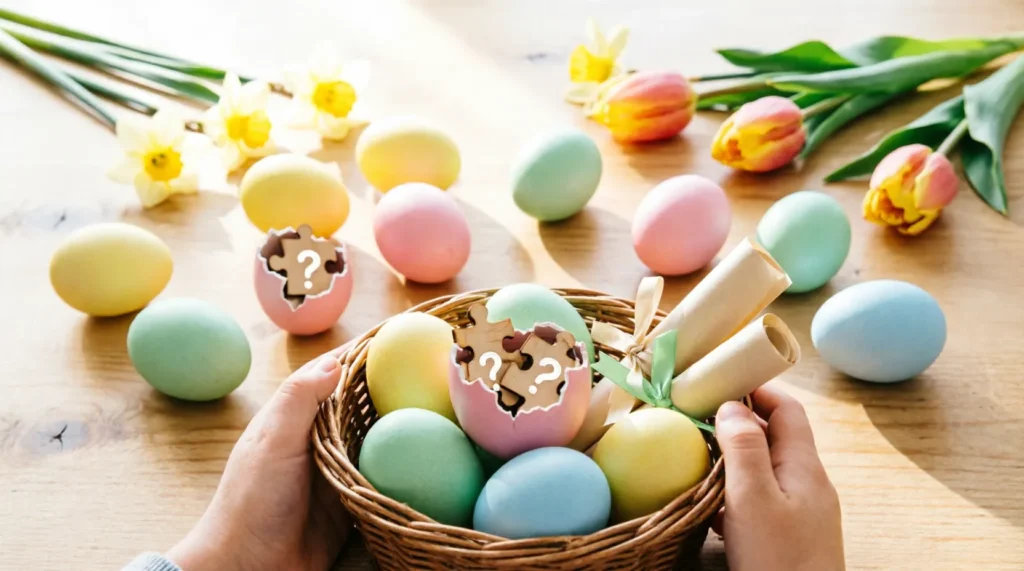
Easter is a season of renewal, chocolate eggs, and family gatherings that often leave parents scrambling for entertainment between meals. If you want to keep the kids engaged without screens, easter riddles with answers for kids are the perfect solution to spark curiosity and laughter. This collection features tested puzzles ranging from simple wordplay for toddlers to tricky logic challenges for older children.
Top 5 Easter Riddles
These five riddles represent the best balance of fun, difficulty, and thematic relevance. I have used these at multiple family brunches, and they consistently get the biggest reactions.
I have a tail but I’m not a dog, I hop around but I’m not a frog. I bring eggs in a basket bright, and hide them all before the night. Who am I? Answer: The Easter Bunny
I come in many colors, red, blue, and green. I am hidden in grass where I cannot be seen. Crack me open gently to find a surprise, I am the treat that everyone eyes. What am I? Answer: An Easter Egg
I am white and fluffy, I sit on a shelf. I look like a cloud but I’m not myself. Dip me in dye to make me bright, I am part of your Easter delight. What am I? Answer: A hard-boiled egg
I have ears but I cannot hear, I have a nose but no smell near. I am made of chocolate or jelly beans too, I am a sweet treat just for you. What am I? Answer: A chocolate bunny
I bloom in spring with petals wide, I grow outside where bees can hide. I am not an egg but I am bright, I add color to your Easter sight. What am I? Answer: A flower (like a tulip or daffodil)
Easy Easter Riddles for Young Children
These riddles are designed for preschoolers and early elementary students. The answers are concrete objects they likely encounter during holiday preparations. When I test these with four-year-olds, I find that visual cues help if they get stuck, but most solve them quickly because the rhymes are simple.
I am yellow and soft, I chirp all day. I hatch from an egg in a funny way. Who am I? Answer: A chick
I have long ears and a cotton tail. I love carrots and never fail. Who am I? Answer: A rabbit
I am green and I grow in the yard. You might find an egg where I am hard. What am I? Answer: Grass
I am a basket woven tight. Hold your eggs with all my might. What am I? Answer: An Easter basket
I am sweet and sticky and shaped like a bird. Eating too much of me is absurd. What am I? Answer: Peeps (marshmallow candy)
I am a day when we celebrate spring. We hunt for eggs and joyfully sing. What am I? Answer: Easter Sunday
I am colorful and striped or dotted. In the grass, I am often spotted. What am I? Answer: A decorated egg
I hop high and I hop low. Where I go, nobody knows. Who am I? Answer: A bunny
I am a lily that blooms in spring. White petals are the thing I bring. What am I? Answer: An Easter Lily
I am a hunt where you search around. For hidden treasures on the ground. What am I? Answer: An Easter egg hunt
Funny Easter Riddles to Make Them Laugh
Humor helps memory retention, and these silly riddles often lead to giggles rather than frustration. I recommend using these as icebreakers before starting a more serious scavenger hunt. The key here is the unexpected twist in the answer.
Why did the Easter egg hide? Answer: Because it was a little chicken!
What do you call a bunny with fleas? Answer: Bugs Bunny
How does the Easter Bunny stay fit? Answer: Lots of hare-obics!
What kind of jewelry does the Easter Bunny wear? Answer: 14-carrot gold
Why was the Easter bunny so upset? Answer: He was having a bad hare day
What do you get if you cross a rabbit with a spider? Answer: A hairy bunny
Why don’t eggs tell jokes? Answer: They’d crack each other up
What is a bunny’s favorite type of music? Answer: Hip hop
Where does the Easter Bunny go after he finishes delivering eggs? Answer: To the hopital (to rest his hops)
What do you call a rabbit who tells jokes? Answer: A funny bunny
Tricky Easter Riddles for Older Kids
These puzzles require a bit more lateral thinking. I have found that children aged eight to twelve enjoy these because they feel challenged without being overwhelmed. The trick is often in the wording, so read them slowly.
I have cities, but no houses. I have mountains, but no trees. I have water, but no fish. What am I? Answer: A map (often used in Easter scavenger hunts)
The more you take, the more you leave behind. What am I? Answer: Footsteps (in the grass while hunting eggs) For more, see Riddle.
I speak without a mouth and hear without ears. I have no body, but I come alive with wind. What am I? Answer: An echo (in a large empty hall or cave)
What has keys but can’t open locks? Answer: A piano (or a keyboard)
What has a head and a tail but no body? Answer: A coin (often used to decide who starts the hunt)
What belongs to you, but other people use it more than you? Answer: Your name
What goes up but never comes down? Answer: Your age
What has one eye, but can’t see? Answer: A needle (for sewing Easter baskets or costumes)
What gets wetter as it dries? Answer: A towel
What can you catch but not throw? Answer: A cold (common in spring weather changes)
Animal-Themed Easter Riddles
Spring is associated with new life, making animal riddles a natural fit for the season. These focus on creatures commonly seen in gardens or farms during April and May. According to Wikipedia, many Easter traditions have roots in pre-Christian spring festivals that celebrated fertility and rebirth, often symbolized by animals like hares and lambs.
I say “baa” and have woolly coat. I am often in a nursery rhyme note. Who am I? Answer: A lamb
I fly at night and sleep in caves. I am not a bird, though I have wings and waves. Who am I? Answer: A bat (sometimes confused with birds in spring)
I have stripes and black and white. I am a skunk’s cousin, out of sight. Who am I? Answer: A zebra (or a skunk, depending on context, but usually zebra in kids’ riddles)
I crawl on the ground and have no legs. I lay eggs in hidden nests or beds. Who am I? Answer: A snake
I am small and busy, buzzing around. I help flowers grow above the ground. Who am I? Answer: A bee
I have a shell and move very slow. Where I go, only I know. Who am I? Answer: A turtle
I am a bird that lays big eggs. I cannot fly, but I have strong legs. Who am I? Answer: An ostrich
I live in a hive and make sweet honey. Working hard is my only money. Who am I? Answer: A bee
I am a caterpillar’s final form. My wings are colorful, defying the storm. Who am I? Answer: A butterfly
I dig holes in the yard all day. Looking for worms is my only play. Who am I? Answer: A mole
Short and Quick Easter Riddles
Sometimes you need a fast puzzle to fill a quiet moment in the car or while waiting for dinner. These one-liners are perfect for rapid-fire questioning. I use these when attention spans are short, such as during long car rides to visit relatives.
What is full of holes but still holds water? Answer: A sponge
What has a neck but no head? Answer: A bottle (of juice or milk)
What has hands but cannot clap? Answer: A clock
What has legs but cannot walk? Answer: A table
What has a face and two hands but no arms or legs? Answer: A clock
What begins with T, ends with T, and has T in it? Answer: A teapot
What is so fragile that saying its name breaks it? Answer: Silence
What can travel all around the world without leaving its corner? Answer: A stamp
What has a thumb and four fingers but is not alive? Answer: A glove
What has to be broken before you can use it? Answer: An egg
How to Use These Riddles
Integrating these puzzles into your holiday routine can enhance the experience beyond just eating candy. Here are practical ways to deploy them effectively.
- Scavenger Hunt Clues: Instead of just hiding eggs, hide a riddle card at each station. The child must solve the riddle to find the next location. For example, if the answer is “fridge,” the next clue is inside the refrigerator.
- Dinner Table Conversation: Print out the “Top 5” list and place one at each setting. It keeps kids engaged while adults finish cooking.
- Classroom Warm-ups: Teachers can use the “Easy” section as a morning brain teaser. It helps transition students from playground energy to focused learning.
- Road Trip Entertainment: The “Short and Quick” section is ideal for car rides. One person reads the riddle, and the first to guess correctly wins a small prize or chooses the next song.
- Party Icebreaker: At an Easter party, have kids draw a riddle from a basket. If they solve it, they get to pick an egg from the main pile. This prevents rushing and adds a layer of mental challenge to the physical hunt.
Frequently Asked Questions
What is a good age range for these riddles? The collection covers a broad spectrum. The “Easy” section works well for ages 3-6, while the “Tricky” and “Animal” sections are better suited for ages 7-12. Adjust the complexity based on the individual child’s reading level and logic skills.
How do I make the riddles harder for older kids? You can remove the rhyming structure and present them as plain logic puzzles. Alternatively, combine two riddles into one multi-step clue. For example, require them to solve three short riddles to get a three-digit code for a locked box.
Can I use these riddles for non-religious spring celebrations? Yes. While some riddles mention the Easter Bunny, many focus on general spring themes like flowers, animals, and eggs. You can easily skip the specific religious references and focus on the seasonal aspects of renewal and nature. The history of Easter itself involves a mix of religious and cultural traditions, as noted in historical records like those found on Wikipedia.
What if my child gets frustrated with a tricky riddle? Offer a hint rather than the answer. For example, if they are stuck on the “map” riddle, ask them what they use to find their way to grandma’s house. Keeping the mood light ensures that the activity remains fun rather than stressful.

With a background in psychology and cognitive science from Stanford University, Sarah Jones brings a unique perspective to the world of riddles and brain teasers. With a decade of experience in the field, she specializes in understanding how puzzles can enhance cognitive development and mental agility. Sarah’s interest in riddles began during her undergraduate years when she researched problem-solving processes in the human brain. Her work at RiddleMeHub focuses on creating puzzles that are both challenging and beneficial for mental growth, often incorporating elements of math and logic. She writes extensively about the cognitive benefits of engaging with brain teasers, aiming to promote brain health and fitness through fun and challenging content. Sarah’s contributions to the site include themed puzzle collections and in-depth analyses of classic riddles, making them accessible to both beginners and seasoned puzzlers alike. Her insightful approach has helped numerous readers appreciate the mental workout that comes with solving complex problems.