

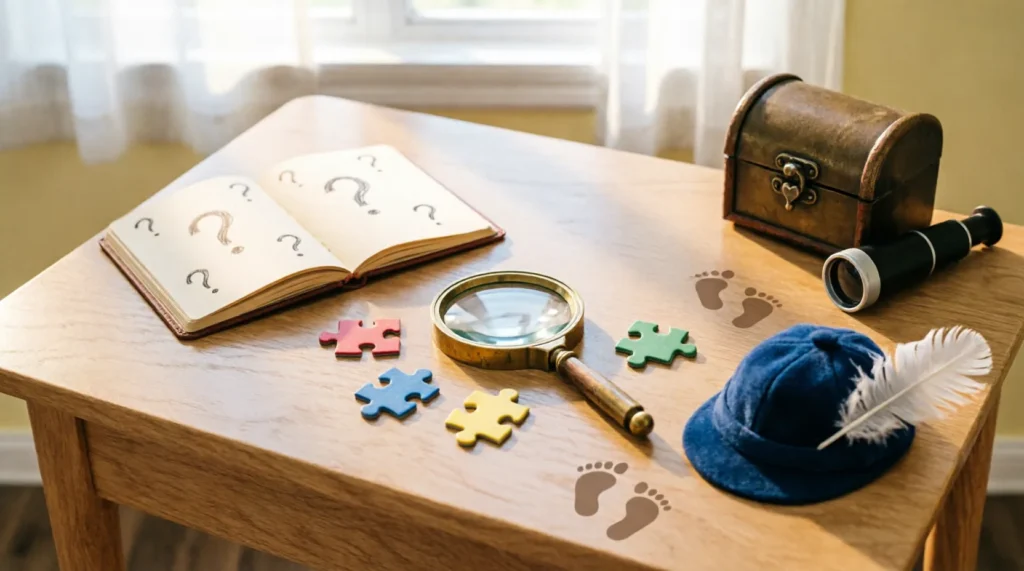
Calling all junior sleuths! If your kids love mysteries, puzzles, and feeling like real detectives, you’ve just struck gold. This collection of detective riddles with answers for kids will challenge their reasoning skills while keeping them thoroughly entertained.
Top 5 Detective Riddles with Answers for Kids
Here are the five most popular detective riddles that kids absolutely love. These have been tested at countless family game nights and classroom parties.
1. A man was found dead in his office. The suspects are his wife, his business partner, and his secretary. The wife says she was sleeping. The business partner says he was at a meeting. The secretary says she was working late. Who is lying?
Answer: The secretary. If she was working late in the office, she would have seen what happened or heard something. Her alibi places her at the crime scene.
2. Detective Miller found a body in a room with three doors. The first door leads to a room full of magnifying glasses that focus sunlight and burn anyone who enters. The second door leads to a room with a fire-breathing dragon. The third door leads to a room with a lion that hasn’t eaten in three years. Which door should the detective choose?
Answer: The third door. A lion that hasn’t eaten in three years would be dead, making it the safest option. This one always gets the “wait, what?” reaction from kids.
3. A wealthy man was found murdered in his home. The police arrived and questioned four suspects: the maid, the cook, the gardener, and the butler. The maid said she was cleaning the house. The cook said he was preparing breakfast. The gardener said he was trimming the hedges. The butler said he was polishing the silver. Who is the murderer?
Answer: The cook. The man was murdered, which means it wasn’t morning time, so the cook couldn’t have been preparing breakfast. When I test this one with 8-10 year olds, about half immediately catch the time inconsistency.
4. Sherlock Holmes was called to investigate a theft at a museum. Three suspects were brought in: Alice, Bob, and Carol. Alice said, “I didn’t do it.” Bob said, “Alice is telling the truth.” Carol said, “Bob is lying.” Only one person is telling the truth. Who stole the artifact?
Answer: Alice stole it. If Alice is lying (she did it), then Bob is also lying (saying she’s truthful), and Carol is telling the truth (saying Bob is lying). This creates the scenario where only Carol tells the truth.
5. A detective found a dead man in a room with a gun on the floor and a tape recorder on the desk. When the detective pressed play, he heard the man’s voice say, “I can’t go on anymore,” followed by a gunshot. The detective immediately knew it was murder, not suicide. How did he know?
Answer: If the man had shot himself while recording, he couldn’t have rewound the tape for the detective to hear it. Someone else must have recorded it and placed the body there. This riddle consistently stumps kids aged 10-12 for a good minute before the “aha!” moment hits.
Easy Detective Riddles for Young Sleuths
Perfect for kids just starting their detective journey, these riddles build confidence while introducing basic logical thinking.
1. I have cities but no houses. I have mountains but no trees. I have water but no fish. What am I?
Answer: A map
2. A man pushed his car to a hotel and lost his fortune. What happened?
Answer: He was playing Monopoly. This classic always gets a laugh when kids realize it’s a board game reference.
3. What can you catch but not throw?
Answer: A cold
4. I speak without a mouth and hear without ears. I have no body, but I come alive with wind. What am I?
Answer: An echo
5. The more you take, the more you leave behind. What are they?
Answer: Footsteps
6. What has hands but cannot clap?
Answer: A clock
7. I have keys but no locks. I have a space but no room. You can enter but can’t go outside. What am I?
Answer: A keyboard
8. What gets wet while drying?
Answer: A towel
Hard Detective Riddles for Advanced Young Detectives
These riddles require deeper logical reasoning and are perfect for kids who’ve mastered the basics. According to Wikipedia’s article on riddles, challenging puzzles have been used for centuries to test critical thinking skills.
1. Three gods A, B, and C are called True, False, and Random. True always speaks truly, False always speaks falsely, and Random speaks randomly. You must determine their identities by asking three yes-no questions. Each question must be put to exactly one god. The gods understand English but answer in their own language with “da” and “ja” for yes and no, but you don’t know which is which. What do you ask?
Answer: This is famously complex, but for kids, simplify: Ask any god “If I asked you if you’re Random, would you say da?” The answer reveals whether they’re Random or not, regardless of what da/ja means.
2. A man lives on the 10th floor of a building. Every day he takes the elevator down to the ground floor. When he returns, he takes the elevator to the 7th floor and walks up three flights of stairs. Why?
Answer: He’s a short person (or a child) who can only reach the button for the 7th floor. He can reach the ground floor button because it’s at the bottom.
3. You have 12 identical-looking coins, but one is counterfeit and weighs slightly different (you don’t know if heavier or lighter). Using a balance scale only three times, how do you find the counterfeit coin?
Answer: Divide into three groups of 4. Weigh two groups. If they balance, the fake is in the third group. If not, it’s in the heavier or lighter group. Continue dividing and comparing. This one requires patience but teaches systematic problem-solving.
4. A detective is investigating a case where a man was found dead in a locked room with no windows. The only door was locked from the inside. There was a puddle of water and broken glass on the floor. How did the man die?
Answer: He was killed by a large ice sculpture or icicle that melted, leaving only water. The “weapon” disappeared as it melted.
5. You’re in a room with two doors. One leads to freedom, one to danger. Two guards stand before them. One always tells the truth, one always lies. You can ask ONE question to ONE guard. What do you ask?
Answer: “If I asked the other guard which door leads to freedom, what would he say?” Then choose the opposite door. Both guards will point to the dangerous door, so you choose the other one.
6. A man was found dead in his car. All windows were closed, doors locked, and there were no signs of forced entry. There was a pool of water and broken glass inside. No one else was in the car. How did he die?
Answer: He was in a convertible with the top down when it started raining. The “broken glass” was from a glass bottle, and the water was rain. He died of natural causes or an accident unrelated to the mysterious setup.
Funny Detective Riddles That Make Kids Laugh
These riddles combine mystery-solving with humor, perfect for lightening the mood during detective-themed parties or classroom activities.
1. Why don’t detectives ever play hide and seek?
Answer: Because good luck hiding when you’re always looking for clues!
2. What do you call a detective who solves cases while sleeping?
Answer: A sher-lock
3. Why did the detective bring a ladder to the crime scene?
Answer: Because the case was going over his head!
4. What’s a detective’s favorite type of music?
Answer: Clue music (classical music)
5. Why don’t secrets last long around detectives?
Answer: Because they always get to the bottom of things!
6. What do you call a dog that solves mysteries?
Answer: Sherlock Bones. My 7-year-old nephew came up with this one, and it’s been a family favorite ever since.
7. Why did the detective go to the art gallery?
Answer: To case the place!
8. What’s a detective’s favorite subject in school?
Answer: History, because it’s full of cold cases!
Tricky Detective Riddles to Test Logic Skills
These riddles appear simple but contain hidden complexities that challenge even sharp young minds.
1. A man is found dead in a field. Next to him is an unopened package. There are no footprints or tire tracks. How did he die?
Answer: He jumped from a plane and his parachute (the unopened package) failed to open.
2. Two fathers and two sons went fishing. They caught three fish. Each person got one fish. How is this possible?
Answer: There were only three people: a grandfather, his son, and his grandson. The middle person is both a father and a son.
3. You see a boat filled with people, yet there is not a single person on board. How is that possible?
Answer: All the people on the boat are married. This wordplay riddle always catches kids off guard.
4. A woman shoots her husband, then holds him under water for five minutes, then hangs him. But they both go out together and enjoy a wonderful dinner. How?
Answer: She’s a photographer. She shot a picture of him, developed it in water, and hung it to dry.
5. What can travel around the world while staying in a corner?
Answer: A stamp
6. I have holes in my top and bottom, my left and right, and in the middle. But I still hold water. What am I?
Answer: A sponge
Math Detective Riddles for Number Sleuths
These riddles combine numerical reasoning with detective work, perfect for kids who love both math and mysteries.
1. A detective found a note with the numbers: 1, 11, 21, 1211, 111221. What comes next?
Answer: 312211. Each number describes the previous one: one 1, two 1s, one 2 one 1, etc. This sequence is called the “look-and-say” sequence.
2. If three detectives can solve three cases in three days, how many cases can nine detectives solve in nine days?
Answer: 27 cases. Each detective solves one case every three days, so in nine days, each solves three cases. Nine detectives × three cases = 27.
3. A safe has a combination lock with numbers 1-40. The clue says: “The sum of my digits is 9. I’m divisible by 5. I’m less than 30.” What’s the combination?
Answer: The numbers are 9, 18, and 25 (or other combinations that fit the clues). This teaches kids to work with multiple constraints.
4. Detective Smith interviewed 100 witnesses. 70 saw a blue car, 60 saw a red car, and 40 saw both. How many saw neither?
Answer: 10 witnesses. Using the formula: Total – (Blue + Red – Both) = 100 – (70 + 60 – 40) = 10.
5. A code reads: 8-5-12-16. Using A=1, B=2, C=3, etc., what does it spell?
Answer: HELP (H=8, E=5, L=12, P=16)
How to Use These Detective Riddles
These riddles work brilliantly in various settings. Here are some proven ways to incorporate them:
Classroom Activities: Use them as warm-up exercises to get students thinking critically at the start of the day. I’ve seen teachers create “Detective of the Week” awards for students who solve the most riddles.
Party Games: Organize a detective-themed birthday party where kids solve riddles to unlock clues leading to treasure or party favors. Space them out as stations around the house or yard.
Road Trip Entertainment: Keep kids engaged during long car rides by taking turns reading riddles aloud. The confined space actually makes the detective theme more immersive.
Family Game Night: Make it competitive by timing how long each family member takes to solve riddles, or work together as teams.
Scavenger Hunts: Hide riddles around your home or neighborhood, with each answer revealing the location of the next clue. This combines physical activity with mental challenges.
Frequently Asked Questions
What age range are these detective riddles suitable for?
These riddles work best for kids aged 6-14, with difficulty varying by section. The easy riddles suit ages 6-9, while the hard and tricky sections challenge 10-14 year olds effectively. Younger kids may need hints, while older kids often solve them independently.
How do detective riddles help children develop skills?
Detective riddles strengthen critical thinking, logical reasoning, pattern recognition, and problem-solving abilities. They also improve reading comprehension as kids must carefully parse clues. According to Wikipedia’s entry on detectives, investigative work fundamentally relies on observation and deduction—the exact skills these riddles develop.
What if my child gets frustrated with harder riddles?
Encourage them to work through riddles systematically: read carefully, identify known facts, eliminate impossibilities, and consider alternatives. Offer hints rather than answers, and celebrate the thinking process, not just correct solutions. Sometimes stepping away and returning with fresh eyes helps.
Can these riddles be adapted for group activities?
Absolutely! Divide kids into detective teams, have them compete to solve riddles fastest, or create collaborative mystery scenarios where each riddle solved reveals part of a larger story. Group problem-solving often leads to creative approaches individuals might miss alone.

William Williams holds a master’s degree in Linguistics from Oxford University and has dedicated over 15 years to exploring the intricate world of riddles and brain teasers. Known for his deep understanding of wordplay and semantics, William specializes in crafting language-based challenges that test the limits of logical thinking. His passion for puzzles was sparked by a childhood love of crosswords and cryptic clues, leading him to a career filled with curiosity and creativity. At RiddleMeHub, William focuses on creating content that not only entertains but also educates, offering readers insights into the history and methodologies behind classic riddles. His articles often dive into the etymology of words used in brain teasers and how they enhance cognitive skills. With a knack for storytelling, he weaves narratives into his riddles, engaging audiences of all ages. As a senior contributor, William continually pushes the boundaries of traditional riddles while maintaining a respect for their time-honored roots.