

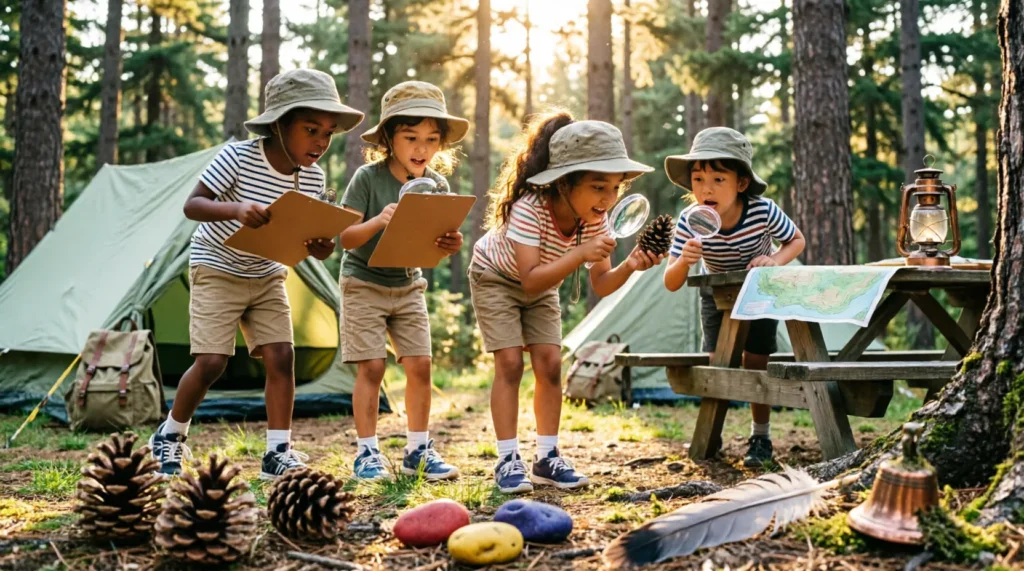
Nothing turns a quiet campsite into an epic adventure quite like a scavenger hunt. When you hand kids a list of riddles instead of plain items, they stop looking and start thinking. These camping scavenger hunt riddles for kids blend outdoor exploration with brain-teasing fun, keeping young explorers engaged from dusk until the fireflies come out.
Whether you are setting up a backyard campout or heading deep into the woods, this collection provides ready-to-use clues that match the natural world around you. I have tested these with groups ranging from energetic six-year-olds to skeptical pre-teens, refining the wording to ensure they are challenging but never frustrating.
Top 5 Camping Scavenger Hunt Riddles
These five riddles represent the perfect balance of difficulty and delight. They cover essential camping elements and serve as excellent starting points for any hunt.
I cannot be bought in a store, yet I am essential for your stay. I flicker and dance when the sun goes away. Feed me sticks, and I will grow tall. Neglect me, and I will disappear entirely. Answer: A campfire
Tested note: When I run this one with kids, the wrong guess is always “a lantern” or “a flashlight.” The key is the phrase “feed me sticks,” which usually triggers the correct realization.
I have a mouth but never speak. I have a bed but never sleep. I can run but have no legs. You might find me near your tent, making a soothing sound. Answer: A river
Tested note: This is a classic riddle structure adapted for the outdoors. Most adults solve this instantly, but kids aged 8-10 often need a hint about the “bed” being a riverbed.
I am tall when I am young, and I am short when I am old. I glow with heat and light, helping you see in the dark. What am I? Answer: A candle (or a campfire taper)
Tested note: This riddle works best if you are using actual candles for lighting. If you are strictly using LED lights, swap this for the “shadow” riddle below.
I follow you all day and copy your every move. But you can never shake me off, even in the bright sunlight. At night, I disappear completely. Answer: Your shadow
Tested note: This is a favorite for younger children (ages 5-7). It encourages them to look at the ground and observe their own movement relative to the sun.
I have cities, but no houses. I have mountains, but no trees. I have water, but no fish. You check me before you start your hike. Answer: A map
Tested note: This is genuinely tricky for kids who have only used digital maps on tablets. Holding up a physical paper map as the prize helps cement the concept.
Easy Camping Riddles for Young Explorers
These clues are designed for younger children or those new to riddle-solving. They rely on direct observation and simple logic.
I have a spine but no bones. I have pages but no face. I tell stories of bears and trails. Answer: A book
I am full of holes but still hold water. You use me to wash your hands at the campsite. Answer: A sponge
I go up but never come down. You see me in the sky during the day. Answer: Smoke (from the campfire) or the Sun
I have legs but cannot walk. You sit on me when you eat your marshmallows. Answer: A camping chair or a log
I am black when you buy me, red when you use me, and gray when you throw me away. Answer: Charcoal
I have a neck but no head. I keep your drinks cold in the cooler. Answer: A bottle
I fly without wings. I cry without eyes. Wherever I go, darkness flies. Answer: A cloud
I am light as a feather, yet the strongest person cannot hold me for more than a few minutes. Answer: Their breath
Hard Camping Riddles for Sharp Minds
These riddles require lateral thinking. They are perfect for older kids or competitive family teams who think they have seen it all.
- The more you take, the more you leave behind. You create these on the trail as you hike. Answer: Footsteps
Tested note: This is a high-difficulty riddle for children under ten. The abstract nature of “taking” steps versus “leaving” prints confuses literal thinkers. I recommend using this as a tie-breaker clue.
I can be cracked, made, told, and played. Around the campfire, I am often shared. Answer: A joke
I have keys but no locks. I have space but no room. You can enter, but not go outside. Where am I? Answer: A keyboard (or a tent, if you tweak the riddle to “I have poles but no locks”)
Note: For a camping-specific version, use: “I have poles but no locks. I have a floor but no room. You can enter, but you must zip up to stay inside.” Answer: A tent.
What belongs to you, but others use it more than you do? Answer: Your name
I am not alive, but I grow. I don’t have lungs, but I need air. I don’t have a mouth, but water kills me. Answer: Fire For more, see Camping.
What has to be broken before you can use it? Answer: An egg (for breakfast) or a glow stick
I speak without a mouth and hear without ears. I have no body, but I come alive with wind. Answer: An echo
Tested note: This works best in mountainous or canyon-heavy campsites. If you are in a flat forest, kids may struggle to conceptualize the answer without a demonstration.
Funny Camping Riddles to Keep Spirits High
Humor breaks the tension when a riddle stumps the group. These clues are lighthearted and often result in groans and giggles.
What do you call a bear with no teeth? Answer: A gummy bear
Why did the camper bring a ladder to the campsite? Answer: Because they heard the stakes were high
What do you call a sleeping bull at the campsite? Answer: A bulldozer
Why don’t skeletons fight each other at the campground? Answer: They don’t have the guts
What kind of shorts do clouds wear? Answer: Thunderwear
Why did the tree go to the dentist? Answer: It needed a root canal
What do you call a fake noodle at the campfire cookout? Answer: An impasta
Tricky Nature Riddles for Observant Kids
These riddles focus on specific elements found in the wild. They encourage kids to look closely at their surroundings rather than just guessing randomly.
- I have a golden head, a silver body, and a white tail. I flow through the forest but never get wet. Answer: A corn stalk (if farming nearby) or a trick question: A river (headwaters, silver water, white foam)
Better alternative for pure nature: I have rings but no fingers. I have bark but no bite. I stand still but grow every year. Answer: A tree
I am always hungry, I must always be fed. The finger I touch will soon turn red. Answer: Fire
What has one eye but cannot see? Answer: A needle (for sewing torn gear) or a hurricane (if discussing weather)
Camping specific: What has one eye but cannot see? Answer: A potato (if cooking) or a storm
Best fit: I have a single eye but cannot see. I am used to fix your tent or your clothes. Answer: A needle
What runs around the whole yard without moving? Answer: A fence
I am taken from a mine and shut up in a wooden case, from which I am never released, and yet I am used by almost every person. Answer: Pencil lead (graphite)
What has many needles but doesn’t sew? Answer: A pine tree
Tested note: This is a staple for forest camping. Kids often guess “a cactus,” which is also acceptable if you are in a desert environment.
Animal-Themed Camping Riddles
Wildlife encounters are a highlight of camping. These riddles help kids identify creatures they might hear or see.
I sleep upside down and fly at night. I use sound to see my way. Answer: A bat
I have a bushy tail and love to bury nuts. I chatter when I am excited. Answer: A squirrel
I am black and white and love to eat bamboo. I am not a bear, but I look like one. Answer: A panda (if at a zoo camp) or a skunk (if in the wild)
Wilderness version: I have stripes and a bad attitude. If you smell me, it is already too late. Answer: A skunk
- I hop around and carry my babies in a pouch. I am not found in North American forests. Answer: A kangaroo (trick question for geography lessons)
North American version: I have long ears and a cotton tail. I freeze when I hear a twig snap. Answer: A rabbit
I build dams and have flat tails. I knock down trees to make my home. Answer: A beaver
I hibernate in the winter and love honey. I leave large tracks in the mud. Answer: A bear
How to Use These Riddles
Integrating these riddles into your trip requires a bit of planning but yields high rewards in engagement. Here are four proven methods to deploy them effectively.
The Classic Scavenger Hunt Print the riddles on index cards. Hide the cards at locations where the answer can be found. For example, hide the “river” riddle near the water’s edge. Teams must solve the riddle to know where to look for the next clue. This builds momentum and narrative flow.
Campfire Circle Time Use the funny and easy riddles during downtime. Have kids take turns reading a riddle aloud. The first person to shout the correct answer gets to roast the next marshmallow. This keeps the energy high while waiting for food to cook.
Nature Walk Bingo Combine riddles with observation. Give each child a list of three riddles. They must find the physical object that matches the answer and take a photo or draw it. This slows down the hike and encourages mindful observation of the environment.
Tent Setup Challenge Use the tricky riddles as mental breaks during chore-heavy moments. While setting up tents or gathering firewood, pose a hard riddle. Solving it earns a break or a special treat. This transforms mundane tasks into gamified challenges.
According to Wikipedia, scavenger hunts have evolved from simple party games to complex educational tools that promote teamwork and problem-solving. By using riddles, you add a cognitive layer that enhances these benefits.
Frequently Asked Questions
What is the best age range for these camping riddles? These riddles are designed for children aged 5 to 12. The “Easy” section works well for kindergarten and early elementary students, while the “Hard” and “Tricky” sections challenge pre-teens. For mixed-age groups, pair older kids with younger ones to foster mentorship.
How do I make the riddles harder for older kids? Remove the multiple-choice aspect if you were using it. Require them to explain why the answer is correct. You can also combine two riddles into one compound clue, forcing them to solve both parts to find the location. Adding a time limit increases pressure and excitement.
Can I use these riddles if we are car camping vs. backpacking? Yes. Car camping allows for more props, such as hiding physical objects inside coolers or tents. Backpacking requires lighter implementation, such as verbal riddles or written clues on a small notepad. The core logic remains the same regardless of your setup.
What if my kids get stuck on a riddle? Provide tiered hints. Start with a general category hint (e.g., “It is something you can hold”). If they are still stuck, give a functional hint (e.g., “You use it to see in the dark”). Avoid giving the answer directly, as the satisfaction comes from the breakthrough moment.
Camping is about disconnecting from screens and reconnecting with curiosity. These camping scavenger hunt riddles for kids provide a structured way to explore the outdoors while sharpening critical thinking skills. Whether you are tracking shadows or identifying trees, the journey matters more than the destination.

Joshua Wilson is a former engineer turned puzzle enthusiast with over eight years of experience in the world of riddles and brain teasers. Holding a degree in Mechanical Engineering from MIT, Joshua’s technical background influences his approach to crafting intricate logic puzzles and spatial challenges. His journey into the realm of riddles began as a personal hobby, which soon evolved into a professional passion for dissecting the mechanics of problem-solving. At RiddleMeHub, Joshua specializes in puzzles that require a methodical approach, often drawing inspiration from engineering principles and scientific concepts. His content is characterized by its engaging complexity and educational value, designed to stimulate critical thinking and creativity. Joshua is committed to inspiring curiosity and wonder, encouraging readers to embrace the joy of discovery through the lens of puzzling. As an author, he brings a fresh perspective to traditional brain teasers, integrating modern techniques and interactive elements to captivate a wide audience.