

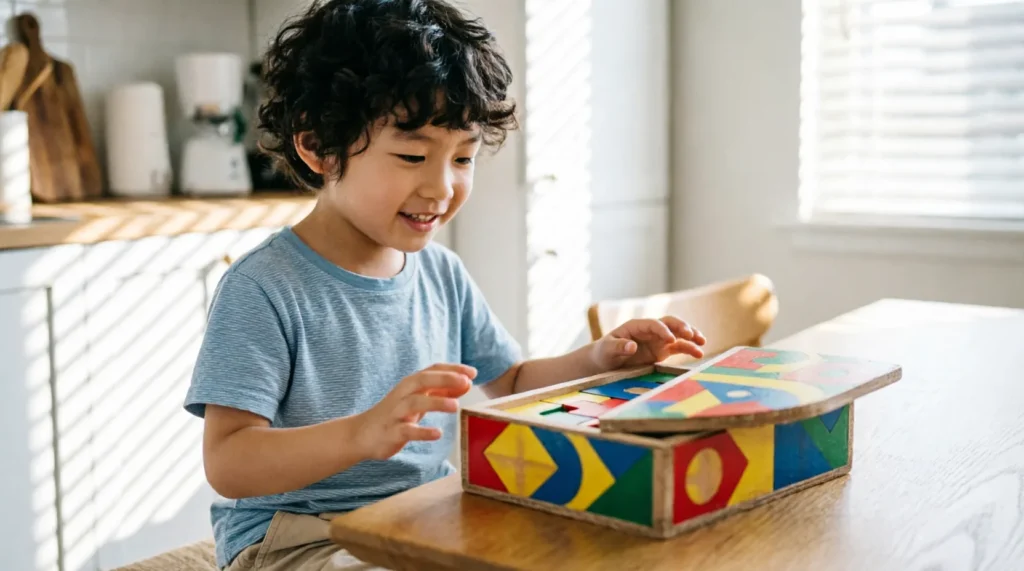
Six is a magical age for logic, making it the perfect time to introduce first graders to brain teasers and wordplay. This thoroughly tested collection of the best riddles for 6 year olds guarantees giggles, groans, and serious cognitive growth.
Top 5 Best Riddles for 6 Year Olds
- What has hands but cannot clap?
Answer: A clock.
When I run this one with kids, the wrong guess is always “a statue!” or “a ghost!” before they finally realize that clocks have hands. It is a fantastic introduction to homonyms.
- I am full of holes but I can still hold water. What am I?
Answer: A sponge.
- What goes up but never comes down?
Answer: Your age.
Difficulty: Easy. Kids understand aging, but the finality of “never comes down” makes it a solid logic check.
- What has to be broken before you can use it?
Answer: An egg.
- What has one eye, but can’t see?
Answer: A needle.
Easy Riddles for First Graders
- What has many teeth, but can’t bite?
Answer: A comb.
- Where does today come before yesterday?
Answer: In the dictionary.
- What can you catch, but not throw?
Answer: A cold.
- What kind of room has no doors or windows?
Answer: A mushroom.
First graders love this one because it involves wordplay on the word “room.” Expect them to start naming other fake rooms, like a “ball-room” or a “bath-room,” which is a great segue into compound words.
- What gets wetter the more it dries?
Answer: A towel.
Kids always guess “a sponge” first because of the earlier riddle, but a towel is the classic answer here.
- I have branches, but no fruit, trunk or leaves. What am I?
Answer: A bank.
- What goes up and down but doesn’t move?
Answer: Stairs.
- What is always in front of you but can’t be seen?
Answer: The future.
My niece stared at me for a full minute before whispering “tomorrow?” The future is a massive concept for a first grader, making this a brilliant introduction to abstract thinking.
Funny Riddles That Make Kids Giggle
- What do you call a bear with no teeth?
Answer: A gummy bear.
- Why did the teddy bear say no to dessert?
Answer: Because she was stuffed.
Six-year-olds are obsessed with food jokes. If you want to extend this game, ask them to invent their own food puns after you finish the list.
- What has a bottom at the top?
Answer: Your legs.
- What do you call a fake noodle?
Answer: An impasta.
- Why do bees have sticky hair?
Answer: Because they use honeycombs.
- What do you call a pig that does karate?
Answer: A pork chop.
- What do you call cheese that isn’t yours?
Answer: Nacho cheese.
Animal Riddles for Young Explorers
- I have a long neck and spots. I eat leaves from tall trees. What am I?
Answer: A giraffe.
- I hop around and carry my babies in a pouch. What am I?
Answer: A kangaroo.
- I have eight legs and spin a web to catch my food. What am I?
Answer: A spider.
- I sleep upside down and fly at night. What am I?
Answer: A bat.
- I wear a tuxedo and swim in the freezing cold. What am I?
Answer: A penguin.
Whenever I use this one at a birthday party, the kids immediately start waddling around the room pretending to be penguins. It is highly interactive and gets them moving.
- I change colors to hide from my enemies. What am I?
Answer: A chameleon.
Tricky Riddles That Require a Second Look
- What belongs to you, but other people use it more than you do?
Answer: Your name.
Difficulty: Genuinely Hard. Six-year-olds are highly possessive of their belongings, so realizing something of theirs is used more by others requires serious perspective-shifting.
- If you drop a yellow hat in the Red Sea, what does it become?
Answer: Wet.
Kids expect a color-mixing trick here and will confidently yell “orange!” or “purple!”
- A rooster lays an egg on the roof of a barn. Which way does it roll?
Answer: It doesn’t. Roosters don’t lay eggs.
Most kids are so focused on the physics of the roof slope that they completely miss the biological impossibility of the premise. It teaches them to slow down and process every word.
- What has 13 hearts, but no other organs?
Answer: A deck of cards.
- I shave every day, but my beard stays the same. What am I?
Answer: A barber.
- What month of the year has 28 days?
Answer: All of them.
This is a great place to talk about time. A Year is the orbital period of Earth around the Sun, which we divide into twelve calendar months. Every single one of those months has at least 28 days!
Short Riddles for Quick Car Rides
- What has a face and two hands but no arms or legs?
Answer: A clock.
- What starts with a T, ends with a T, and has T in it?
Answer: A teapot.
- What has words, but never speaks?
Answer: A book.
- I am an odd number. Take away a letter and I become even. What number am I?
Answer: Seven (remove the ‘s’ and it becomes ‘even’).
First graders love this one because it mixes math with spelling. It usually takes a few hints, but once they get it, they feel like geniuses.
- What can run but never walks, has a mouth but never talks, has a head but never weeps, has a bed but never sleeps?
Answer: A river.
- What has many keys but can’t open a single lock?
Answer: A piano.
Math and Logic Riddles for Little Thinkers
- If you have three apples and you take away two, how many apples do you have?
Answer: Two. (You took two, so you have two!)
Kids are so used to subtraction word problems from their math worksheets that they immediately yell “one!” Teaching them to listen to the exact phrasing of the question is a vital reading comprehension skill.
- What has a thumb and four fingers, but is not alive?
Answer: A glove.
- I add five to nine, and get two. The answer is correct, but how?
Answer: When it is 9 AM, add 5 hours to it and you get 2 PM.
This one is fantastic for teaching clock math, though you might need to draw a circle on a piece of paper to help them visualize it.
- Two fathers and two sons go fishing. They catch one fish each, but only bring home three fish total. How is this possible?
Answer: The group consists of a grandfather, a father, and a son.
Difficulty: Looks Hard, Actually Easy. Once you draw three stick figures on a napkin (grandpa, dad, son), the math clicks instantly.
- If it takes one man three days to dig a hole, how long does it take two men to dig half a hole?
Answer: You can’t dig half a hole.
- What is the easiest way to throw a ball as hard as you can, and have it stop and come right back to you without hitting anything or anyone?
Answer: Throw it straight up in the air.
How to use these riddles
- Family Game Night: Instead of just reading them out loud, write them on slips of paper and put them in a decorated mason jar. Let the child draw one and act as the “riddle master” while the adults guess. They love feeling like they have the power and holding the secret knowledge. If the adults guess wrong, let the child give a dramatic reveal of the answer.
- Classroom Brain Breaks: First grade teachers know that attention spans wane after about 20 minutes of focused work. Use a quick riddle to reset the room and bring their focus back to the front. Try the “thumb on your chest” method: tell the kids that if they know the answer, they should quietly put their thumb on their chest instead of shouting it out. This prevents the fastest thinkers from ruining the puzzle for everyone else and gives the whole class a moment to process the clues.
- Scavenger Hunts: Write the answers on sticky notes and hide them around the house or yard. Give the child the riddle, and they have to find the physical object that matches the answer to get their next clue. For example, if the answer is “a towel,” they run to the bathroom, find the sticky note on the towel, and read the next riddle printed on it.
- Road Trip Entertainment: Keep a printed list in the glovebox or saved on your phone. When the inevitable “are we there yet?” chorus begins, fire off a few animal or tricky riddles. It engages their brains far more than staring at a screen, and it encourages the whole family to participate in the backseat.
Frequently Asked Questions
What is a good riddle for a 6-year-old? A good riddle for this specific age relies heavily on concrete nouns they interact with on a daily basis: clocks, towels, maps, shoes, and common animals. Abstract concepts like “time,” “silence,” or “echoes” can be far too vague unless framed very simply. The best riddles for first graders use vocabulary they already know from their reading books, ensuring that the challenge lies in the logic, not in deciphering unknown words.
How do these riddles work? According to the formal definition of a Riddle, it is a statement or question having a double or veiled meaning put forth as a puzzle. For a six-year-old, the most effective puzzles rely on literal interpretations and shifting perspectives. When you say “what has hands,” their developing brain immediately pictures human hands. The “aha!” moment comes from successfully shifting their perspective to an object’s physical features. This cognitive flexibility is a crucial developmental milestone.
Why do kids love groaning at the answers? The dramatic groan is actually a sign of cognitive success! When a child hears the answer, their brain rapidly reconciles the misleading clue with the logical solution. That slight feeling of being “tricked” in a safe, playful environment triggers a release of dopamine. It is the exact same psychological reward mechanism that makes puns and dad jokes funny to adults. They groan because they love the feeling of their brain being stretched.
How can I help my child if they get stuck? Never just give the answer immediately, as that robs them of the satisfaction of solving it. Instead, give categorical hints. If the answer is “a sponge,” say, “It’s something you use in the kitchen.” If they still don’t know, narrow it down: “It’s something you use to wipe up spilled milk.” Scaffolding the hints builds their deductive reasoning skills without causing frustration, teaching them how to narrow down possibilities logically.

William Williams holds a master’s degree in Linguistics from Oxford University and has dedicated over 15 years to exploring the intricate world of riddles and brain teasers. Known for his deep understanding of wordplay and semantics, William specializes in crafting language-based challenges that test the limits of logical thinking. His passion for puzzles was sparked by a childhood love of crosswords and cryptic clues, leading him to a career filled with curiosity and creativity. At RiddleMeHub, William focuses on creating content that not only entertains but also educates, offering readers insights into the history and methodologies behind classic riddles. His articles often dive into the etymology of words used in brain teasers and how they enhance cognitive skills. With a knack for storytelling, he weaves narratives into his riddles, engaging audiences of all ages. As a senior contributor, William continually pushes the boundaries of traditional riddles while maintaining a respect for their time-honored roots.