

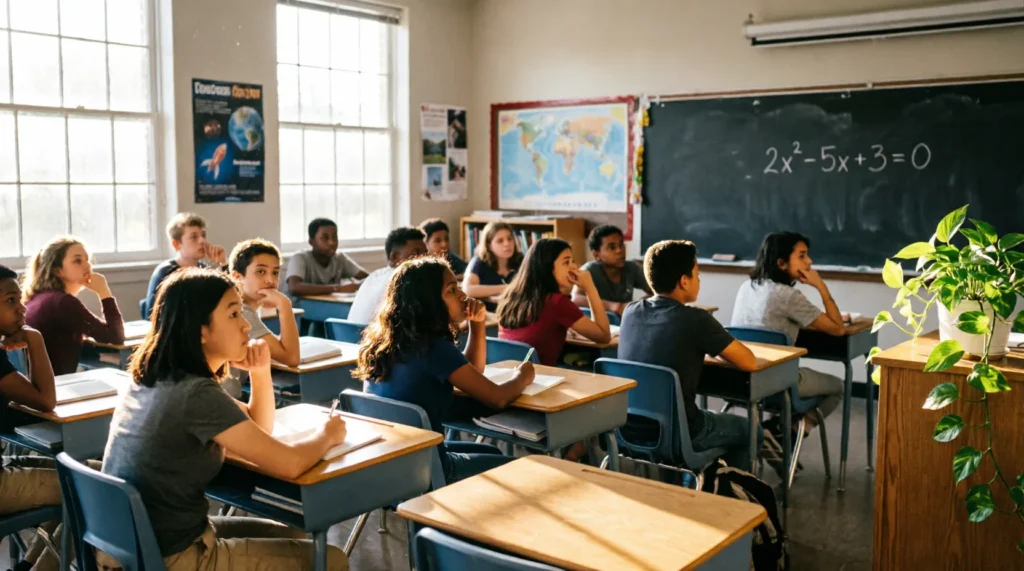
Middle school mornings can be rough, but a quick brain-teaser is the perfect way to wake up a sleepy classroom. Historically, the term Ringer described someone whose job was to ring a bell, and today, these morning puzzles act as a mental bell to kickstart your students’ focus. This collection is curated specifically for 6th through 8th graders, blending wordplay, logic, and a bit of humor to get their gears turning.
Top 5 Bell Ringer Riddles for Middle School
I speak without a mouth and hear without ears. I have no body, but I come alive with wind. What am I?
Answer: An echo.
When I run this one with 7th graders, the wrong guess is always “a ghost” or “a cloud.” It takes a minute for them to realize sound itself can bounce. Once one kid gets it, the whole room suddenly starts testing echoes in the hallway.
The more of this there is, the less you see. What is it?
Answer: Darkness.
This one looks hard but is actually incredibly easy once a student stops thinking of physical objects and starts thinking about environmental conditions.
I have cities, but no houses. I have mountains, but no trees. I have water, but no fish. What am I?
Answer: A map.
Middle schoolers usually guess “a dream” or “a video game” before landing on the correct answer. I love watching the lightbulb moment when they realize it is a geography tool.
What has to be broken before you can use it?
Answer: An egg.
A classic that always trips up kids who overthink it and guess “a safe” or “a glowstick.” The literal interpretation is usually the right one here.
I am tall when I am young, and I am short when I am old. What am I?
Answer: A candle.
I usually pair this with a real candle on my desk to give them a subtle visual hint. It is a great way to introduce discussions about states of matter.
Easy Bell Ringer Riddles to Start the Class
What month of the year has 28 days?
Answer: All of them.
A great calendar check that catches kids who instantly blurt out “February!” without reading the whole question.
What is full of holes but still holds water?
Answer: A sponge.
What question can you never answer yes to?
Answer: “Are you asleep yet?”
My 9-year-old solved this in ten seconds, while my 14-year-old spent five minutes arguing about whether you can talk in your sleep. It is a brilliant reminder to read the exact wording of a prompt.
What has many keys but can’t open a single lock?
Answer: A piano.
Where does today come before yesterday?
Answer: In the dictionary.
What goes up but never comes down?
Answer: Your age.
What can you break, even if you never pick it up or touch it?
Answer: A promise.
What gets wet while drying?
Answer: A towel.
Hard Bell Ringer Riddles for Advanced Thinkers
I have branches, but no fruit, trunk or leaves. What am I?
Answer: A bank.
What can travel all around the world without leaving its corner?
Answer: A stamp.
What English word has three consecutive double letters?
Answer: Bookkeeper.
8th graders love this one, but they almost always guess “sweet tooth” or “committee” (which has double letters, but not consecutive). It is a fantastic spelling challenge that actually gets them asking for dictionaries.
If you drop me I’m sure to crack, but give me a smile and I’ll always smile back. What am I?
Answer: A mirror.
What has a head and a tail but no body?
Answer: A coin.
The person who makes it, sells it. The person who buys it never uses it. The person who uses it never knows they are using it. What is it?
Answer: A coffin.
A bit morbid, but middle schoolers find it hilarious rather than scary. They usually guess “a hospital bed” first.
I am an odd number. Take away a letter and I become even. What number am I?
Answer: Seven.
The math-to-wordplay pivot here is brutal for kids who are strictly literal thinkers. Removing the ‘s’ leaves the word ‘even’.
What five-letter word becomes shorter when you add two letters to it?
Answer: Short.
Funny Bell Ringer Riddles to Break the Ice
Why did the math book look sad?
Answer: Because it had too many problems.
What do you call a fake noodle?
Answer: An impasta.
This pun always gets a massive groan, which is exactly the reaction you want to wake up a tired classroom.
Why don’t skeletons fight each other?
Answer: They don’t have the guts.
What do you call a bear with no teeth?
Answer: A gummy bear.
Why did the scarecrow win an award?
Answer: Because he was outstanding in his field.
What do you call a pig that does karate?
Answer: A pork chop.
Why did the bicycle fall over?
Answer: Because it was two-tired.
What do you call cheese that isn’t yours?
Answer: Nacho cheese.
Peak middle school humor. If they do not laugh, they are not awake yet.
Tricky Bell Ringer Riddles With a Twist
A man who was outside in the rain without an umbrella or hat didn’t get a single hair on his head wet. Why?
Answer: He was bald.
What invention lets you look right through a wall?
Answer: A window.
If you have me, you want to share me. If you share me, you haven’t kept me. What am I?
Answer: A secret.
I shave every day, but my beard stays the same. What am I?
Answer: A barber.
You see a boat filled with people. It hasn’t sunk, but when you look again you don’t see a single person on the boat. Why?
Answer: All the people were married.
The linguistic trick on the word “single” trips up almost everyone. They assume the boat sank or the people were invisible. When you explain the answer, half the class usually groans while the other half laughs at their own oversight.
What word in the English language does the following: the first two letters signify a male, the first three letters signify a female, the first four letters signify a great, while the entire word signifies a great woman. What is the word?
Answer: Heroine.
A girl has as many brothers as sisters, but each brother has only half as many brothers as sisters. How many brothers and sisters are there in the family?
Answer: Four sisters and three brothers.
The math here trips up almost every 6th grader I test it on. They guess 2 and 2, forgetting to count the brother himself.
What can fill a room but takes up no space?
Answer: Light.
How to use these riddles
Classroom Starters Write one of these puzzles on the whiteboard before the first bell rings. It sets a tone of critical thinking before the lesson even begins, and it gives you a few minutes to take attendance while they argue over the answer. I recommend rotating through different difficulty levels throughout the week so no single group of students always dominates the morning.
Scavenger Hunts Print them out and hide them around the school or house. Students must solve the riddle to get the next location clue. It turns a standard treasure hunt into a rigorous logic puzzle. You can even laminate them and leave them in the school library for a permanent, self-guided brain break.
Road Trip Games The ultimate boredom buster for long drives. The driver reads the riddle, and the passengers have until the next exit to figure it out. It keeps everyone engaged without requiring anyone to look at a screen.
Party Icebreakers Write them on slips of paper, put them in a bowl, and have guests draw one to introduce themselves to the person next to them. It completely eliminates the awkward small talk phase of middle school parties.
Frequently Asked Questions
What is a good riddle for middle school students? A good riddle for this age group relies on lateral thinking rather than obscure trivia. Middle schoolers are developing abstract reasoning skills, so puzzles that play with language, perspective, or basic logic work much better than riddles that require advanced scientific knowledge.
How do these riddles work to improve learning? Solving puzzles forces the brain to break out of rigid thinking patterns. When a student realizes their first, most obvious guess is wrong, they practice cognitive flexibility. This translates directly to better problem-solving skills in math and reading comprehension.
What makes a good riddle? A classic Riddle relies on double meanings, wordplay, or lateral thinking to lead the listener down the wrong path before revealing a surprisingly logical answer. The best ones make you feel slightly foolish for missing the obvious, followed immediately by the satisfaction of understanding the trick.
How long should a bell ringer activity take? Keep it under five minutes. The goal is to shift their mental gears, not to consume the entire class period. If they do not solve it in three minutes, just reveal the answer, explain the logic, and move on to your actual lesson plan. Lingering too long turns a fun warm-up into a frustrating chore.

With a background in psychology and cognitive science from Stanford University, Sarah Jones brings a unique perspective to the world of riddles and brain teasers. With a decade of experience in the field, she specializes in understanding how puzzles can enhance cognitive development and mental agility. Sarah’s interest in riddles began during her undergraduate years when she researched problem-solving processes in the human brain. Her work at RiddleMeHub focuses on creating puzzles that are both challenging and beneficial for mental growth, often incorporating elements of math and logic. She writes extensively about the cognitive benefits of engaging with brain teasers, aiming to promote brain health and fitness through fun and challenging content. Sarah’s contributions to the site include themed puzzle collections and in-depth analyses of classic riddles, making them accessible to both beginners and seasoned puzzlers alike. Her insightful approach has helped numerous readers appreciate the mental workout that comes with solving complex problems.