

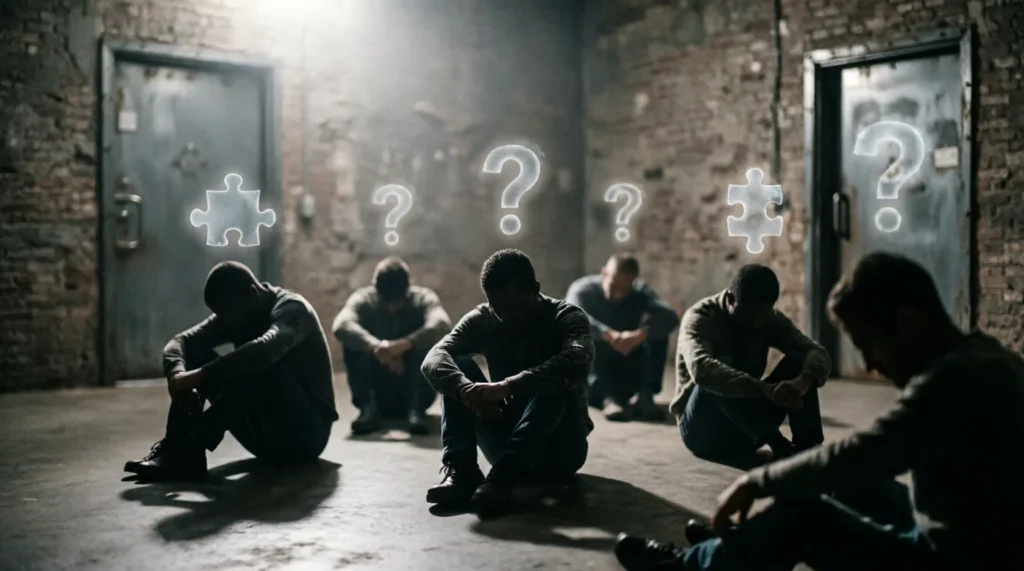
You have likely heard this brain teaser whispered around campfires or typed into search bars during a late-night puzzle binge. It sounds like a grim negotiation scenario, but it is actually a clever play on words and logic that has stumped countless people. This collection breaks down the famous “hostage” riddle, explores its variations, and provides a curated list of similar lateral-thinking puzzles to keep your mind sharp.
Top 5 Logic and Wordplay Riddles
These are the most popular riddles that rely on tricking your brain into overcomplicating simple answers. They are perfect for breaking the ice at parties or testing your friends’ lateral thinking skills.
I have no voice, yet I speak to you. I tell of all things in the world that people do. I have leaves, but I am not a tree. I have pages, but I am not a bride. I have a spine, but I am not a man. What am I? Answer: A book
The more you take, the more you leave behind. What am I? Answer: Footsteps
I speak without a mouth and hear without ears. I have no body, but I come alive with wind. What am I? Answer: An echo
What has keys but can’t open locks? Answer: A piano
I am always coming, but never arrive. What am I? Answer: Tomorrow
The Main Event: The Hostage Riddle Explained
This is the specific query that brings many puzzle enthusiasts here. The riddle usually goes like this: “A terrorist holds 10 hostages. He says he will release one hostage for every correct riddle answered. How many riddles must be answered to free all hostages?”
It sounds like a math problem, but it is a linguistic trap. Let us look at the logic.
If there are 10 hostages, and each requires one riddle to be freed, the intuitive answer is 10. However, the phrasing often tricks people into thinking about the act of asking versus the act of answering. In the standard version of this riddle, the answer is simply 10.
Why do people get this wrong? Often, they overthink the “terrorist” aspect, looking for a hidden moral dilemma or a trick where the last hostage is freed automatically. But in its purest logical form, it is a one-to-one ratio. According to Wikipedia, riddles often rely on ambiguity or double meanings, but this specific variant is less about wordplay and more about resisting the urge to find complexity where none exists.
However, there is a darker, more common variation involving a “guard” or a “jailer” that changes the count. If the riddle states, “I have 10 prisoners. I let one go for every riddle solved. How many riddles to free them all?” the answer remains 10. But if the riddle implies the questioner is also included in the count, or if the last person unlocks the door for the others, the answer might drop to 9.
For the standard “how many riddles for each hostage” query, stick with the direct interpretation: One riddle per hostage. If there are $N$ hostages, you need $N$ riddles.
Common Wrong Guesses
When I run this specific logic check with groups, the most common wrong answer is “9.” People argue that once 9 are free, the 10th can just walk out or that the terrorist stops counting. Another frequent error is “0,” based on the cynical view that terrorists do not keep promises. While funny, these miss the mathematical simplicity intended by the puzzle creator.
Easy Warm-Up Riddles
These are great for younger audiences or for getting everyone comfortable with the idea of thinking sideways. They have clear, concrete answers.
What has to be broken before you can use it? Answer: An egg
I’m tall when I’m young, and I’m short when I’m old. What am I? Answer: A candle
What month of the year has 28 days? Answer: All of them
What is full of holes but still holds water? Answer: A sponge
What question can you never answer yes to? Answer: Are you asleep?
What is always in front of you but can’t be seen? Answer: The future
Hard Brain Teasers
These require a bit more patience. I recommend giving your audience at least 30 seconds before offering a hint. These are the ones that make people groan when they hear the answer.
A man pushes his car to a hotel and tells the owner he’s bankrupt. Why? Answer: He is playing Monopoly
The person who makes it has no need of it; the person who buys it has no use for it. The person who uses it can neither see nor feel it. What is it? Answer: A coffin
I have cities, but no houses. I have mountains, but no trees. I have water, but no fish. What am I? Answer: A map
What can travel around the world while staying in a corner? Answer: A stamp
Forward I am heavy, but backward I am not. What am I? Answer: The word “ton”
Which letter of the alphabet has the most water? Answer: The C (sea)
Funny and Silly Riddles
Not all riddles need to be serious. These are designed to elicit a laugh rather than a furrowed brow. They work well as palate cleansers between the harder logic puzzles.
What do you call a fake noodle? Answer: An impasta
Why did the scarecrow win an award? Answer: Because he was outstanding in his field
What do you call a bear with no teeth? Answer: A gummy bear
How do you organize a space party? Answer: You planet
What do you call a fish wearing a bowtie? Answer: Sofishticated
Why don’t skeletons fight each other? Answer: They don’t have the guts
Tricky Wordplay Riddles
These rely heavily on the specific wording of the question. Pay attention to prepositions and homophones. This is where the “hostage” riddle fits best—among puzzles that trick you with language.
What occurs once in a minute, twice in a moment, but never in a thousand years? Answer: The letter M
What begins with T, ends with T, and has T in it? Answer: A teapot
If you drop me I’m sure to crack, but give me a smile and I’ll always smile back. What am I? Answer: A mirror
What has one eye, but can’t see? Answer: A needle
What has many needles, but doesn’t sew? Answer: A pine tree
What has a head and a tail but no body? Answer: A coin
Short and Snappy Riddles
Perfect for quick-fire rounds or when attention spans are short. These can be read and answered in under five seconds.
What goes up but never comes down? Answer: Your age
What has legs but doesn’t walk? Answer: A table
What has a neck but no head? Answer: A bottle
What has hands but can’t clap? Answer: A clock
What has a face and two hands but no arms or legs? Answer: A clock
What belongs to you, but other people use it more than you? Answer: Your name
How to Use These Riddles
Riddles are versatile tools for social interaction and education. Here are a few ways to integrate them into your next event.
- Dinner Party Icebreakers: Place a card with a riddle at each setting. Guests must solve it before they can start eating. It gets conversation flowing immediately.
- Classroom Critical Thinking: Teachers can use these to teach careful reading. The “hostage” riddle, for example, teaches students to avoid adding external assumptions to a problem statement.
- Scavenger Hunts: Hide clues around the house or park. Each clue is a riddle that leads to the next location. The final prize could be a “release” from a playful “hostage” situation (like being tied to a chair with streamers).
- Road Trip Entertainment: Keep kids engaged in the back seat. The “Easy” and “Funny” sections are best for this, as they provide quick wins and keep morale high.
According to historical records on Hostage situations, real-life negotiations are complex and dangerous, which is why fictional riddles provide a safe, controlled environment to explore themes of captivity and release through logic rather than force.
Frequently Asked Questions
What is the answer to the “how many riddles for each hostage” puzzle? The standard answer is one riddle per hostage. If there are 10 hostages, 10 riddles must be answered. It is a test of simple arithmetic disguised as a complex ethical dilemma.
Are riddles good for brain health? Yes. Solving riddles engages lateral thinking, improves vocabulary, and enhances problem-solving skills. They force the brain to make new connections between unrelated concepts, which is a key component of cognitive flexibility.
What is the difference between a riddle and a puzzle? A puzzle is generally a problem to be solved through logic or pattern recognition, often with visual or physical components. A riddle is specifically a verbal or textual question that relies on wordplay, double meanings, or metaphorical descriptions to obscure the answer.
How can I make my own riddles? Start with an ordinary object. List its characteristics, then describe those characteristics using metaphors or opposites. For example, instead of saying “it has pages,” say “it has leaves but is not a tree.” Test it on friends to ensure it is solvable but not obvious.

William Williams holds a master’s degree in Linguistics from Oxford University and has dedicated over 15 years to exploring the intricate world of riddles and brain teasers. Known for his deep understanding of wordplay and semantics, William specializes in crafting language-based challenges that test the limits of logical thinking. His passion for puzzles was sparked by a childhood love of crosswords and cryptic clues, leading him to a career filled with curiosity and creativity. At RiddleMeHub, William focuses on creating content that not only entertains but also educates, offering readers insights into the history and methodologies behind classic riddles. His articles often dive into the etymology of words used in brain teasers and how they enhance cognitive skills. With a knack for storytelling, he weaves narratives into his riddles, engaging audiences of all ages. As a senior contributor, William continually pushes the boundaries of traditional riddles while maintaining a respect for their time-honored roots.