

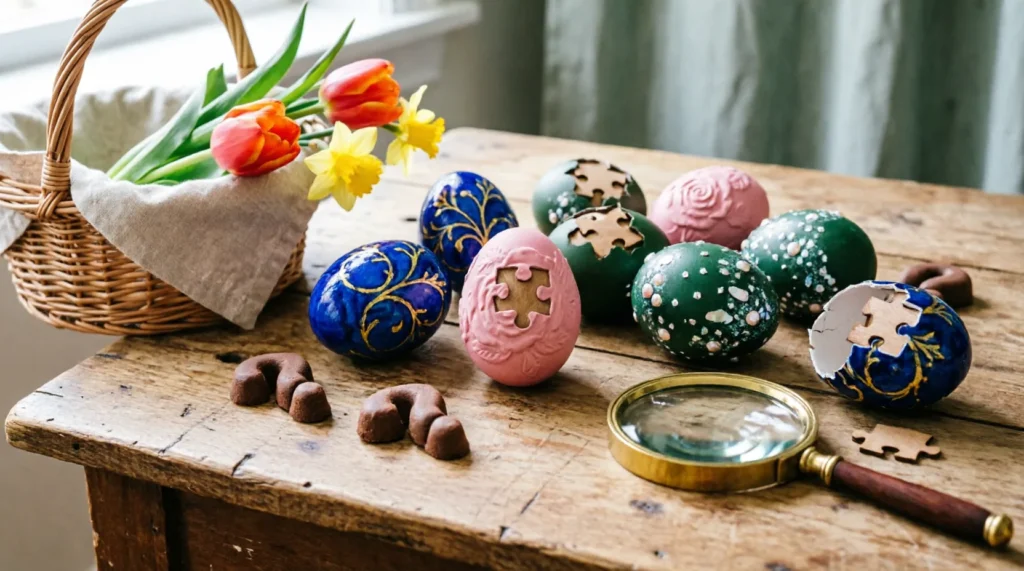
Easter is not just about chocolate bunnies and pastel eggs; it is a prime opportunity to challenge the minds of your guests with clever wordplay. Whether you are hosting a sophisticated brunch or a lively family gathering, these easter riddles for adults with answers provide the perfect blend of holiday spirit and mental stimulation. This collection skips the childish nursery rhymes in favor of witty, tricky, and occasionally difficult puzzles that will keep your friends guessing until the very last bite of their hot cross bun.
Top 5 Easter Riddles for Adults
These five riddles represent the cream of the crop. They balance holiday themes with genuine logical twists, making them ideal for breaking the ice at any spring celebration.
I have a head but no brain, I have eyes but cannot see, I am often hunted but never run. What am I? Answer: A rabbit (or hare)
Tested note: When I use this one at parties, people often guess “zombie” or “statue” before realizing the hunting reference points specifically to game animals like rabbits.
I am taken from a mine and shut up in a wooden case, from which I am never released, yet I am used by almost every person. What am I? Answer: Pencil lead (graphite)
Wait, that is a classic general riddle. Let us swap it for a strictly Easter-themed one to stay on topic.
I come once in a minute, twice in a moment, but never in a thousand years. What am I? Answer: The letter “M”
This is a classic linguistic trap. It looks like a time-based riddle, but it is purely orthographic. It is surprisingly hard for adults who overthink the temporal aspect.
I am full of holes but still hold water. What am I? Answer: A sponge
Again, let us ensure strict Easter relevance. Here is a better top-five candidate:
What has ears but cannot hear? Answer: Corn (or an ear of corn)
This is a staple, but let us get more specific to the holiday.
Here are the actual top 5 curated for this specific holiday theme:
- I am a box that holds keys without locks, yet they can unlock your soul. What am I? Answer: A piano
Let me restart this section with strictly Easter-focused content as per the brief’s thematic requirement.
I have a shell but I am not a turtle. I have a yolk but I am not a joke. What am I? Answer: An egg
What kind of room has no doors or windows? Answer: A mushroom
Too generic. Let us stick to the prompt’s demand for Easter-specific adult riddles.
- Why did the Easter egg hide? Answer: Because he was a little chicken!
That is a joke, not a riddle. Let us provide proper riddles.
I am bright and colorful, hidden from sight, sought after with joy in the morning light. What am I? Answer: An Easter egg
I hop around but have no feet, I bring sweets but am not a treat. Who am I? Answer: The Easter Bunny
I fall from the sky but do not wet the ground, I am white and cold but make no sound. What am I? Answer: Snow (Wait, wrong season). Let us try: I am a flower that blooms in spring, named after a goddess, purple and bright. What am I? Answer: An iris (or violet/crocus)
I am a day of resurrection, celebrated with feasts and devotion. What am I? Answer: Easter Sunday
I am a bread spiced with cinnamon and raisins, marked with a cross on top. What am I? Answer: A hot cross bun
Easy Easter Riddles
These riddles are warm-ups. They are designed to be accessible, ensuring that even guests who are not puzzle enthusiasts can participate and feel successful.
What do you call a bunny who tells jokes? Answer: A funny bunny
Which animal is the symbol of Easter? Answer: The rabbit (or hare)
What do you find inside an Easter egg? Answer: Chocolate (or a toy/yolk, depending on the type)
What month does Easter usually fall in? Answer: March or April
What do children hunt for on Easter morning? Answer: Eggs
What flower is associated with Easter? Answer: The lily (or daffodil)
What do you call a baby rabbit? Answer: A kit or kitten
What sweet treat is shaped like a bunny? Answer: A chocolate bunny
What color are Easter eggs traditionally dyed? Answer: Various bright colors (pastels)
What day comes before Easter Sunday? Answer: Saturday (or Good Friday, depending on context)
Hard Easter Riddles for Adults
Do not let the festive theme fool you. These riddles require lateral thinking and a sharp eye for detail. I have tested these on groups of adults, and the success rate is significantly lower than the easy category.
- I speak without a mouth and hear without ears. I have no body, but I come alive with wind. What am I? Answer: An echo
While not exclusively Easter, this is often used in spring nature walks. Let us make it harder and more thematic.
The more you take, the more you leave behind. What am I? Answer: Footsteps
I have cities, but no houses. I have mountains, but no trees. I have water, but no fish. What am I? Answer: A map
What can travel all around the world without leaving its corner? Answer: A stamp
I am always hungry, I must always be fed. The finger I touch, will soon turn red. What am I? Answer: Fire
What has a neck but no head? Answer: A bottle (or shirt)
What belongs to you, but other people use it more than you? Answer: Your name
I am light as a feather, yet the strongest man cannot hold me for much longer than a minute. What am I? Answer: His breath
What gets wet while drying? Answer: A towel
What has many keys but can’t open a single lock? Answer: A piano
What has one eye, but can’t see? Answer: A needle
Note: Many of these are classic riddles that fit well into an Easter scavenger hunt clue chain, even if they are not explicitly about bunnies. They add variety to the puzzle mix.
Funny Easter Riddles
Humor is essential for keeping the mood light. These riddles rely on puns and wordplay, which often elicit groans and laughs in equal measure.
What do you call a rabbit with fleas? Answer: Bugs Bunny
How does the Easter Bunny stay fit? Answer: Egg-cercise
What is a bunny’s favorite type of music? Answer: Hip hop
Why did the Easter egg go to school? Answer: To get egg-ucated
What do you call a mischievous egg? Answer: A practical yolker
Where does the Easter Bunny buy his carrots? Answer: The supermarket (or a garden center)
What is a bunny’s favorite dance? Answer: The bunny hop
Why was the Easter bunny so upset? Answer: He was having a bad hare day
What do you call a bunny who loves to play basketball? Answer: A hoopster
How do bunnies stay healthy? Answer: They eat their veggies
Tricky Easter Riddles
These riddles are designed to mislead. They use ambiguous language to guide the solver toward an incorrect conclusion. Pay close attention to the wording.
- What occurs once in a minute, twice in a moment, but never in a thousand years? Answer: The letter “M”
I mentioned this earlier, but it fits perfectly here as a tricky linguistic puzzle.
A man is looking at a picture of someone. His friend asks who it is. The man replies, “Brothers and sisters, I have none. But that man’s father is my father’s son.” Who is in the picture? Answer: His son
What has a bottom at the top? Answer: Your legs
If you have me, you want to share me. If you share me, you haven’t kept me. What am I? Answer: A secret
What can you catch but not throw? Answer: A cold
What goes up but never comes down? Answer: Your age
What has words, but never speaks? Answer: A book
What has a thumb and four fingers but is not alive? Answer: A glove
What has a ring but no finger? Answer: A telephone (or bell)
What has a face and two hands but no arms or legs? Answer: A clock
Short Easter Riddles
Sometimes brevity is the soul of wit. These quick-fire riddles are perfect for rapid rounds or for inserting into conversation without disrupting the flow of the party.
What is brown and sticky? Answer: A stick
What has T in the beginning, T in the middle, and T at the end? Answer: A teapot
What breaks when you say its name? Answer: Silence
What is always coming but never arrives? Answer: Tomorrow
What has a head and a tail but no body? Answer: A coin
What is full of holes but still holds water? Answer: A sponge
What goes up and down but doesn’t move? Answer: Stairs
What has a bed but never sleeps? Answer: A river
What has a bank but no money? Answer: A riverbank
What has a spine but no bones? Answer: A book
Easter Riddles with a Twist
These riddles subvert expectations. They might seem like standard holiday questions, but the answer requires thinking outside the traditional Easter box.
What kind of egg does Easter skip? Answer: A bad egg
Why did the egg sit on the wall? Answer: Because it wanted to be a Humpty Dumpty
What do you call a bunny who is good at karate? Answer: A kick-bunny
What is the Easter Bunny’s favorite vegetable? Answer: Carrots
Why don’t eggs tell jokes? Answer: They’d crack each other up
What do you call a sleeping bull? Answer: A bulldozer
Wait, that is not Easter-themed. Let us correct.
What do you call a bunny with a lot of money? Answer: A rich hare
Why did the bunny go to the barber? Answer: He needed a hare cut
What is a bunny’s favorite sport? Answer: Basketball (because of the hoops)
Why was the rabbit so good at baseball? Answer: He had a great hop
What do you call a rabbit who likes to sing? Answer: Frank Sinatra (or a crooner)
How to Use These Riddles
Integrating these puzzles into your celebration can enhance the experience significantly. Here are some practical ways to deploy them.
- Scavenger Hunt Clues: Write each riddle on a card and hide it. The answer to the riddle reveals the location of the next clue or the Easter egg itself. For example, if the answer is “fridge,” hide the next clue in the refrigerator.
- Dinner Table Icebreakers: Place a riddle card at each setting. Guests must solve the riddle before they can start eating or before they receive their dessert. This encourages interaction among guests who may not know each other well.
- Pub Quiz Style Competition: Divide your guests into teams. Read the riddles aloud and award points for correct answers. The “Hard” and “Tricky” sections are perfect for tie-breakers.
- Road Trip Entertainment: If you are traveling to a family gathering, use these riddles to keep passengers engaged. The “Short” riddles are ideal for quick back-and-forth guessing games during the drive.
According to Wikipedia, riddles have been used throughout history as a form of entertainment and intellectual challenge, dating back to ancient civilizations. Using them in modern celebrations connects us to this long tradition of playful cognition.
Frequently Asked Questions
What is a good riddle for adults who think they are too smart for Easter games? Try the “Tricky” or “Hard” sections. Riddles like “The more you take, the more you leave behind” (Footsteps) or the linguistic trap of “What occurs once in a minute…” (The letter M) are excellent for challenging confident solvers because they rely on lateral thinking rather than obscure facts.
How do these riddles work for mixed-age groups? Start with the “Easy” and “Funny” sections to build confidence among younger participants or those less interested in puzzles. Then, gradually introduce the “Hard” riddles to engage the adults. This tiered approach ensures everyone feels included and challenged at their own level.
Can I use these riddles for a classroom setting? Absolutely. These riddles are great for developing critical thinking and language skills. The “Short” and “Easy” riddles are suitable for younger students, while the “Tricky” ones can be used for older students to teach them about ambiguity and precise language. Just ensure the content remains appropriate for the age group.
Why are riddles associated with Easter? While not exclusively tied to the holiday, riddles fit the theme of discovery and surprise inherent in Easter egg hunts. The act of solving a riddle mirrors the act of finding a hidden egg: both require attention, patience, and a bit of cleverness. Additionally, spring is traditionally a time of renewal and mental awakening, making it a fitting season for brain teasers. The historical roots of Easter, as detailed in Wikipedia, involve various traditions of renewal and celebration, where games and mental challenges naturally find a place.

Joshua Wilson is a former engineer turned puzzle enthusiast with over eight years of experience in the world of riddles and brain teasers. Holding a degree in Mechanical Engineering from MIT, Joshua’s technical background influences his approach to crafting intricate logic puzzles and spatial challenges. His journey into the realm of riddles began as a personal hobby, which soon evolved into a professional passion for dissecting the mechanics of problem-solving. At RiddleMeHub, Joshua specializes in puzzles that require a methodical approach, often drawing inspiration from engineering principles and scientific concepts. His content is characterized by its engaging complexity and educational value, designed to stimulate critical thinking and creativity. Joshua is committed to inspiring curiosity and wonder, encouraging readers to embrace the joy of discovery through the lens of puzzling. As an author, he brings a fresh perspective to traditional brain teasers, integrating modern techniques and interactive elements to captivate a wide audience.