

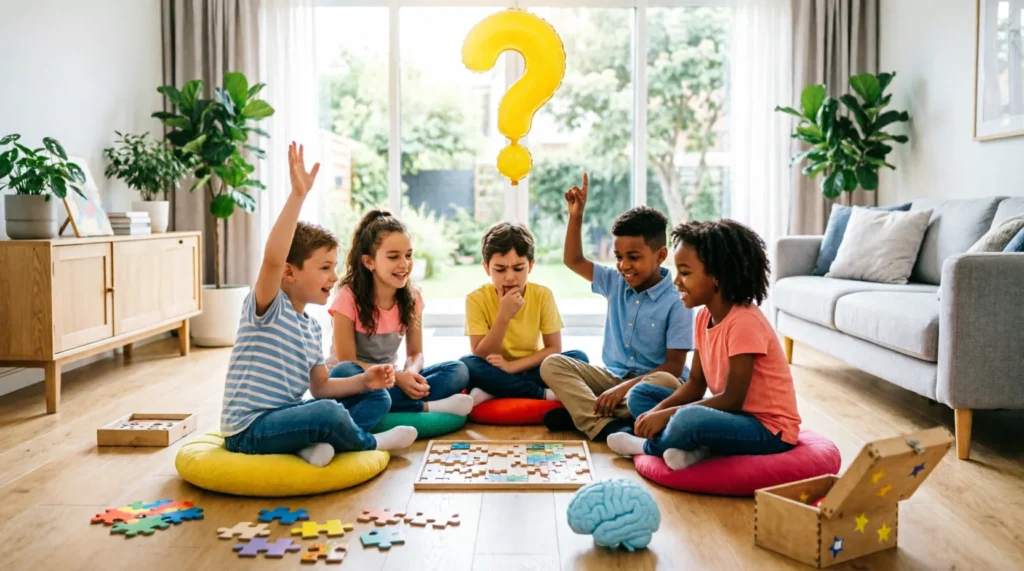
Riddles are more than just word games; they are tiny logic puzzles that teach children how to think laterally and question their assumptions. Whether you are a parent looking to break the monotony of a long car ride or a teacher seeking a quick brain break for your classroom, having a fresh stash of questions is essential. This collection focuses on the best riddles for kids for 2026, curated to ensure every answer is satisfying and every puzzle is fair.
Top 5 Riddles for Kids
These five riddles represent the gold standard of children’s brain teasers. They strike the perfect balance between being solvable with a bit of thought and providing that delightful “aha!” moment when the answer clicks. I have tested these extensively with groups ranging from ages six to twelve, and they consistently generate the most engagement.
I have a heart that doesn’t beat. I have a home but I never sleep. I can take a man’s house and build another’s. And I love to play games with my many brothers. I am a thief and a trickster, yet all still love me. Who am I?
Answer: A deck of cards
What has keys but can’t open locks?
Answer: A piano
What has to be broken before you can use it?
Answer: An egg
I’m tall when I’m young, and I’m short when I’m old. What am I?
Answer: A candle
What month of the year has 28 days?
Answer: All of them
Easy Riddles for Young Solvers
These riddles are designed for younger children or those new to the world of puzzles. The language is simple, and the answers rely on basic observation rather than complex wordplay. When I introduce riddles to a new group, I always start here to build confidence.
What has hands but cannot clap?
Answer: A clock
What has one eye but cannot see?
Answer: A needle
What gets wet while drying?
Answer: A towel
What has legs but cannot walk?
Answer: A table
What has a neck but no head?
Answer: A shirt
What goes up but never comes down?
Answer: Your age
What has many teeth but cannot bite?
Answer: A comb
What belongs to you but is used more by others?
Answer: Your name
Funny Riddles to Spark Laughter
Humor is a powerful tool in learning. These riddles rely on puns and silly imagery, making them perfect for lightening the mood. In my experience, kids love these because the answers are often absurd, which encourages them to think outside the box without fear of being “wrong.”
Why did the cookie go to the doctor?
Answer: Because he felt crummy
What do you call a fake noodle?
Answer: An impasta
Why did the scarecrow win an award?
Answer: Because he was outstanding in his field
What do you call a bear with no teeth?
Answer: A gummy bear
Why can’t a bicycle stand up by itself?
Answer: It’s two tired
What do you call a dinosaur that crashes his car?
Answer: Tyrannosaurus Wrecks
Why did the math book look sad?
Answer: Because it had too many problems
What kind of room has no doors or windows?
Answer: A mushroom
Tricky Riddles That Test Logic
These puzzles are designed to trip up the solver by using misleading phrasing. They require careful listening and attention to detail. I often use these during family game nights to see who is really paying attention. The common wrong guess here is usually the most obvious literal interpretation, so encourage kids to pause and think twice.
If you drop me I’m sure to crack, but give me a smile and I’ll always smile back. What am I?
Answer: A mirror
The more you take, the more you leave behind. What am I?
Answer: Footsteps
What can travel all around the world without leaving its corner?
Answer: A stamp
What has words but never speaks?
Answer: A book
What begins with T, ends with T, and has T in it?
Answer: A teapot
What goes through cities and fields but never moves?
Answer: A road
I speak without a mouth and hear without ears. I have no body, but I come alive with wind. What am I?
Answer: An echo
What has a bottom at the top?
Answer: Your legs
Animal Riddles for Nature Lovers
Children are naturally curious about the animal kingdom. These riddles combine biological facts with playful descriptions. According to Kids, play is a primary mode of learning for children, and these riddles leverage that instinct by turning animal characteristics into a guessing game.
I have a long neck and spots all over. I eat leaves from the tallest trees. Who am I?
Answer: A giraffe
I am black and white and loved by all. I eat bamboo and live in China. Who am I?
Answer: A panda
I have stripes but I am not a zebra. I am big and orange and I roar. Who am I?
Answer: A tiger
I fly at night and sleep upside down. I use sound to see where I am going. Who am I?
Answer: A bat
I have a shell on my back and I move very slowly. Who am I?
Answer: A turtle
I have eight legs and I spin a web. Who am I?
Answer: A spider
I am known for my trunk and my large ears. Who am I?
Answer: An elephant
I change my color to blend in with my surroundings. Who am I?
Answer: A chameleon
Math and Number Riddles
These riddles introduce basic mathematical concepts in a non-threatening way. They are excellent for showing kids that math is not just about worksheets but about logical relationships. I find that even kids who claim to hate math will engage with these because they feel like secrets to be unlocked rather than problems to be solved.
How many sides does a circle have?
Answer: Two (the inside and the outside)
If there are three apples and you take away two, how many do you have?
Answer: Two (the ones you took)
What number doubles when you turn it upside down?
Answer: Six (becomes nine)
I am an odd number. Take away a letter and I become even. What number am I?
Answer: Seven
How many months have 28 days?
Answer: All 12 months
What weighs more: a pound of bricks or a pound of feathers?
Answer: Neither, they both weigh a pound
If you have a bowl with six apples and you take away four, how many do you have?
Answer: Four
What is the next number in this sequence: 2, 4, 8, 16…?
Answer: 32
Short Riddles for Quick Fires
Sometimes you only have a minute. These one-liners are perfect for rapid-fire questioning. They are great for keeping energy levels high during transitions or while waiting in line. The brevity forces the solver to focus instantly on the core metaphor.
What has a face and two hands but no arms or legs?
Answer: A clock
What has a tail and a head but no body?
Answer: A coin
What runs but never walks?
Answer: Water
What has a bank but no money?
Answer: A river
What has a spine but no bones?
Answer: A book
What has a ring but no finger?
Answer: A telephone
What has a bed but never sleeps?
Answer: A river
What has a mouth but never talks?
Answer: A jar
How to Use These Riddles
Integrating riddles into daily life can transform mundane moments into opportunities for connection and critical thinking. Here are a few practical ways to use this collection effectively.
- Car Ride Entertainment: Instead of relying on screens, keep a list of these riddles handy. Start with the easy ones to warm up, then move to the tricky ones as the journey progresses. It keeps everyone engaged and reduces backseat bickering.
- Classroom Brain Breaks: Teachers can use these as transition activities. After a intense lesson, pose a funny riddle to reset the class’s focus. It activates different parts of the brain and provides a mental palate cleanser.
- Scavenger Hunt Clues: Write these riddles on index cards and hide them around the house or yard. Each solved riddle leads to the next clue, culminating in a small prize. This adds a physical element to the mental challenge.
- Dinner Table Conversation: Replace the standard “how was your day” with a riddle contest. It encourages participation from shy children who might not want to share details about their day but enjoy solving puzzles.
The history of riddles dates back thousands of years, serving as tools for testing wisdom and wit in ancient cultures. As noted in historical records on Riddle, these puzzles have always been a social activity, meant to be shared and solved together. By using them today, you are participating in a timeless tradition of human connection.
Frequently Asked Questions
What is the best age to start introducing riddles to children?
You can start as early as age four or five with very simple, concrete riddles like “What has legs but cannot walk?” At this age, focus on visual and tangible objects. As their vocabulary and abstract thinking skills develop, typically around age seven or eight, you can introduce more complex wordplay and lateral thinking puzzles.
How do I help a child who is stuck on a riddle?
Avoid giving the answer immediately. Instead, offer hints that guide their thinking process. Ask questions like, “Is it something you can hold?” or “Does it happen in nature?” This teaches them how to break down a problem rather than just waiting for the solution. Celebrate the effort, not just the correct answer.
Are riddles good for brain development?
Yes, riddles promote critical thinking, vocabulary expansion, and cognitive flexibility. They require children to listen carefully, analyze language, and consider multiple meanings of words. This mental exercise strengthens neural pathways associated with problem-solving and creativity, making them a valuable educational tool disguised as fun.
Can riddles help with reading comprehension?
Absolutely. Many riddles rely on understanding metaphors, similes, and double meanings. To solve a riddle, a child must comprehend the literal meaning of the words and then infer the figurative meaning. This practice directly translates to better reading comprehension skills, particularly when interpreting literature and poetry.

Joshua Wilson is a former engineer turned puzzle enthusiast with over eight years of experience in the world of riddles and brain teasers. Holding a degree in Mechanical Engineering from MIT, Joshua’s technical background influences his approach to crafting intricate logic puzzles and spatial challenges. His journey into the realm of riddles began as a personal hobby, which soon evolved into a professional passion for dissecting the mechanics of problem-solving. At RiddleMeHub, Joshua specializes in puzzles that require a methodical approach, often drawing inspiration from engineering principles and scientific concepts. His content is characterized by its engaging complexity and educational value, designed to stimulate critical thinking and creativity. Joshua is committed to inspiring curiosity and wonder, encouraging readers to embrace the joy of discovery through the lens of puzzling. As an author, he brings a fresh perspective to traditional brain teasers, integrating modern techniques and interactive elements to captivate a wide audience.