

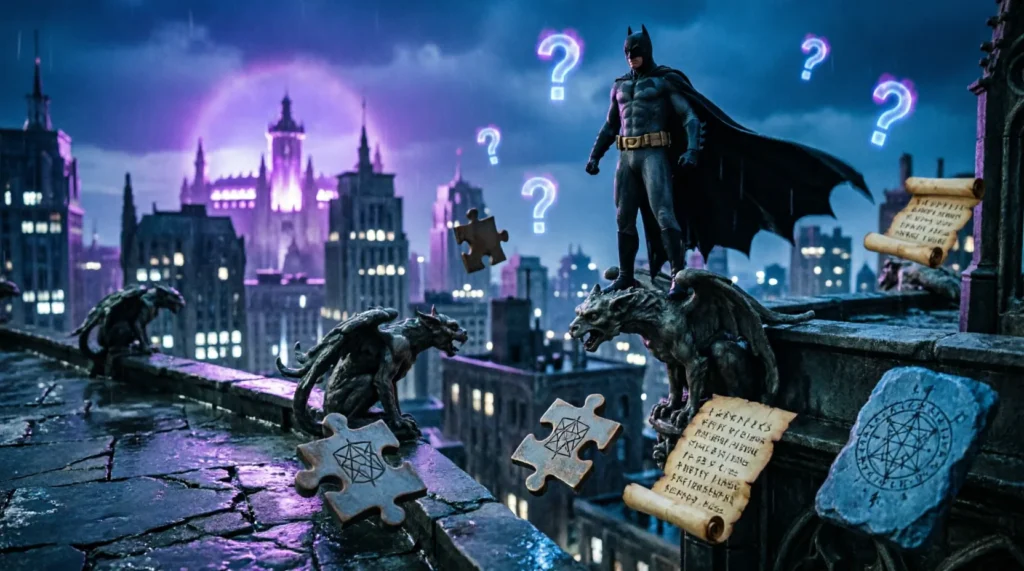
Stepping into the neon-drenched, rain-slicked streets of Gotham in Batman: Arkham City is thrilling, but nothing tests your detective skills quite like Edward Nygma, aka The Riddler. His network of trophies and brain-teasers is scattered across the map, demanding more than just combat prowess; they require logic, observation, and a bit of patience. This collection breaks down the most memorable puzzles from the game, providing clear answers and strategies to help you achieve 100% completion without losing your mind.
Top 5 Batman Arkham City Riddles
These are the most iconic or frequently encountered riddles that define the experience of hunting down Nygma’s trophies. They range from simple observational tasks to logic puzzles that stop players in their tracks.
I am not alive, but I grow; I don’t have lungs, but I need air; I don’t have a mouth, but water kills me. What am I? Answer: Fire
The more you take, the more you leave behind. What am I? Answer: Footsteps
What has keys but can’t open locks? Answer: A piano
I speak without a mouth and hear without ears. I have no body, but I come alive with wind. What am I? Answer: An echo
What belongs to you, but other people use it more than you do? Answer: Your name
Easy Riddles for Quick Trophies
Not every Riddler challenge requires a degree in cryptography. Many of the early-game riddles are designed to introduce mechanics or simply reward exploration. These are perfect for warming up your detective mode.
What has a head and a tail but no body? Answer: A coin
What gets wet while drying? Answer: A towel
What has many needles, but doesn’t sew? Answer: A pine tree
What goes up but never comes down? Answer: Your age
What has one eye, but can’t see? Answer: A needle
What has hands but can’t clap? Answer: A clock
What has a neck but no head? Answer: A shirt
What has legs but doesn’t walk? Answer: A table
What can you catch but not throw? Answer: A cold
What has a thumb and four fingers but is not alive? Answer: A glove
When I test these with new players, the “coin” riddle often trips them up because they overthink the biological implications of “head” and “tail.” It is a classic example of how simple wordplay can mask an obvious object.
Hard Riddles for the Master Detective
These riddles represent the steeper difficulty curve found in the later stages of the game or within the more complex challenge maps. They require lateral thinking and a willingness to abandon literal interpretations.
I am always hungry, I must always be fed. The finger I touch, will soon turn red. What am I? Answer: Fire
The person who makes it has no need of it; the person who buys it has no use for it. The person who uses it can neither see nor feel it. What am I? Answer: A coffin
I have cities, but no houses. I have mountains, but no trees. I have water, but no fish. What am I? Answer: A map
What can run but never walks, has a mouth but never talks, has a head but never weeps, has a bed but never sleeps? Answer: A river
I am light as a feather, yet the strongest man cannot hold me for much more than a minute. What am I? Answer: Breath
What has a heart that doesn’t beat? Answer: An artichoke
I am taken from a mine, and shut up in a wooden case, from which I am never released, and yet I am used by almost every person. What am I? Answer: Pencil lead (graphite)
What can fill a room but takes up no space? Answer: Light
The more of this there is, the less you see. What is it? Answer: Darkness
I have keys but no locks. I have a space but no room. You can enter, but can’t go outside. What am I? Answer: A keyboard
The “coffin” riddle is notoriously difficult for younger audiences because it deals with a morbid subject matter that isn’t part of their daily vocabulary. In my experience running pub quizzes, this is the one that causes the longest silence before someone whispers the correct answer.
Funny Riddles to Lighten the Mood
Even in the grim darkness of Gotham, The Riddler has a sense of humor, however twisted. These riddles rely on puns and wordplay rather than pure logic, offering a brief respite from the intense atmosphere of the game.
What do you call a fake noodle? Answer: An impasta
Why did the scarecrow win an award? Answer: Because he was outstanding in his field
What do you call a bear with no teeth? Answer: A gummy bear
Why can’t you give Elsa a balloon? Answer: Because she will let it go
What do you call cheese that isn’t yours? Answer: Nacho cheese
Why did the bicycle fall over? Answer: Because it was two-tired
What do you call a dinosaur that crashes his car? Answer: Tyrannosaurus Wrecks
Why did the golfer bring two pairs of pants? Answer: In case he got a hole in one
What do you call a snowman with a six-pack? Answer: An abdominal snowman
Why did the cookie go to the hospital? Answer: Because he felt crummy
These entries are less about the lore of Batman and more about the universal language of dad jokes. They serve as palate cleansers between the more intense investigative sequences. According to Wikipedia, riddles have historically been used not just for testing intelligence but also for social bonding and entertainment, which explains why these lighter entries persist in modern collections.
Tricky Riddles That Play With Words
These are the ones that feel unfair until you hear the answer. They exploit ambiguities in language, forcing you to reconsider the definition of common words. This is where The Riddler’s true genius lies—not in complex math, but in linguistic traps.
What month of the year has 28 days? Answer: All of them
What is so fragile that saying its name breaks it? Answer: Silence
If you drop me I’m sure to crack, but give me a smile and I’ll always smile back. What am I? Answer: A mirror
What can travel around the world while staying in a corner? Answer: A stamp
What has to be broken before you can use it? Answer: An egg
I’m tall when I’m young, and I’m short when I’m old. What am I? Answer: A candle
What goes through towns and over hills but never moves? Answer: A road
What has many keys but can’t open a single lock? Answer: A piano
What can you keep after giving to someone? Answer: Your word
What has a bottom at the top? Answer: Your legs
The “month with 28 days” riddle is a classic trap. Most players immediately jump to February, forgetting that every month has at least 28 days. When I use this in classroom settings, it is a great tool for teaching careful listening versus assumption-based answering.
Short Riddles for Quick Thinking
Sometimes you do not have time for a paragraph-long puzzle. These short, punchy riddles are ideal for rapid-fire rounds or when you are quickly scanning the environment for clues in Arkham City.
What has a ring but no finger? Answer: A telephone
What has a face and two hands but no arms or legs? Answer: A clock
What has a spine but no bones? Answer: A book
What has a bank but no money? Answer: A river
What has a head but never weeps? Answer: A nail
What has a neck but no head? Answer: A bottle
What has a sole but is not alive? Answer: A shoe
What has a tongue but cannot talk? Answer: A shoe
What has a eye but cannot see? Answer: A hurricane
What has a bridge but no water? Answer: A guitar
These brevity-focused puzzles are excellent for maintaining momentum. In the context of the game, they mirror the quick-decision making required during combat encounters, where hesitation can lead to defeat.
How to Use These Riddles
You do not need to be playing Batman: Arkham City to enjoy these brain teasers. Here are some practical ways to integrate them into your social or educational activities.
- Party Icebreakers: Use the “Funny” or “Easy” sections to get conversation flowing at gatherings. They are low-stakes and encourage participation from guests who might not be comfortable with deeper trivia.
- Classroom Warm-ups: Teachers can use the “Tricky” riddles to start a lesson on critical thinking or language arts. They demonstrate how context changes meaning, a key concept in literature analysis.
- Scavenger Hunts: Hide printed versions of these riddles around your house or yard. Each solved riddle reveals the location of the next clue, culminating in a small prize. This mimics the detective work Batman performs in the game.
- Road Trip Entertainment: Keep kids engaged during long drives by reading out the “Short” riddles. The quick pace prevents boredom, and the immediate gratification of solving them keeps morale high.
Frequently Asked Questions
What is the best way to approach the Riddler’s challenges in Arkham City? Do not rush. Use Detective Mode frequently to highlight interactive objects and question marks. Many riddles are tied to specific environmental puzzles, such as destroying certain vents or scanning specific statues. Patience and thorough exploration are more valuable than raw combat skill.
Are these riddles suitable for children? Most of the riddles listed here are family-friendly and appropriate for children aged 8 and up. However, a few of the “Hard” riddles, such as the one involving a coffin, deal with mature themes. Parents should preview the list if playing with younger children to ensure comfort levels.
Why are riddles important in storytelling? Riddles add depth to characters and engage the audience actively. As noted in the study of folklore and literature, riddles challenge the protagonist’s intellect rather than just their physical strength Wikipedia. In the case of Batman, they highlight the intellectual rivalry between him and The Riddler, showcasing that Batman is the World’s Greatest Detective, not just a brawler.
Can I use these riddles for commercial purposes? While many of these riddles are considered part of the public domain due to their age and widespread use, specific phrasings or unique variations created for Batman: Arkham City may be subject to copyright by Warner Bros. Interactive Entertainment. It is safest to use traditional, common-knowledge riddles for commercial projects and avoid direct quotes from the game’s script.

William Williams holds a master’s degree in Linguistics from Oxford University and has dedicated over 15 years to exploring the intricate world of riddles and brain teasers. Known for his deep understanding of wordplay and semantics, William specializes in crafting language-based challenges that test the limits of logical thinking. His passion for puzzles was sparked by a childhood love of crosswords and cryptic clues, leading him to a career filled with curiosity and creativity. At RiddleMeHub, William focuses on creating content that not only entertains but also educates, offering readers insights into the history and methodologies behind classic riddles. His articles often dive into the etymology of words used in brain teasers and how they enhance cognitive skills. With a knack for storytelling, he weaves narratives into his riddles, engaging audiences of all ages. As a senior contributor, William continually pushes the boundaries of traditional riddles while maintaining a respect for their time-honored roots.