

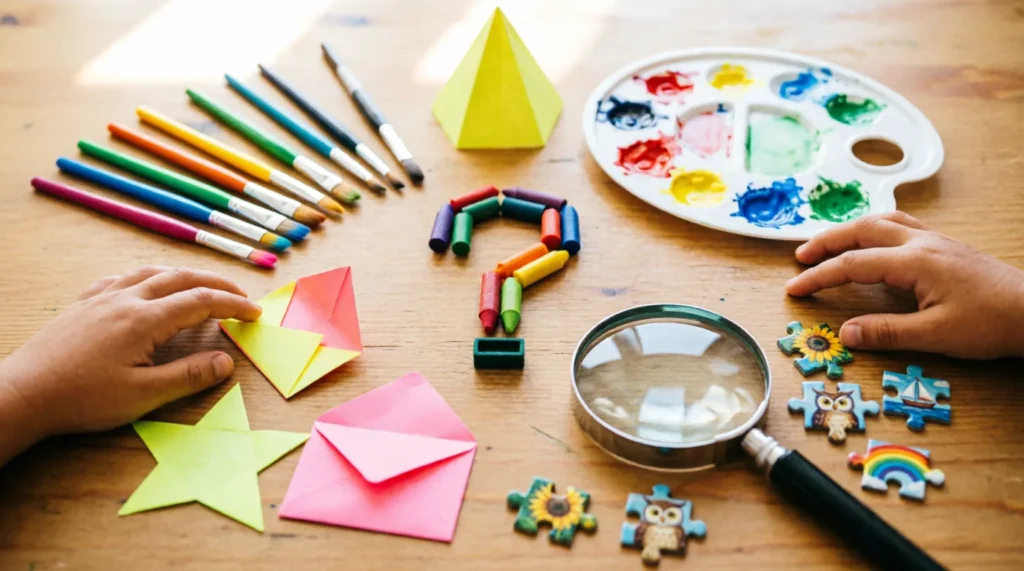
Get ready to paint a picture in your mind with these clever art riddles for kids with answers. Whether you are an art teacher looking for a warm-up activity or a parent planning a museum-themed birthday party, this collection blends creativity with critical thinking. These puzzles celebrate colors, famous artists, and the tools of the trade, making them perfect for young minds who love to create and guess.
Top 5 Art Riddles for Kids
Here are the five most popular and engaging riddles to kick off your creative session. These cover the basics of art supplies and concepts that every young artist should know.
I have no voice, but I can tell you a story. I have no legs, but I can take you on a journey. You need me to start, but you decide when I’m done. What am I? Answer: A canvas
I come in a tube or a jar. I can be mixed to make new shades. If you spill me on your shirt, your mom might not be happy. What am I? Answer: Paint
Tested note: When I use this one with elementary students, they almost always guess “glue” first because of the mess factor. It’s a great way to talk about the difference between adhesives and pigments.
I have keys but no locks. I have space but no room. You can enter, but you can’t go inside. What am I? (Hint: Think about digital art!) Answer: A keyboard
I am flat and thin. I hold many colors at once. Artists hold me in one hand while they work with the other. What am I? Answer: A palette
I can be rough or smooth. I can be white or colored. You draw on me with pencils or crayons. What am I? Answer: Paper
Easy Art Riddles for Beginners
These riddles are perfect for younger children or those just starting to explore the world of creativity. They focus on common objects found in any art classroom.
I have a point but I am not sharp. I leave a mark that can be erased. What am I? Answer: A pencil
I am wet and sticky. I help stick paper together. What am I? Answer: Glue
I come in many shapes and sizes. You use me to cut paper or fabric. What am I? Answer: Scissors
I am long and thin. I come in many colors. You use me to color inside the lines. What am I? Answer: A crayon
I am soft and squishy. You can mold me into any shape. I dry out if you leave me uncovered. What am I? Answer: Clay
I have bristles and a handle. You dip me in water or paint. What am I? Answer: A paintbrush
I am used to clean up mistakes. I am often pink or white. What am I? Answer: An eraser
I protect your clothes from paint. You wear me like a cape. What am I? Answer: An apron
I am a container for water. You use me to rinse your brushes. What am I? Answer: A water cup
I am a book with blank pages. You fill me with your drawings. What am I? Answer: A sketchbook
Famous Artist and Style Riddles
Once kids master the tools, they can guess the masters. These riddles introduce historical figures and movements in a fun, accessible way. According to Wikipedia, art history is a vast field, but these clues simplify the biggest names for young learners.
I painted a lady with a mysterious smile. I lived in Italy a long time ago. Who am I? Answer: Leonardo da Vinci
I cut off part of my ear. I painted starry nights and sunflowers. Who am I? Answer: Vincent van Gogh For more, see Riddle.
Tested note: This is often the hardest riddle for kids under ten because the biographical detail is dark. However, older elementary students usually recognize the “Starry Night” reference immediately.
I melted clocks in my paintings. I had a funny mustache. Who am I? Answer: Salvador Dalí
I painted a screaming person on a bridge. I was from Norway. Who am I? Answer: Edvard Munch
I painted large water lilies. I loved gardens and light. Who am I? Answer: Claude Monet
I painted a girl with a pearl earring. I lived in the Netherlands. Who am I? Answer: Johannes Vermeer
I painted Campbell’s Soup cans. I used bright pop colors. Who am I? Answer: Andy Warhol
I painted abstract squares of color. I loved primary colors. Who am I? Answer: Piet Mondrian
I sculpted David. I also painted the Sistine Chapel ceiling. Who am I? Answer: Michelangelo
I painted dancing girls in tutus. I loved pastel colors. Who am I? Answer: Edgar Degas
Tricky Art Concept Riddles
These riddles require a bit more lateral thinking. They focus on the elements of art rather than physical objects.
I am what happens when you mix red and yellow. I am the color of the sun. What am I? Answer: Orange
I am the opposite of light. I am what you see when there is no light. What am I? Answer: Black
I am not a color, but I am made of all colors. You see me after it rains. What am I? Answer: A rainbow
I am the surface quality of an object. I can be rough, smooth, bumpy, or soft. What am I? Answer: Texture
I am the path a point takes when it moves. I can be straight, curved, or zigzag. What am I? Answer: A line
I am a shape that has three sides. I am often used in warning signs. What am I? Answer: A triangle
I am the feeling of depth in a painting. I make things look far away or close up. What am I? Answer: Perspective
I am the balance of elements in a piece of art. I can be symmetrical or asymmetrical. What am I? Answer: Balance
I am the main subject of a painting. I am what the artist wants you to look at first. What am I? Answer: The focal point
I am the frame around a picture. I can be simple or ornate. What am I? Answer: A border
Funny and Punny Art Riddles
Humor helps memory stick. These riddles use wordplay related to art supplies and techniques to get a giggle while learning.
Why did the artist go to jail? Answer: Because he was framed!
What do you call a painting by a cat? Answer: A purr-trait!
Why was the paintbrush tired? Answer: Because it had been working hard all day!
What kind of art do cows make? Answer: Moo-saic!
Why did the sculpture break up with the clay? Answer: Because their relationship was too fragile!
What do you call a fake noodle in an art class? Answer: An impasta!
Why did the painter bring a ladder to the studio? Answer: To reach the high notes in his composition!
What is an artist’s favorite type of music? Answer: Draw-ing room ballads!
Why don’t skeletons fight each other in art class? Answer: They don’t have the guts to compete!
What did the pencil say to the paper? Answer: “I’ve got something sharp to say!”
Short and Quick Fire Riddles
Perfect for a fast-paced game or a quick brain break. These are one-liners that require instant recall.
I mix colors. Who am I? Answer: A painter
I carve stone. Who am I? Answer: A sculptor
I take photos. Who am I? Answer: A photographer
I draw comics. Who am I? Answer: A cartoonist
I design buildings. Who am I? Answer: An architect
I make pottery. Who am I? Answer: A potter
I print images. Who am I? Answer: A printer
I sketch quickly. Who am I? Answer: A sketcher
I blend pastels. Who am I? Answer: An artist
I hang art. Who am I? Answer: A curator
How to Use These Art Riddles
Integrating these puzzles into your routine can enhance learning and engagement. Here are a few practical ways to use this collection effectively.
- Classroom Warm-ups: Start your art lesson with one “Riddle of the Day.” It gets students focused and primes their brains for creative thinking before they pick up a brush.
- Museum Scavenger Hunts: If you are visiting a local gallery, print out the “Famous Artist” riddles. Have kids find the artwork that matches the clue. This turns a passive walk into an active discovery mission.
- Party Icebreakers: At an art-themed birthday party, place a riddle card at each seat. Kids can solve them while waiting for the cake or during a drying period for their crafts.
- Road Trip Entertainment: Keep a list of these riddles handy for long car rides. They require no props and keep kids engaged without screens.
- Homework Helpers: Use the “Easy” section to help younger siblings learn vocabulary. The “Tricky” section can challenge older students to think about abstract concepts like texture and perspective.
Frequently Asked Questions
What is a good age range for these art riddles? These riddles are designed primarily for children aged 6 to 12. The “Easy” section works well for first and second graders, while the “Famous Artist” and “Tricky” sections are better suited for upper elementary and middle school students who have some exposure to art history or basic design principles.
How do these riddles help with learning? Solving riddles encourages critical thinking and vocabulary retention. By linking a definition or characteristic to a specific art term or figure, kids reinforce their memory through association. It also helps them practice listening skills and lateral thinking, which are valuable in problem-solving across all subjects.
Can I use these riddles for non-art classes? Absolutely. While the content is art-focused, the skill of solving riddles is universal. Language arts teachers can use them to discuss metaphors and wordplay. History teachers can use the artist riddles to introduce historical periods. They are versatile tools for any educator looking to add a fun element to their lesson plan.
Where can I find more information about the artists mentioned? For deeper dives into the lives and works of the artists mentioned, such as Van Gogh or Da Vinci, reputable online encyclopedias and museum websites are excellent resources. You can also visit local libraries for children’s biographies that present these figures in an age-appropriate manner. Understanding the context behind the art makes the riddles even more meaningful.

William Williams holds a master’s degree in Linguistics from Oxford University and has dedicated over 15 years to exploring the intricate world of riddles and brain teasers. Known for his deep understanding of wordplay and semantics, William specializes in crafting language-based challenges that test the limits of logical thinking. His passion for puzzles was sparked by a childhood love of crosswords and cryptic clues, leading him to a career filled with curiosity and creativity. At RiddleMeHub, William focuses on creating content that not only entertains but also educates, offering readers insights into the history and methodologies behind classic riddles. His articles often dive into the etymology of words used in brain teasers and how they enhance cognitive skills. With a knack for storytelling, he weaves narratives into his riddles, engaging audiences of all ages. As a senior contributor, William continually pushes the boundaries of traditional riddles while maintaining a respect for their time-honored roots.