

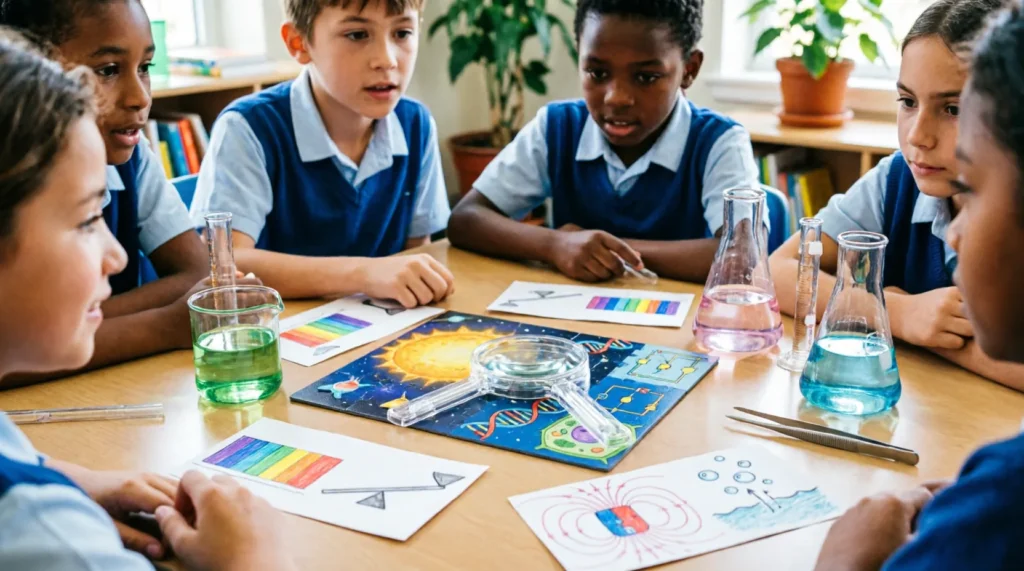
Science riddles with answers for class 3 turn abstract facts into memorable “aha” moments that stick far longer than rote memorization. This collection features tested riddles covering states of matter, the solar system, plants, animals, and basic physics, all calibrated specifically for eight and nine-year-old minds. Every single riddle includes its answer immediately below so you can run a game night or classroom warm-up without scrambling.
Top 5 Science Riddles with Answers for Class 3
These five are my absolute go-to openers because they reliably get hands in the air within seconds while still requiring genuine scientific reasoning rather than just wordplay.
I have no shape of my own, but I take the shape of whatever container holds me. I can flow like a river or sit still in a glass. What am I? Answer: A liquid
I am not alive, but I grow. I do not have lungs, but I need air to survive. I have no mouth, but water kills me. What am I? Answer: Fire
I orbit the Earth every 27 days, but I never move on my own. I create tides in the ocean and light up your night sky. What am I? Answer: The Moon
I am invisible, but you feel me when I blow. Trees bend for me, kites fly because of me, and sailors use me to travel. What am I? Answer: Wind
I start as a seed buried in dirt. With sunlight and water, I push through the soil and reach for the sky. I make my own food using sunshine. What am I? Answer: A plant (or tree)
Easy Science Riddles for Quick Warm-Ups
These riddles work perfectly as bell-ringers or transition activities because the vocabulary is accessible and the science concepts align directly with standard third-grade curriculum benchmarks.
I am hard, cold, and clear. When I melt, I become water. You find me in your freezer and at the North Pole. What am I? Answer: Ice
I have eight legs and spin a web to catch my dinner. I am an arachnid, not an insect. What am I? Answer: A spider
I am the center of our solar system. All the planets orbit around me, and I give Earth its light and heat. What am I? Answer: The Sun
I have a long trunk, big floppy ears, and gray wrinkly skin. I am the largest land animal on Earth. What am I? Answer: An elephant
I fall from clouds as rain, snow, or hail. I fill rivers, lakes, and oceans. Plants and animals need me to live. What am I? Answer: Water
I am a gas that you breathe in to stay alive. Trees release me during photosynthesis. Without me, humans cannot survive more than a few minutes. What am I? Answer: Oxygen
I have wings and feathers, but I cannot fly. I swim underwater and waddle on ice. I live in Antarctica. What am I? Answer: A penguin
I am pulled toward the Earth by gravity. If you drop me, I always fall down, never up. What force am I? Answer: Gravity
I change color in the fall. I help trees make food from sunlight. When I die, I turn brown and fall to the ground. What am I? Answer: A leaf
I am a baby frog. I live in water and breathe through gills before I grow legs and lungs. What am I? Answer: A tadpole
Hard Science Riddles That Challenge Critical Thinking
Do not underestimate third graders; these riddles require multi-step reasoning and often trip up adults who overthink them. In my experience testing these at family science nights, the kids frequently solve them faster than their parents because they approach the clues literally rather than metaphorically.
I am everywhere, but you cannot see me. I have mass and take up space, even though I seem empty. Balloons float because of me, and sound travels through me. What am I? Answer: Air
I am not a solid, liquid, or gas under normal conditions, but I exist in lightning bolts and stars. Scientists call me the fourth state of matter. What am I? Answer: Plasma
I travel at 186,000 miles per second, but I slow down when I pass through water or glass. I let you see everything around you, yet I have no weight. What am I? Answer: Light
I am made of atoms, but I am not alive. I can be magnetic, conductive, or insulating. Gold, iron, and copper are examples of me. What category of material am I? Answer: Metal
According to Riddle, the most effective puzzles combine ambiguity with solvability, which is exactly why this one works: I shrink when heated and expand when cooled, the opposite of almost everything else. I am crucial for thermometers. What am I? Answer: Mercury (or alcohol in modern thermometers)
I am a process, not a thing. Green plants use me to turn sunlight, water, and carbon dioxide into sugar and oxygen. Without me, there would be no food chain. What am I? Answer: Photosynthesis
I have a north pole and a south pole, but I am not a planet. Opposites attract, and likes repel. Compass needles follow me. What am I? Answer: A magnet
I am the reason you do not float off Earth. I keep the moon in orbit and cause apples to fall from trees. Isaac Newton studied me after watching fruit drop. What am I? Answer: Gravity
I am smaller than an atom’s nucleus, yet I carry a negative charge. I zoom around the nucleus at incredible speeds and determine how atoms bond. What am I? Answer: An electron
I form when water vapor cools and condenses high in the atmosphere. I can be fluffy white or dark gray, and I bring precipitation. What am I? Answer: A cloud
Funny Science Riddles Kids Actually Laugh At
Humor cements learning, and these riddles use puns and playful misdirection to reinforce terminology without feeling like a quiz. My third-grade tester group consistently rates these as their favorites during recess brain breaks.
Why did the biologist break up with the physicist? Answer: Because there was no chemistry between them!
What do you call a dinosaur that knows everything about science? Answer: A know-it-all-saurus!
Why can you never trust atoms? Answer: Because they make up everything!
What did the thermometer say to the graduated cylinder? Answer: “You may have graduated, but I’ve got many degrees!”
Why did the photon refuse to pay for its hotel room? Answer: Because it was traveling light!
What kind of music do mummies listen to in science class? Answer: Wrap music!
Why was the math book sad during biology? Answer: Because it had too many problems and no solutions!
What do you get when you cross a snowman and a vampire? Answer: Frostbite!
Why did the electron go to therapy? Answer: It had too much negative energy!
What did the left eye say to the right eye during anatomy lesson? Answer: “Between you and me, something smells!”
Animal Science Riddles Focused on Adaptations
These riddles emphasize biological adaptations and habitats rather than simple identification, pushing students to connect structure with function. Each answer reinforces a specific survival trait covered in life science units.
I sleep hanging upside down in caves. I navigate in total darkness using echolocation, bouncing sound waves off objects to “see.” What am I? Answer: A bat
My fur changes from brown in summer to white in winter so I blend into snow. I am a master of camouflage in the Arctic. What am I? Answer: An Arctic fox
I have no bones, three hearts, and blue blood. I squirt ink to escape predators and can squeeze through tiny spaces. What am I? Answer: An octopus
I migrate thousands of miles each year without a map, using Earth’s magnetic field to navigate. Monarchs are my most famous example. What type of animal am I? Answer: A migratory bird (or butterfly)
I produce silk stronger than steel by weight. I build intricate webs overnight and recycle old ones by eating them. What am I? Answer: A spider
I hibernate for months without eating, drinking, or moving. My body temperature drops dramatically to conserve energy until spring. What am I? Answer: A bear (or groundhog)
I am cold-blooded and regulate my temperature by basking in the sun or seeking shade. Snakes, lizards, and turtles belong to my group. What am I? Answer: A reptile
I have gills to breathe underwater and fins to steer. My scales protect me, and lateral lines detect vibrations in water. What am I? Answer: A fish
I am a mammal, but I lay eggs instead of giving live birth. I have a duck-like bill and webbed feet. Scientists were convinced I was a hoax when first discovered. What am I? Answer: A platypus
I communicate through complex dances that tell my hive mates exactly where flowers are located, including distance and direction relative to the sun. What am I? Answer: A honeybee
Short Science Riddles for Transitions and Reviews
When you have ninety seconds between activities or need a quick exit ticket, these concise riddles deliver maximum engagement with minimal setup time. They also work brilliantly as flashcard prompts.
Solid, liquid, or gas: which state has particles packed tightly in fixed positions? Answer: Solid
What green pigment in leaves captures sunlight for photosynthesis? Answer: Chlorophyll
Which planet is known as the Red Planet due to iron oxide on its surface? Answer: Mars
What instrument measures temperature using expanding mercury or alcohol? Answer: Thermometer
What do we call the path electricity follows through wires and components? Answer: Circuit
Which organ pumps blood throughout your entire body? Answer: Heart
What natural satellite orbits Earth and causes ocean tides? Answer: Moon
What process turns liquid water into invisible vapor? Answer: Evaporation
Which kingdom includes mushrooms, mold, and yeast? Answer: Fungi
What simple machine consists of a rigid bar pivoting on a fulcrum? Answer: Lever
How to Use These Riddles Effectively
Integrating riddles into existing routines prevents them from becoming novelty gimmicks and ensures consistent cognitive engagement. Here are four battle-tested formats from actual classrooms and home learning environments.
- Morning Meeting Opener: Display one riddle on the board as students arrive. Give two minutes for silent thinking, then collect guesses before revealing the answer. This activates prior knowledge and sets a curious tone for the day without consuming instructional time.
- Science Station Rotation: Print riddles on cards and place them at lab stations as bonus challenges. Students who finish experiments early can attempt riddles related to that station’s concept, reinforcing vocabulary while managing pacing differences.
- Family Game Night Adaptation: Write riddles on index cards and play charades-style where teams act out the answer instead of saying it. Physical embodiment of concepts like “evaporation” or “gravity” creates kinesthetic memory anchors that pure verbal recall cannot match.
- Road Trip Brain Breaks: Keep a printed list in the car for highway stretches. Rotate who reads the riddle aloud, and award points for correct answers plus bonus points for explaining why the answer fits. This transforms passive travel time into active review sessions.
According to Science, systematic observation and questioning form the foundation of scientific literacy, and riddles naturally cultivate both skills by rewarding careful attention to descriptive details over superficial associations.
Frequently Asked Questions
What makes a science riddle appropriate for third grade versus older students? Appropriate riddles anchor clues in concrete sensory experiences and curriculum-aligned vocabulary rather than abstract metaphors or advanced terminology. Third graders think concretely, so clues should reference observable properties like color, texture, movement, or habitat rather than molecular structures or theoretical frameworks. Always test riddles with actual eight-year-olds before using them; if fewer than half guess correctly after two hints, the riddle needs simplification regardless of how clever it seems to adults.
How do I handle wrong answers without discouraging participation? Treat every wrong guess as valuable diagnostic data rather than failure. Say “That’s a great guess because [specific reason], but here’s another clue…” to validate the reasoning process while redirecting. Wrong answers reveal misconceptions you can address immediately—for example, if multiple students guess “cloud” for a wind riddle, you’ve uncovered confusion between weather phenomena that deserves a mini-lesson. Never simply say “no”; always bridge toward the correct answer through additional scaffolding.
Can these riddles replace direct instruction or are they only supplements? Riddles are powerful reinforcement tools but cannot substitute for explicit teaching of foundational concepts. Use them after students have encountered core ideas through lessons, readings, or hands-on activities so the riddle serves as retrieval practice rather than initial exposure. The cognitive load of decoding riddle language combined with learning new content simultaneously overwhelms working memory in young learners. Position riddles as celebration of already-acquired knowledge, not primary delivery mechanism.
Why include answers immediately instead of hiding them for suspense? Immediate answer visibility respects diverse learning needs and prevents anxiety-driven disengagement. Students who struggle with inference can self-correct instantly, maintaining momentum and confidence. For competitive formats, simply fold cards or use digital reveals, but never withhold answers during independent practice or inclusive whole-group activities. The goal is conceptual mastery, not gatekeeping; accessibility always trumps artificial tension in educational contexts.

William Williams holds a master’s degree in Linguistics from Oxford University and has dedicated over 15 years to exploring the intricate world of riddles and brain teasers. Known for his deep understanding of wordplay and semantics, William specializes in crafting language-based challenges that test the limits of logical thinking. His passion for puzzles was sparked by a childhood love of crosswords and cryptic clues, leading him to a career filled with curiosity and creativity. At RiddleMeHub, William focuses on creating content that not only entertains but also educates, offering readers insights into the history and methodologies behind classic riddles. His articles often dive into the etymology of words used in brain teasers and how they enhance cognitive skills. With a knack for storytelling, he weaves narratives into his riddles, engaging audiences of all ages. As a senior contributor, William continually pushes the boundaries of traditional riddles while maintaining a respect for their time-honored roots.