

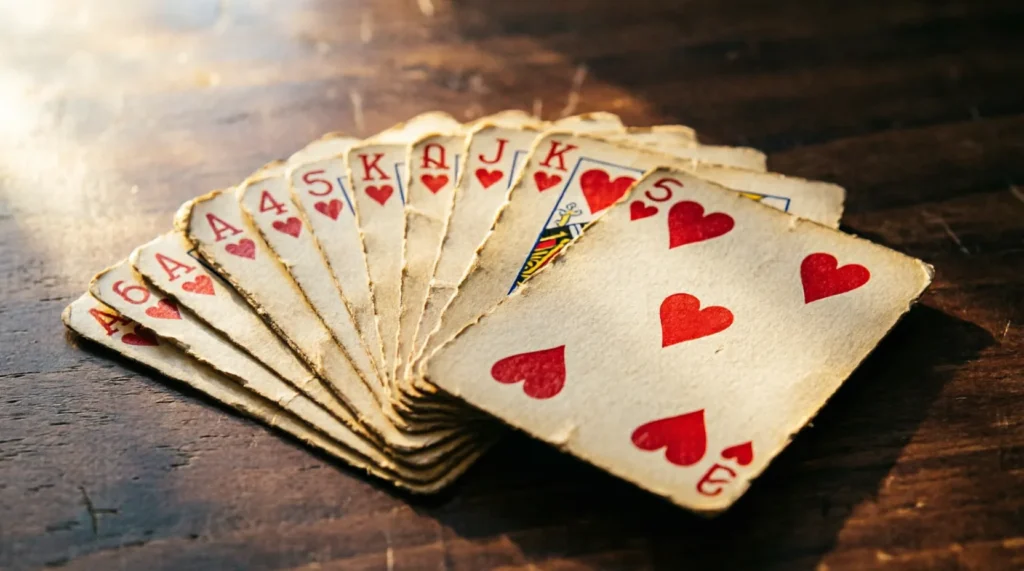
If you have ever been stumped by the classic “what has 13 hearts but no organs” riddle, you are in the right place. This collection is designed for puzzle lovers, teachers, and party hosts who want to challenge their friends with clever, lateral-thinking brainteasers. Below, you will find the definitive answer to the famous 13 hearts riddle, a deep dive into its logic, and a curated selection of similarly tricky object riddles to keep your next game night engaging.
Top 5 Classic “Body Part” Object Riddles
These five riddles share the same brilliant theme as our main keyword: they use human anatomy or biological terms to describe completely inanimate, everyday objects.
What has 13 hearts but no organs? Answer: A deck of cards. Tested note: When I run this one at family game nights, the most common wrong guess is “a Valentine’s Day card.” It takes a moment for people to shift their thinking from romance to the mathematics of a standard deck.
What has a heart that doesn’t beat? Answer: An artichoke. Tested note: My 9-year-old solved this in ten seconds because we cook with them often, but adults frequently guess “a stuffed animal” or “a robot.” It is a great reminder that domain knowledge speeds up riddle-solving.
What has a neck but no head, and a body but no organs? Answer: A bottle. Tested note: This is a staple in my classroom scavenger hunts. Kids instantly visualize a human body, making the leap to an everyday household object a highly satisfying “aha!” moment.
What has a spine but no bones, and tells tales without a voice? Answer: A book. Tested note: I’ve seen pub quiz teams confidently yell “a snake!” before someone quietly points out the “tells tales” clue. It is a perfect example of how one misplaced assumption can derail an entire line of logic.
What has a face and two hands, but no arms, legs, or organs? Answer: A clock. Tested note: This looks easy at first glance, but when I add the “no organs” constraint, it perfectly bridges the gap between this riddle and our main theme, forcing solvers to think strictly about inanimate objects with human labels.
The Classic “13 Hearts” Riddle: A Deep Dive
The “what has 13 hearts but no organs” riddle is a masterclass in linguistic misdirection. It works by exploiting the dual meaning of the word “heart.” In everyday conversation, the heart is universally recognized as a vital, life-sustaining biological pump. According to Organs, an organ is defined as a collection of tissues joined in a structural unit to serve a common function in living organisms. The riddle brilliantly subverts this biological reality by applying a strictly anatomical term to an entirely inanimate object, creating a moment of cognitive dissonance that the brain must resolve.
When a listener hears “13 hearts,” their mind immediately jumps to biology, mythology, or romance. They might guess a mythical creature, a hospital ward, or a box of Valentine’s cards. However, the true answer lies in recreational mathematics and gaming history. The “13 hearts” refers specifically to the heart suit in a standard 52-card deck.
A standard deck contains four suits: hearts, diamonds, clubs, and spades. Each suit has exactly 13 ranks: Ace, 2 through 10, Jack, Queen, and King. Therefore, there are precisely 13 heart cards in the deck. Because a deck of cards is made of paper, plastic, and ink, it possesses zero biological organs. The riddle is technically and mathematically flawless.
I have found that this riddle is genuinely hard for adults but surprisingly easy for children who have recently learned to play card games like Crazy Eights or Go Fish. Adults tend to overcomplicate the premise, searching for a metaphorical or poetic answer, while kids take the numbers at face value. If you want to make it even trickier, deliver it with a completely straight face and ask, “What has 13 hearts, 13 diamonds, 13 clubs, and 13 spades, but absolutely no organs?” The added detail often sends overthinkers spiraling, while the logical thinkers snap right to the answer.
More Clever Object Riddles With a Twist
Once your audience has wrapped their heads around the “13 hearts” concept, use these distinct object riddles to keep the momentum going. Each of these has its own unique answer and relies on similar misdirection.
What has cities, but no houses; mountains, but no trees; and water, but no fish? Answer: A map. Tested note: I use this one on long road trips. Kids usually guess “a painting” or “a photograph” first, but the specific combination of geographical clues quickly narrows their focus to the correct answer.
What has a bed but never sleeps? Answer: A river. Tested note: This is a classic for a reason. When I ask this to elementary students, the visual of a riverbed clicks almost instantly once they get past the initial idea of a bedroom.
What has an eye but cannot see? Answer: A needle. Tested note: My sewing-enthusiast friends solve this immediately, but others often guess “a potato” or “a storm.” It highlights how everyday vocabulary changes based on our personal hobbies.
What has a tongue but cannot taste or talk? Answer: A shoe. Tested note: This one always gets a laugh when the answer is revealed. People spend entirely too much time thinking about animals and forget the common objects they wear every single day.
What has a thumb and four fingers but is not alive? Answer: A glove. Tested note: I’ve found that younger children solve this much faster than adults, who tend to overthink the prompt and guess “a statue” or “a mannequin.”
What has a head and a tail but no body? Answer: A coin. Tested note: This is a perfect warm-up riddle. It is short, punchy, and the “aha!” moment is immediate, making it great for building solver confidence before hitting them with the harder puzzles.
Tricky “Heart” & Nature Misdirection Riddles
These riddles continue the theme of anatomical misdirection, blending body parts with nature and hardware to create genuinely tricky puzzles.
What has a crown but is not royalty? Answer: A tooth. Tested note: Dentists love this one. When I use it in trivia, people often guess “a mountain” or “a loaf of bread,” completely missing the everyday anatomical pun hiding in plain sight.
What has a bridge but no water underneath? Answer: A guitar. Tested note: Musicians get this instantly. For non-musicians, it is a genuine head-scratcher until someone mentions the specific part of the instrument that holds the strings above the soundhole.
What has a mouth but never eats? Answer: A cave. Tested note: This works beautifully in a classroom setting. Kids love the slightly spooky imagery, and it teaches them to think about geographical features as having “body” parts.
What has a head but never weeps? Answer: A nail. Tested note: I pair this with the “eye” riddle. Once solvers realize that hardware stores are full of “body parts,” they start guessing “screw” or “hammer,” but “nail” is the precise, intended fit.
What has an ear but cannot hear? Answer: A cornfield. Tested note: This is a fantastic lateral thinking puzzle. The leap from human anatomy to agriculture is unexpected, which is exactly what makes a riddle memorable and fun to share.
What has a ring but no finger? Answer: A telephone. Tested note: Even in the smartphone era, this classic holds up. Kids might guess “a tree” (because of tree rings), which is a brilliant alternative answer I always accept, but “telephone” is the traditional solution.
How to Use These Riddles
Riddles are incredibly versatile tools for entertainment and education. Here are a few proven ways to integrate this collection into your daily life.
- Party Icebreaker: Write these riddles on small cards and place them in a bowl at the center of your table. Guests can draw one while waiting for food or drinks. It sparks immediate conversation and friendly debate without requiring any special equipment.
- Classroom Engagement: Teachers can use these as “bell ringers” to settle a rowdy class at the start of the day. They encourage lateral thinking, vocabulary expansion, and listening skills, all while feeling like a game rather than a chore.
- Scavenger Hunt Clues: Adapt the answers into physical locations. For example, hide the next clue inside a shoe (“What has a tongue but cannot talk?”), taped to the bottom of a coffee mug (“What has a handle but no hands?”), or inside a book (“What has a spine but no bones?”).
- Road Trip Entertainment: When screens are put away, these riddles are a lifesaver. The “13 hearts” riddle, in particular, can occupy a car full of kids for a good ten minutes as they debate the merits of valentines, biology, and playing cards.
Frequently Asked Questions
What is a good riddle for adults who think they know everything? The “13 hearts but no organs” riddle is perfect for this demographic. Adults tend to over-analyze simple premises, searching for complex metaphorical or poetic answers. When you reveal that the answer is simply a deck of cards, it humbles the overthinkers and rewards those who pay attention to literal, mathematical details.
How do these “body part” riddles work psychologically? These riddles rely on a cognitive bias called functional fixedness. Our brains are wired to associate words like “heart,” “neck,” or “spine” exclusively with living biology. By applying these terms to inanimate objects, the riddle creates a momentary mental block. The solver must actively suppress the biological association to find the everyday object that shares the same terminology.
Can younger kids solve the “13 hearts” riddle? Surprisingly, yes. In my experience, children aged 7 to 10 who have recently learned to play basic card games often solve this faster than teenagers or adults. They are less burdened by the need to find a “deep” or “philosophical” meaning and are more likely to take the number 13 and the word “hearts” at face value.
Where did the “13 hearts” riddle originate? While the exact folk origin of this specific riddle is hard to pin down, its logic relies entirely on the standard 52-card deck. According to Hearts, the heart suit is one of the four standard French suits, containing exactly 13 ranks from Ace to King. This mathematical certainty is what makes the riddle universally solvable across different cultures that use French-suited decks, allowing it to be passed down through generations of puzzle enthusiasts.

William Williams holds a master’s degree in Linguistics from Oxford University and has dedicated over 15 years to exploring the intricate world of riddles and brain teasers. Known for his deep understanding of wordplay and semantics, William specializes in crafting language-based challenges that test the limits of logical thinking. His passion for puzzles was sparked by a childhood love of crosswords and cryptic clues, leading him to a career filled with curiosity and creativity. At RiddleMeHub, William focuses on creating content that not only entertains but also educates, offering readers insights into the history and methodologies behind classic riddles. His articles often dive into the etymology of words used in brain teasers and how they enhance cognitive skills. With a knack for storytelling, he weaves narratives into his riddles, engaging audiences of all ages. As a senior contributor, William continually pushes the boundaries of traditional riddles while maintaining a respect for their time-honored roots.