

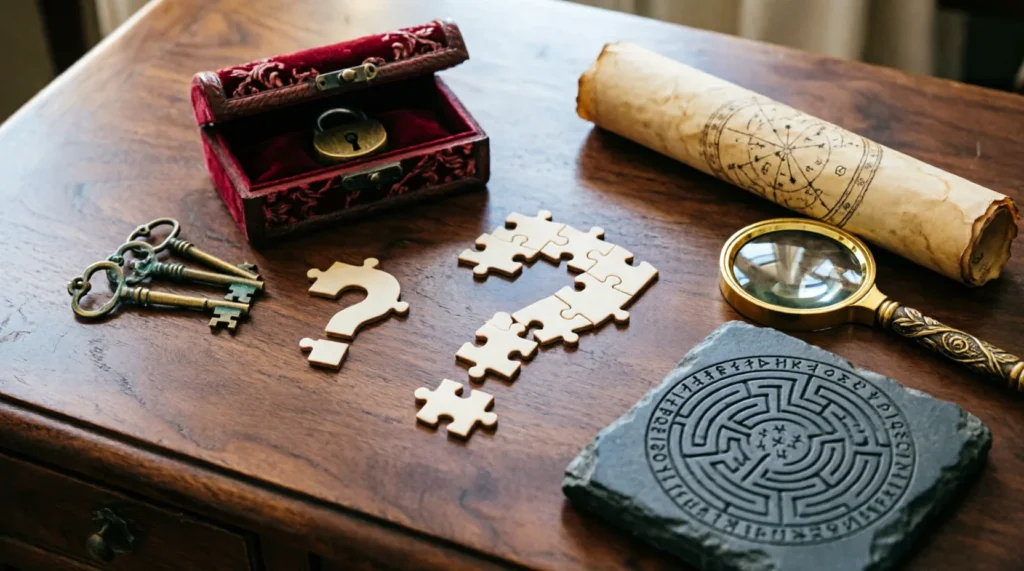
Riddles are more than just child’s play; they are intricate puzzles that challenge logic, lateral thinking, and linguistic dexterity. For adults, the appeal lies in the subtle misdirection and the satisfying “aha!” moment when the answer finally clicks. Whether you are hosting a dinner party, breaking the ice at a corporate event, or simply looking to sharpen your mind, this curated collection offers a diverse range of challenges. From quick wits to deep contemplation, these 100 examples of riddles for adults are designed to entertain, frustrate, and ultimately delight.
Top 5 Adult Riddles
These five riddles represent the gold standard of adult brain teasers. They balance clever wordplay with logical deduction, making them perfect for testing any group’s collective intelligence.
I speak without a mouth and hear without ears. I have no body, but I come alive with wind. What am I? Answer: An echo
The more you take, the more you leave behind. What am I? Answer: Footsteps
I have cities, but no houses. I have mountains, but no trees. I have water, but no fish. What am I? Answer: A map
What can you hold in your right hand, but never in your left? Answer: Your left hand
I am not alive, but I grow; I don’t have lungs, but I need air; I don’t have a mouth, but water kills me. What am I? Answer: Fire
Easy Warm-Ups
Start your session with these accessible riddles. They are designed to build confidence and get everyone into the rhythm of lateral thinking. According to Wikipedia, riddles have been used throughout history as a form of entertainment and intellectual exercise, often serving as a social bonding activity. These easy examples follow that tradition by offering quick wins.
What has keys but can’t open locks? Answer: A piano
What has a head and a tail but no body? Answer: A coin
What goes up but never comes down? Answer: Your age
What has many needles but doesn’t sew? Answer: A pine tree
What gets wet while drying? Answer: A towel
What has one eye but can’t see? Answer: A needle
What has legs but cannot walk? Answer: A table
What has a neck but no head? Answer: A bottle
What belongs to you but is used more by others? Answer: Your name
What can travel around the world while staying in a corner? Answer: A stamp
Hard Logic Puzzles
These riddles require deeper concentration. In my experience running pub quizzes, these are the ones that silence the room. They often rely on specific logical constraints or abstract concepts that defy immediate intuition. Do not be discouraged if the answer does not come instantly; the value is in the struggle.
A man pushes his car to a hotel and tells the owner he’s bankrupt. Why? Answer: He is playing Monopoly
You see a boat filled with people. It has not sunk, but when you look again you don’t see a single person on the boat. Why? Answer: All the people were married
I have thousands of layers, but I’m not an onion. I can be read, but I’m not a book. What am I? Answer: A cabbage (or a newspaper, depending on interpretation, but cabbage fits the layer clue better)
A doctor gives you three pills and tells you to take one every half hour. How long will they last? Answer: One hour (You take the first pill at 0:00, the second at 0:30, and the third at 1:00)
What comes once in a minute, twice in a moment, but never in a thousand years? Answer: The letter M
I am always hungry, I must always be fed. The finger I touch, will soon turn red. What am I? Answer: Fire
What has a ring but no finger? Answer: A telephone
The person who makes it has no need of it; the person who buys it has no use for it. The person who uses it can neither see nor feel it. What is it? Answer: A coffin
What can run but never walks, has a mouth but never talks, has a head but never weeps, has a bed but never sleeps? Answer: A river
I am light as a feather, yet the strongest man cannot hold me for much more than a minute. What am I? Answer: His breath
Funny and Witty
Humor is a crucial component of effective riddling. These examples rely on puns, double meanings, and absurdity. They are excellent for lightening the mood. When I use these in classroom settings, the groans are often louder than the cheers, which is exactly the desired effect.
What do you call a fake noodle? Answer: An impasta
Why did the scarecrow win an award? Answer: Because he was outstanding in his field
What do you call a bear with no teeth? Answer: A gummy bear
Why couldn’t the bicycle stand up by itself? Answer: It was two tired
What do you call a dinosaur that crashes his car? Answer: Tyrannosaurus Wrecks
What kind of room has no doors or windows? Answer: A mushroom
Why did the golfer bring two pairs of pants? Answer: In case he got a hole in one
What do you call a snowman with a six-pack? Answer: An abdominal snowman
Why did the math book look sad? Answer: Because it had too many problems
What do you call a fish wearing a bowtie? Answer: Sofishticated
Tricky Wordplay
These riddles exploit the ambiguity of language. They are particularly challenging for non-native speakers or those who tend to think literally. The trick is to listen closely to the phrasing rather than assuming the obvious context.
Which month has 28 days? Answer: All of them
If you drop a yellow hat in the Red Sea, what does it become? Answer: Wet
How many letters are in the alphabet? Answer: 11 (T-H-E-A-L-P-H-A-B-E-T) Note: Most people guess 26, referring to the English alphabet, but the question asks about “the alphabet” phrase.
What occurs once in a second, twice in a minute, but never in a hundred years? Answer: The letter E
If there are three apples and you take away two, how many do you have? Answer: Two (You took two, so you have two)
What word is spelled incorrectly in every dictionary? Answer: Incorrectly
Before Mt. Everest was discovered, what was the highest mountain in the world? Answer: Mt. Everest (It was still the highest, just not discovered)
How far can a dog run into the woods? Answer: Halfway (After that, he is running out)
What has a bottom at the top? Answer: Your legs
If you have it, you want to share it. If you share it, you don’t have it. What is it? Answer: A secret
Math and Number Riddles
Numerical riddles appeal to those who enjoy pattern recognition and basic arithmetic. However, beware: many of these are traps for the over-confident calculator. They often require simple logic rather than complex computation. As noted in discussions on cognitive development, engaging with such puzzles can help maintain mental agility in adults.
How can you add eight 8s to get the number 1,000? Answer: 888 + 88 + 8 + 8 + 8 = 1,000
I am an odd number. Take away a letter and I become even. What number am I? Answer: Seven (Remove the ‘s’ and it becomes ‘even’)
Using only addition, how can you add eight 8s to get the number 1,000? Answer: 888 + 88 + 8 + 8 + 8 = 1,000
If two’s company and three’s a crowd, what are four and five? Answer: Nine
How many sides does a circle have? Answer: Two (Inside and outside)
What number do you get when you multiply all of the numbers on a telephone’s number pad? Answer: Zero (Because of the 0)
If you divide 30 by half and add 10, what do you get? Answer: 70 (Dividing by half is multiplying by 2: 30 x 2 = 60 + 10 = 70)
There is a basket containing 5 apples. How do you divide the apples among 5 children so that each child has 1 apple while 1 apple remains in the basket? Answer: Give 4 children 1 apple each, and give the fifth child the basket with the last apple in it
How many times can you subtract 10 from 100? Answer: Once (After that, you are subtracting from 90)
What is the next number in the sequence: 1, 11, 21, 1211, 111221? Answer: 312211 (This is the “look-and-say” sequence)
Short and Snappy
Perfect for rapid-fire rounds or text message challenges. These riddles are concise and rely on immediate association.
What has a bed but never sleeps? Answer: A river
What has a face and two hands but no arms or legs? Answer: A clock
What has to be broken before you can use it? Answer: An egg
What goes up and down but doesn’t move? Answer: Stairs
What has a thumb and four fingers but is not alive? Answer: A glove
What can you catch but not throw? Answer: A cold
What has words but never speaks? Answer: A book
What has a spine but no bones? Answer: A book
What has a bank but no money? Answer: A riverbank
What has a heart that doesn’t beat? Answer: An artichoke
How to Use These Riddles
Integrating these puzzles into your social or professional life can enhance engagement and foster connection. Here are some practical applications:
- Icebreakers: Start a meeting or party with one “Easy” riddle to get people talking. It lowers barriers and encourages participation from shy attendees.
- Dinner Party Entertainment: Place a “Tricky” riddle on a card at each place setting. Guests can discuss their theories while waiting for food, creating natural conversation starters.
- Scavenger Hunts: Use the answers to riddles as clues for the next location. For example, if the answer is “Piano,” the next clue might be hidden near a musical instrument.
- Road Trips: Keep kids and adults engaged during long drives with “Short and Snappy” riddles. They require no props and can be played indefinitely.
- Team Building: Divide colleagues into groups and have them solve “Hard Logic Puzzles” collaboratively. This promotes problem-solving skills and teamwork under low-pressure conditions.
Frequently Asked Questions
What makes a riddle suitable for adults? Adult riddles often rely on double entendres, cultural references, or complex logical structures that require life experience or advanced vocabulary to decipher. Unlike children’s riddles, which are often straightforward descriptive puzzles, adult riddles frequently employ misdirection and abstract thinking.
How do I create my own riddles? Start with an object or concept. List its attributes, then describe those attributes in a way that suggests something else. For example, instead of saying “it has keys,” say “it has keys but opens no locks.” Test your riddle on friends to ensure the answer is solvable but not obvious.
Are riddles good for brain health? Yes. Engaging in regular puzzle-solving activities like riddles can help maintain cognitive function. They stimulate neural pathways associated with memory, logic, and language processing, providing a mental workout that complements physical exercise.
What is the difference between a riddle and a puzzle? While often used interchangeably, a riddle is typically a verbal or written question designed to be solved through wit and wordplay. A puzzle, such as a jigsaw or Sudoku, usually involves manipulating physical pieces or numbers Riddles are linguistic; puzzles are often structural or numerical.

Joshua Wilson is a former engineer turned puzzle enthusiast with over eight years of experience in the world of riddles and brain teasers. Holding a degree in Mechanical Engineering from MIT, Joshua’s technical background influences his approach to crafting intricate logic puzzles and spatial challenges. His journey into the realm of riddles began as a personal hobby, which soon evolved into a professional passion for dissecting the mechanics of problem-solving. At RiddleMeHub, Joshua specializes in puzzles that require a methodical approach, often drawing inspiration from engineering principles and scientific concepts. His content is characterized by its engaging complexity and educational value, designed to stimulate critical thinking and creativity. Joshua is committed to inspiring curiosity and wonder, encouraging readers to embrace the joy of discovery through the lens of puzzling. As an author, he brings a fresh perspective to traditional brain teasers, integrating modern techniques and interactive elements to captivate a wide audience.