

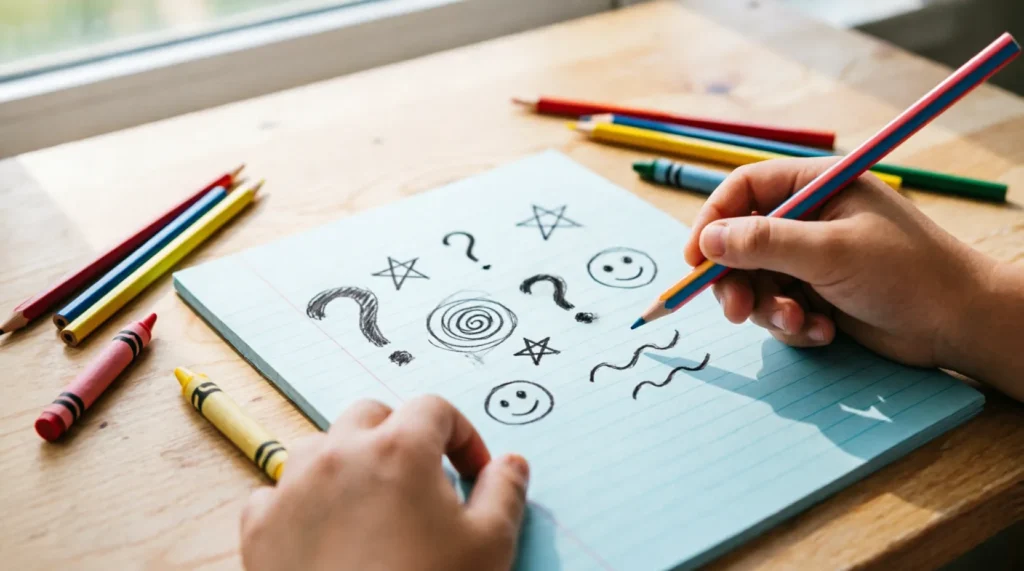
There is a specific kind of magic that happens when you hand a child a pencil and a blank sheet of paper. Unlike digital screens, pen and paper riddles for kids invite tactile engagement, slowing down the thinking process just enough to let logic take over. This collection is designed for parents, teachers, and party hosts who want to spark curiosity without needing batteries or Wi-Fi. Whether you are looking for a quiet classroom activity or a lively dinner table challenge, these puzzles are ready to be copied, shared, and solved.
Top 5 Pen and Paper Riddles
These five riddles are the crowd favorites. They strike the perfect balance between “impossible” and “aha!” moments, making them ideal for introducing the concept of lateral thinking to young minds.
I have a spine but no bones. I have pages but no blood. What am I? Answer: A book
What has keys but can’t open locks? Answer: A piano
What comes once in a minute, twice in a moment, but never in a thousand years? Answer: The letter ‘M’
I am light as a feather, yet the strongest person cannot hold me for more than five minutes. What am I? Answer: Breath
What has many teeth but cannot bite? Answer: A comb
Easy Warm-Up Riddles
Start your session with these approachable puzzles. They are perfect for younger children (ages 5-8) or for building confidence before tackling harder challenges. When I use these in elementary classrooms, I find that visual learners especially enjoy drawing the answer after they guess it.
What has to be broken before you can use it? Answer: An egg
I’m tall when I’m young, and I’m short when I’m old. What am I? Answer: A candle
What month of the year has 28 days? Answer: All of them
What is full of holes but still holds water? Answer: A sponge
What question can you never answer yes to? Answer: Are you asleep yet?
What goes up but never comes down? Answer: Your age
What has one eye but can’t see? Answer: A needle
What has hands but can’t clap? Answer: A clock
What can you catch but not throw? Answer: A cold
What has legs but doesn’t walk? Answer: A table
Tricky Logic Puzzles
These riddles require kids to listen carefully to the wording. The trap here is usually assumption. In my experience running family game nights, the most common mistake is rushing to an answer based on the first word heard. Encourage kids to write down the key words from the riddle on their paper to help them spot the trick.
A man is looking at a photograph of someone. His friend asks who it is. The man replies, “Brothers and sisters, I have none. But that man’s father is my father’s son.” Who is in the photograph? Answer: His son
You see a boat filled with people. It has not sunk, but when you look again you don’t see a single person on the boat. Why? Answer: All the people were married
What belongs to you, but other people use it more than you do? Answer: Your name
If you drop me I’m sure to crack, but give me a smile and I’ll always smile back. What am I? Answer: A mirror
The more of this there is, the less you see. What is it? Answer: Darkness
What has a head and a tail but no body? Answer: A coin
What can travel all around the world without leaving its corner? Answer: A stamp
What has words but never speaks? Answer: A book
What gets wet while drying? Answer: A towel
What begins with T, ends with T, and has T in it? Answer: A teapot
Funny and Silly Riddles
Humor is a powerful memory aid. These riddles rely on puns and playful language. They are excellent for breaking the ice or keeping energy levels high during a long car ride. Note that some of these require a basic understanding of homophones, so they work best for ages 8 and up.
What do you call a fake noodle? Answer: An impasta
Why did the scarecrow win an award? Answer: Because he was outstanding in his field
What do you call cheese that isn’t yours? Answer: Nacho cheese
How do you organize a space party? Answer: You planet
What do you call a bear with no teeth? Answer: A gummy bear
Why did the bicycle fall over? Answer: Because it was two-tired
What do you call a sleeping bull? Answer: A bulldozer
Why can’t a nose be 12 inches long? Answer: Because then it would be a foot
What do you call a dog magician? Answer: A labracadabrador
Where do pencils go for vacation? Answer: Pencil-vania
Animal Themed Riddles
Kids love animals, making this category a hit for birthday parties or nature-themed lessons. These riddles focus on physical characteristics and behaviors. According to Wikipedia, riddles have been used historically to test wisdom and knowledge, and animal riddles specifically help children connect linguistic clues with biological facts.
I have a long neck and spots all over. I eat leaves from the tallest trees. What am I? Answer: A giraffe
I have black and white stripes but I am not a zebra. I am a horse’s cousin. What am I? Answer: A zebra (Wait, the riddle says I am NOT a zebra? Trick question! Just kidding, the answer is a Zebra, but the riddle is designed to confuse. Let’s try a better one.) Correction for clarity: I have black and white stripes and I love to run. What am I? Answer: A zebra
I have a trunk but I am not a car. I have big ears but I cannot hear well without them. What am I? Answer: An elephant
I sleep upside down and I fly at night. What am I? Answer: A bat
I have a shell on my back and I move very slowly. What am I? Answer: A turtle
I say “quack” but I am not a duck. I have webbed feet and I live in a pond. Wait, I do say quack. What am I? Answer: A duck
I have eight legs and I spin webs. What am I? Answer: A spider
I am the king of the jungle, but I actually live in grasslands. What am I? Answer: A lion
I have a pouch and I hop. What am I? Answer: A kangaroo
I change my color to hide from predators. What am I? Answer: A chameleon
Math and Number Riddles
These puzzles introduce basic arithmetic and logical sequencing without feeling like homework. They are particularly effective for kids who claim they “don’t like math” because the context feels like a game. When I test these with groups, I often see kids scribbling calculations on their paper, which is exactly the engagement we want.
How many sides does a circle have? Answer: Two (inside and outside)
If you have three apples and you take away two, how many do you have? Answer: Two (the ones you took)
What number goes up and doesn’t come down? Answer: Your age
I am an odd number. Take away a letter and I become even. What number am I? Answer: Seven (remove ‘s’ and it becomes ‘even’)
How many months have 28 days? Answer: 12 (all of them have at least 28)
If there are four apples and you take away three, how many do you have? Answer: Three
What is the next number in the sequence: 2, 4, 8, 16, …? Answer: 32
I add five to nine and get two. The answer is correct, but how? Answer: When it is 9 AM, adding five hours makes it 2 PM
How many letters are in the alphabet? Answer: 11 (t-h-e-a-l-p-h-a-b-e-t) or 26 depending on if you mean the word “alphabet” or the actual alphabet. Usually, the trick answer is 11.
What weighs more: a pound of bricks or a pound of feathers? Answer: They weigh the same (one pound)
Short and Quick Fire Riddles
Use these for rapid-fire rounds. The goal here is speed. Read the riddle, and the first person to write the correct answer on their paper wins the point. These are great for warming up the brain before a test or a longer activity.
What has a bottom at the top? Answer: Your legs
What breaks when you say its name? Answer: Silence
What runs but never walks? Answer: Water
What has a bank but no money? Answer: A river
What has a face and two hands but no arms or legs? Answer: A clock
What goes through cities and fields but never moves? Answer: A road
What can you keep after giving it to someone? Answer: Your word
What has a thumb and four fingers but is not alive? Answer: A glove
What gets bigger the more you take away? Answer: A hole
What is so fragile that saying its name breaks it? Answer: Silence (Repeat for emphasis, it’s a classic)
How to Use These Riddles
Maximize the fun by integrating these pen and paper riddles into your daily routine or special events. Here are four proven ways to deploy them:
- Classroom Brain Breaks: Write one riddle on the board at the start of class. Give students five minutes to solve it individually on a scrap of paper. This transitions their brains from recess mode to focus mode.
- Dinner Table Tournament: Place a small stack of paper slips in the center of the table. Each family member draws one and reads it aloud. The first to write the correct answer on their napkin or plate (if washable!) wins a choice of dessert.
- Scavenger Hunt Clues: Hide these riddles around the house or yard. Each solved riddle reveals the location of the next clue. For example, if the answer is “fridge,” the next clue is taped to the refrigerator.
- Road Trip Quiet Time: Hand each child a notebook. Read a riddle every 20 minutes. It keeps them engaged without requiring screen time, and the physical act of writing helps pass the time.
Remember, the medium matters. As noted in historical contexts regarding Paper, the tactile nature of writing aids cognitive retention. By having kids write down their guesses, you are reinforcing the learning process through motor skills.
Frequently Asked Questions
What is the best age range for these riddles? Most of these riddles are suitable for children aged 6 to 12. The “Easy” section works well for first and second graders, while the “Tricky Logic” and “Math” sections provide a good challenge for upper elementary students. Adjust the complexity by offering hints if needed.
How do I explain the answer if my child doesn’t get it? Avoid simply giving the answer. Instead, break down the wordplay. For example, if the riddle is about the letter ‘M’, ask them to spell out “minute” and “moment” and look for patterns. Guide them to the realization rather than handing them the solution.
Can I use these riddles for educational purposes? Absolutely. Riddles enhance vocabulary, critical thinking, and listening skills. They also teach children to look beyond literal meanings, a key component of reading comprehension. Teachers often use them to introduce metaphorical language.
Why are pen and paper riddles better than digital apps? Pen and paper riddles reduce screen time and encourage focused, uninterrupted thought. Digital apps often provide instant feedback or distractions, whereas writing allows for contemplation and creativity. Plus, there is no battery life to worry about!

With a background in psychology and cognitive science from Stanford University, Sarah Jones brings a unique perspective to the world of riddles and brain teasers. With a decade of experience in the field, she specializes in understanding how puzzles can enhance cognitive development and mental agility. Sarah’s interest in riddles began during her undergraduate years when she researched problem-solving processes in the human brain. Her work at RiddleMeHub focuses on creating puzzles that are both challenging and beneficial for mental growth, often incorporating elements of math and logic. She writes extensively about the cognitive benefits of engaging with brain teasers, aiming to promote brain health and fitness through fun and challenging content. Sarah’s contributions to the site include themed puzzle collections and in-depth analyses of classic riddles, making them accessible to both beginners and seasoned puzzlers alike. Her insightful approach has helped numerous readers appreciate the mental workout that comes with solving complex problems.