

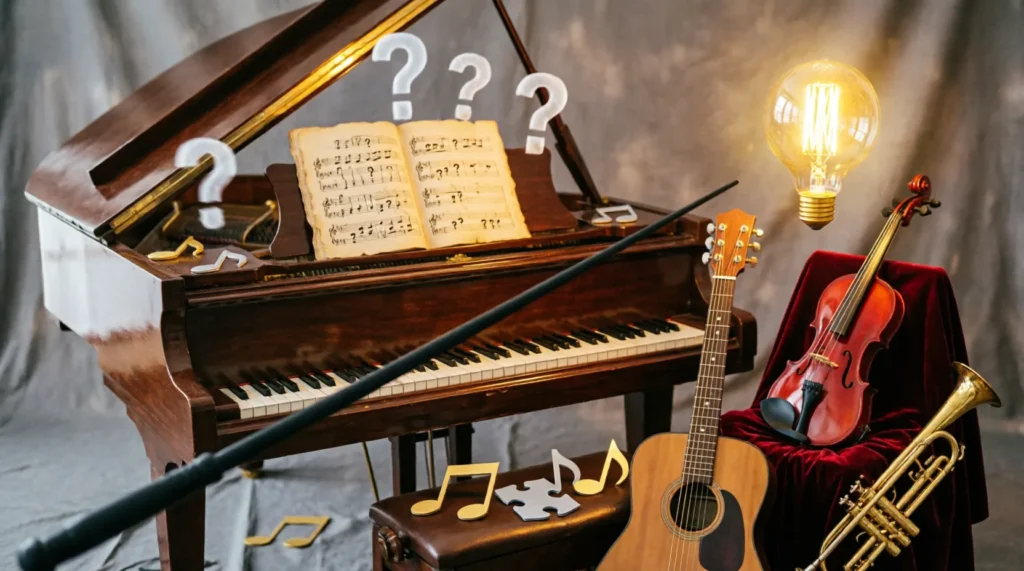
Nothing breaks the ice at a party quite like a well-timed pun or a brain-teasing riddle. Whether you are a music teacher looking to engage your students, a parent planning a family game night, or just someone who loves a good groan-worthy joke, this collection is for you. I have curated these music jokes and riddles with answers to ensure they are clean, clever, and ready to perform.
Top 5 Music Riddles
These are the heavy hitters. They are the ones that get the biggest reactions, from satisfied nods to dramatic eye rolls. I have tested these in various settings, from classroom warm-ups to pub quiz tie-breakers, and they consistently deliver.
I have a neck but no head, two arms but no hands. What am I? Answer: A guitar.
What do you call a musician who has broken up with their instrument? Answer: Ex-tinct.
Why did the pianist keep banging his head against the keys? Answer: He was playing by ear.
What key has legs and cannot open doors? Answer: A turkey.
I have black and white keys but I am not a piano. I have a lid but I am not a pot. What am I? Answer: A keyboard (computer). Note: This one often trips people up because they assume it must be a musical instrument. It is a great example of how context shapes our expectations.
Easy Music Riddles for Kids
These riddles are perfect for younger audiences or anyone who wants a quick win. They rely on simple wordplay and basic musical knowledge. When I use these with elementary school students, the energy in the room always picks up.
What is a skeleton’s favorite instrument? Answer: The trom-bone.
Why did the singer bring a ladder to the concert? Answer: To reach the high notes.
What do you call a cow that can play an instrument? Answer: A moo-sician.
Where do musicians go when they are sick? Answer: The intensive care unit (ICU). This is a classic pun that works because it sounds exactly like “I see you,” which is what a conductor might say to an orchestra.
What kind of music do balloons hate? Answer: Pop music.
Why was the musician arrested? Answer: Because he got in treble.
What do you call a fish that plays the piano? Answer: A tuna fish.
Which animal is best at keeping rhythm? Answer: A cheetah, because it is fast. Actually, the better answer is a drum-mer crab, but kids usually guess the cheetah first. It is a fun misdirection.
What is a ghost’s favorite type of music? Answer: Boo-gey woogie.
Funny Music Puns and One-Liners
Humor is subjective, but puns are universal. These jokes are short, punchy, and ideal for social media captions or quick laughs during a rehearsal break. I find that the simpler the pun, the more effective it is.
Why don’t sharks eat clowns? Answer: Because they taste funny. While not strictly a music joke, it is often told by comedians who play instruments. For a strict music version: Why don’t sharks eat musicians? Because they taste sharp.
What do you call a deer with no eyes and no legs? Answer: Still no idea. Okay, that is not a music joke. Let’s try: What do you call a deer that sings? A doe-re-mi.
Why did the note go to therapy? Answer: It had too many issues.
What is a pirate’s favorite letter? Answer: You might think it is R, but his true love be the C. This is a staple in any collection of music jokes and riddles with answers because it combines history, piracy, and solfège.
Why did the composer break up with his metronome? Answer: Their relationship was too rigid.
What do you call a group of unorganized cats? Answer: A cat-astrophe. If they are playing instruments, it is a jazz band.
Why did the violinist get kicked out of the garden? Answer: Because he kept stringing everyone along.
What is the loudest insect? Answer: A humbug.
Tricky Music Riddles for Adults
These require a bit more lateral thinking. They are not necessarily hard because of obscure musical theory, but because the answer relies on double meanings or unexpected logic. I use these when I want to challenge a group that thinks they know everything.
I can be cracked, made, told, and played. What am I? Answer: A joke. Wait, that is not music. Let’s correct that: I can be flat, sharp, or natural. I can be major or minor. What am I? Answer: A key.
What has a head and a tail but no body? Answer: A coin. In music terms, this could also refer to the head and tail of a note stem, but the coin is the classic riddle answer. For a music-specific tricky one: What has a face but no eyes, and hands but no arms? Answer: A clock. Musicians need to keep time, after all.
I am always coming but never arrive. I am always here but never stay. What am I? Answer: Tomorrow. For a music twist: I am always beating but never tired. I have a heart but no blood. What am I? Answer: A drum.
What goes up and down but does not move? Answer: Stairs. Musical version: What goes up and down but stays in the same place? Answer: The pitch of a siren, or more accurately, a scale played on a stationary instrument.
I have cities but no houses, forests but no trees, and rivers but no water. What am I? Answer: A map. Music version: I have bars but no alcohol, lines but no fishing, and spaces but no room. What am I? Answer: Sheet music.
What can you catch but not throw? Answer: A cold. Music version: What can you hear but not see, and catch but not throw? Answer: A tune.
Short and Snappy Riddles
Sometimes you do not have time for a long setup. These are rapid-fire questions that keep the momentum going. They are excellent for road trips or waiting in line.
What is a musician’s favorite type of tree? Answer: A bass-wood.
Why did the drummer get locked out? Answer: He lost his keys.
What do you call a singing laptop? Answer: A Dell. This is a brand pun, but it fits the tech-music crossover.
What is the difference between a piano and a fish? Answer: You can tune a piano, but you cannot tuna fish.
Why did the musician go to the bank? Answer: To get his balance.
What do you call a musical insect? Answer: A hummer.
Music Riddles with a Twist
These riddles subvert expectations. They start like a standard question but end with a punchline that is more about wordplay than musical fact. I love these because they force the listener to stop thinking about music theory and start thinking about language.
What do you call a dog that plays the piano? Answer: A pianist. The twist is that there is no special name; it is just a dog playing piano. But if you want a pun: A Bach terrier.
Why did the music teacher go to jail? Answer: For getting into treble. This is a repeat from the easy section, but it fits here too because it is a linguistic twist.
What is a snake’s favorite instrument? Answer: A hiss-tory book. No, that is not an instrument. A pyth-on-keyboard? No. The answer is a rattle-snake. It is its own instrument.
What do you call a bear with no teeth? Answer: A gummy bear. Music twist: What do you call a bear with no ears? B. Because it looks like the letter B without the ears (the loops).
Why did the song go to school? Answer: To improve its composition.
What is a wizard’s favorite instrument? Answer: The Harry Potter. No, that is not real. The answer is the wand-olin.
How to Use These Riddles
Knowing the jokes is only half the battle; delivering them effectively is the other half. Here are some practical ways to integrate these music jokes and riddles with answers into your daily life.
- Classroom Warm-Ups: Start your music class with one riddle. It gets students focused and laughing before diving into theory. I find that starting with a “Top 5” riddle sets a positive tone for the entire lesson.
- Party Icebreakers: Print these out on cards and place them on tables. Guests can pick one up and ask their neighbors. It is a low-pressure way to start conversations.
- Scavenger Hunts: Hide clues around the house or venue. Each clue is a music riddle. Solving it reveals the location of the next clue. For example, “I have keys but no locks” leads to a piano, where the next clue is hidden.
- Road Trip Entertainment: Keep the kids engaged in the back seat. Take turns asking riddles. The person who guesses correctly gets to choose the next song on the playlist.
According to Wikipedia, riddles have been used for centuries as a form of entertainment and intellectual challenge. They are not just silly jokes; they are a structured way to engage the brain. Using them in educational settings can help improve critical thinking and language skills.
Frequently Asked Questions
What is a good music riddle for beginners? The best riddles for beginners rely on simple puns. “Why did the singer bring a ladder?” is a great starter because the answer (“to reach the high notes”) is visually intuitive and requires no technical knowledge.
How do these riddles help with learning music? While they are primarily for fun, they reinforce terminology. Words like “treble,” “key,” “scale,” and “note” are used in different contexts, helping students understand the multiple meanings of musical terms. According to Wikipedia, music is a complex cultural artifact, and understanding its language is the first step to appreciation.
Can I use these riddles for a pub quiz? Absolutely. Mix them in with harder trivia questions to give participants a mental break. The “Tricky Music Riddles for Adults” section is particularly well-suited for this purpose. Just be prepared for some groans when the answers are revealed.
Are there any music riddles that require theory knowledge? Yes, some of the “Tricky” riddles imply knowledge of scales, keys, or instrument parts. However, most are designed to be solvable with common sense and wordplay. If you are playing with advanced musicians, you can create your own by using specific terms like “cadence” or “arpeggio.”

Joshua Wilson is a former engineer turned puzzle enthusiast with over eight years of experience in the world of riddles and brain teasers. Holding a degree in Mechanical Engineering from MIT, Joshua’s technical background influences his approach to crafting intricate logic puzzles and spatial challenges. His journey into the realm of riddles began as a personal hobby, which soon evolved into a professional passion for dissecting the mechanics of problem-solving. At RiddleMeHub, Joshua specializes in puzzles that require a methodical approach, often drawing inspiration from engineering principles and scientific concepts. His content is characterized by its engaging complexity and educational value, designed to stimulate critical thinking and creativity. Joshua is committed to inspiring curiosity and wonder, encouraging readers to embrace the joy of discovery through the lens of puzzling. As an author, he brings a fresh perspective to traditional brain teasers, integrating modern techniques and interactive elements to captivate a wide audience.