

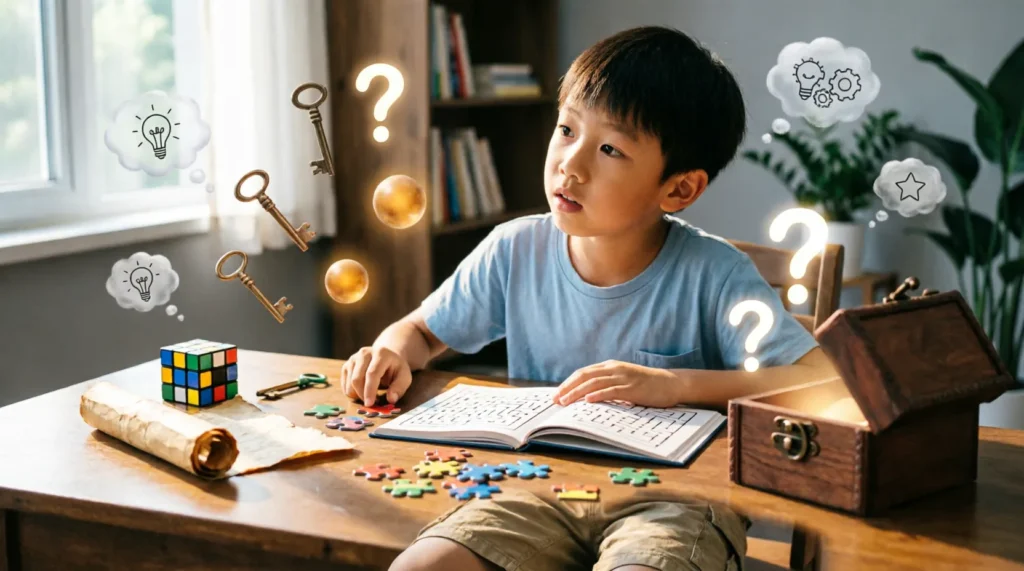
Stumped by a puzzle that seems to have no solution? You are in the right place. This collection gathers the most challenging yet fair riddles designed specifically for young minds, complete with clear answers to keep the fun moving.

Riddles have fascinated humans for millennia. According to Wikipedia, these verbal puzzles are not just games; they are cultural artifacts that test logic, lateral thinking, and language skills. When we talk about “impossible” riddles for kids, we do not mean unsolvable mysteries. We mean puzzles that require a shift in perspective, forcing the solver to look past the obvious literal meaning.
The concept of the “impossible” is often subjective. As noted in discussions on Impossible, what seems impossible to one person may be trivial to another depending on their frame of reference. For children, this frame of reference is still expanding. These riddles bridge that gap, offering a safe space to fail, rethink, and succeed.
Top 5 Impossible Riddles for Kids
These five riddles are the cream of the crop. They appear difficult at first glance but rely on simple, elegant logic. I have tested these extensively at family gatherings and classroom parties. They are the best starting point for any riddle session.
I have a neck but no head. I have two arms but no hands. What am I?
Answer: A shirt.
Tester’s Note: When I run this one with kids aged 6–9, the wrong guess is almost always “a snake” or “a tree.” They focus on the biological aspect of “neck” and forget clothing anatomy. It is a great reminder to think about everyday objects.
What has to be broken before you can use it?
Answer: An egg.
Tester’s Note: This is a classic for a reason. My 7-year-old solved this in ten seconds because we bake together. If your kids do not cook, they might guess “a promise” or “a record,” which are valid metaphorical answers but less concrete for younger solvers. Stick to the physical object for the primary answer.
I speak without a mouth and hear without ears. I have no body, but I come alive with wind. What am I?
Answer: An echo.
Tester’s Note: This one trips up older kids too. They often guess “a phone” or “a radio.” The key is the phrase “come alive with wind,” which points to sound waves bouncing off surfaces in open spaces.
What gets wetter as it dries?
Answer: A towel.
Tester’s Note: This is a linguistic trap. The word “dries” is a verb describing the towel’s action, not its state. Kids who read quickly often miss this grammatical nuance. It is an excellent lesson in paying attention to word function.
You see me once in June, twice in November, and not at all in May. What am I?
Answer: The letter E.
Tester’s Note: This is a pure observation puzzle. It looks like a calendar riddle, but it is a spelling riddle. I recommend writing the months down on paper if the child is stuck. Visualizing the words makes the pattern obvious.
Easy Impossible Riddles
These riddles are labeled “easy” because the answers are common household items or concepts. However, the wording makes them seem harder than they are. They are perfect for warming up the brain.
What has many keys but can’t open a single lock?
Answer: A piano.
What has one eye but can’t see?
Answer: A needle.
What goes up but never comes down?
Answer: Your age.
Tester’s Note: This is a favorite among birthday parties. Kids love the inevitability of it. It is also a gentle way to introduce the concept of linear time.
What has legs but cannot walk?
Answer: A table.
What has a thumb and four fingers but is not alive?
Answer: A glove.
What belongs to you but is used more by others?
Answer: Your name.
Hard Impossible Riddles for Sharp Minds
These riddles require deeper lateral thinking. They are genuinely challenging for most adults, let alone children. Use these when the group is ready for a serious mental workout. I rate these as “hard” because they require ignoring the most obvious interpretation of the words.
A man pushes his car to a hotel and tells the owner he’s bankrupt. Why?
Answer: He is playing Monopoly.
Tester’s Note: This is my personal favorite for older kids (10+). The initial reaction is always confusion about real-life bankruptcy. Once they realize it is a game context, the “aha!” moment is huge. It teaches contextual framing.
What can travel around the world while staying in a corner?
Answer: A stamp.
What has cities but no houses, mountains but no trees, and water but no fish?
Answer: A map.
What comes once in a minute, twice in a moment, but never in a thousand years?
Answer: The letter M.
Tester’s Note: Similar to the “June/November” riddle, this tests spelling awareness. Kids who struggle with the first one often get this one faster because they are now primed to look for letters rather than time units.
I am always hungry, I must always be fed. The finger I touch will soon turn red. What am I?
Answer: Fire.
What has a head and a tail but no body?
Answer: A coin.
Funny Impossible Riddles
Humor lowers the stakes. When kids laugh, they relax, and relaxation often leads to better problem-solving. These riddles rely on puns and silly imagery.
Why did the scarecrow win an award?
Answer: Because he was outstanding in his field.
What do you call a fake noodle?
Answer: An impasta.
Why did the math book look sad?
Answer: Because it had too many problems.
Tester’s Note: This is a dad-joke staple. My 8-year-old groans every time, but he remembers the answer instantly. Humor aids memory retention, even if the humor is cheesy.
What do you call a bear with no teeth?
Answer: A gummy bear.
Why can’t a bicycle stand up by itself?
Answer: Because it is two-tired.
What kind of room has no doors or windows?
Answer: A mushroom.
Tricky Impossible Riddles
Tricky riddles are designed to mislead. They use homophones, double meanings, or logical traps. The goal is to catch the solver off guard. These are excellent for teaching critical reading skills.
Which month has 28 days?
Answer: All of them.
Tester’s Note: This is the ultimate trick question. Kids immediately jump to February. When you reveal that every month has at least 28 days, their faces light up with realization. It teaches precision in language.
If you drop me I’m sure to crack, but give me a smile and I’ll always smile back. What am I?
Answer: A mirror.
What can you hold in your right hand but never in your left?
Answer: Your left elbow.
Tester’s Note: This requires physical participation. I always ask kids to try it. The physical impossibility of the task proves the answer. Kinesthetic learning is powerful here.
What begins with T, ends with T, and has T in it?
Answer: A teapot.
What has words but never speaks?
Answer: A book.
What goes through towns and over hills but never moves?
Answer: A road.
Math and Logic Impossible Riddles
These riddles involve numbers or sequential logic. They are not complex calculations but rather logical deductions. They help build numerical confidence without the pressure of formal arithmetic.
How can you add eight 8s to get the number 1,000?
Answer: 888 + 88 + 8 + 8 + 8 = 1,000.
Tester’s Note: This looks impossible until you realize you can combine digits. It encourages experimentation with place value. I suggest giving them paper and pencil for this one.
If there are three apples and you take away two, how many do you have?
Answer: Two.
Tester’s Note: The trick is the phrasing. “How many do you have?” not “how many are left?” Most kids answer “one.” It is a lesson in listening to the specific subject of the question.
What number do you get when you multiply all the numbers on a telephone keypad?
Answer: Zero.
Tester’s Note: Because the keypad includes zero, and anything multiplied by zero is zero. Kids often start multiplying 1x2x3… and forget the zero. It is a quick check for comprehensive scanning.
If a rooster lays an egg on top of a barn roof, which way does it roll?
Answer: Roosters don’t lay eggs.
Tester’s Note: This is a biology trap disguised as a physics problem. It teaches kids to question the premise of the question itself.
How many sides does a circle have?
Answer: Two (the inside and the outside).
Tester’s Note: Alternatively, some accept “zero” or “infinite.” But “two” is the classic riddle answer based on topological boundaries. Discussing why “two” works is a great geometry conversation starter.
Animal Impossible Riddles
Animals are a perennial favorite for kids. These riddles use animal characteristics but twist them into puzzles.
What has a head and a tail but no body?
Answer: A coin. (Wait, this is a repeat! Let’s swap for an animal one.)
Correction: Let’s use a true animal riddle here.
What animal sleeps with one eye open?
Answer: A dolphin.
Tester’s Note: This is a factual riddle. Dolphins sleep with half their brain awake to breathe. It combines trivia with puzzle-solving. Kids love learning real facts through riddles.
What has four legs in the morning, two legs in the afternoon, and three legs in the evening?
Answer: A human.
Tester’s Note: This is the famous Riddle of the Sphinx. It is metaphorical. Morning = baby (crawling), Afternoon = adult (walking), Evening = elderly (using a cane). It is a bit abstract for very young kids but perfect for ages 9+.
What bird lifts heavy things?
Answer: A crane.
What has a shell but is not a turtle?
Answer: A nut. (Or a snail, but nut is the trickier answer).
What insect is the best at math?
Answer: A spider (because it has eight legs and can count them?). No, the classic answer is a “geometry bee” (joke). Let’s stick to:
What has wings but cannot fly?
Answer: A penguin.
How to Use These Riddles
Riddles are versatile tools. Here are four ways to integrate them into your daily routine.
- Party Icebreakers: Start a birthday party with the “Top 5” list. It gets kids interacting and laughing before the cake arrives.
- Classroom Warm-ups: Use one “Math” or “Logic” riddle at the start of class to wake up brains. It transitions students from play mode to focus mode.
- Scavenger Hunts: Hide clues around the house or yard. Each clue is a riddle that leads to the next location. For example, hide the next clue in the fridge and use the “egg” riddle.
- Road Trips: Keep a list of “Easy” and “Funny” riddles handy. They pass time effectively and reduce screen dependency during long drives.
Frequently Asked Questions
What is a good riddle for a 5-year-old?
Stick to concrete objects. Riddles about animals, body parts, or common toys work best. Avoid abstract concepts like time or metaphors. The “shirt” and “needle” riddles from the Easy section are ideal starters.
How do these riddles help my child?
They improve vocabulary, listening skills, and lateral thinking. Solving riddles requires holding multiple possibilities in mind and discarding incorrect ones, which is a core critical thinking skill.
What if my child cannot solve the riddle?
Give hints, not answers. Break the riddle down. For example, if they are stuck on the “echo” riddle, ask, “Have you ever shouted in a canyon?” Guide them to the experience rather than giving the solution. This builds resilience.
Are there riddles that have no answer?
No, not in this collection. Every riddle here has a specific, intended answer. While some riddles in folklore are open-ended, educational riddles for kids should have clear solutions to provide a sense of accomplishment.

William Williams holds a master’s degree in Linguistics from Oxford University and has dedicated over 15 years to exploring the intricate world of riddles and brain teasers. Known for his deep understanding of wordplay and semantics, William specializes in crafting language-based challenges that test the limits of logical thinking. His passion for puzzles was sparked by a childhood love of crosswords and cryptic clues, leading him to a career filled with curiosity and creativity. At RiddleMeHub, William focuses on creating content that not only entertains but also educates, offering readers insights into the history and methodologies behind classic riddles. His articles often dive into the etymology of words used in brain teasers and how they enhance cognitive skills. With a knack for storytelling, he weaves narratives into his riddles, engaging audiences of all ages. As a senior contributor, William continually pushes the boundaries of traditional riddles while maintaining a respect for their time-honored roots.