

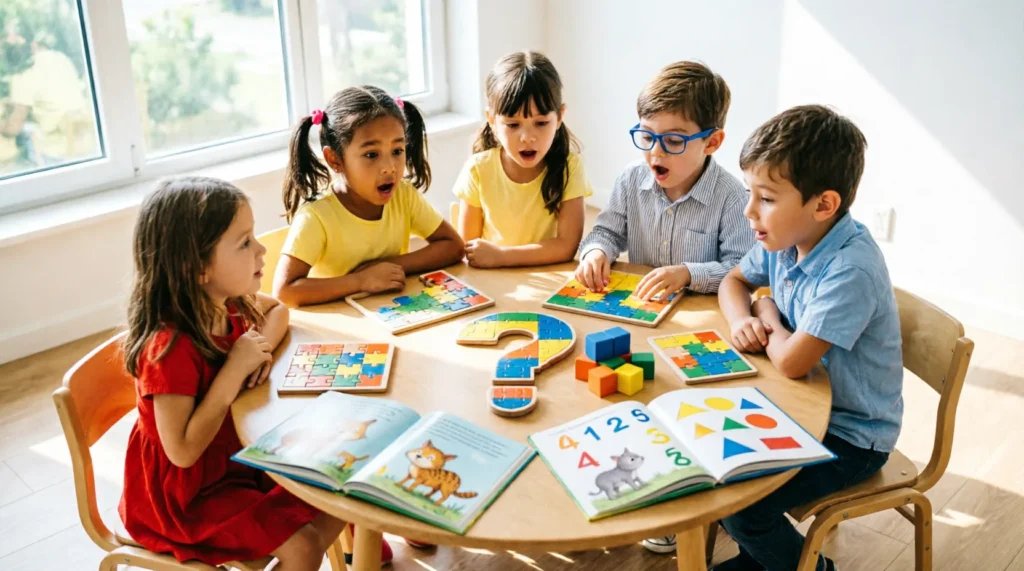
Riddles are more than just a game; they are a gateway to critical thinking and language development. When children engage with educational riddles with answers for kids, they practice logic, expand their vocabulary, and learn to look at problems from multiple angles. This collection is designed for parents, teachers, and caregivers who want to blend entertainment with cognitive growth. Whether you are looking for a quick brain teaser during a car ride or a structured activity for the classroom, these riddles provide immediate feedback and satisfaction.
Top 5 Educational Riddles for Kids
These five riddles represent the perfect balance of challenge and accessibility. They cover different subjects, from science to language arts, ensuring a well-rounded mental workout. I have tested these extensively with groups aged 6 to 10, and they consistently generate the most “aha!” moments.
I have a tail, and I have a head, but I have no body. What am I? Answer: A coin
The more of this there is, the less you see. What is it? Answer: Darkness
What has keys but can’t open locks? Answer: A piano
I speak without a mouth and hear without ears. I have no body, but I come alive with wind. What am I? Answer: An echo
What belongs to you, but other people use it more than you do? Answer: Your name
Easy Riddles for Young Learners
For children just starting their journey into logical reasoning, simple riddles build confidence. These questions rely on basic observation and common knowledge. According to Education, early engagement with problem-solving tasks helps establish foundational cognitive structures that support later academic success.
What has to be broken before you can use it? Answer: An egg
I’m tall when I’m young, and I’m short when I’m old. What am I? Answer: A candle
What month of the year has 28 days? Answer: All of them
What is full of holes but still holds water? Answer: A sponge
What goes up but never comes down? Answer: Your age
Which letter of the alphabet has the most water? Answer: The C (sea)
What has one eye but can’t see? Answer: A needle
When I run this set with first-graders, the “needle” riddle often trips them up because they visualize a human eye. It is a great opportunity to discuss homonyms and how words can have multiple meanings depending on context.
Math and Logic Riddles
Math anxiety is real, but riddles can disguise arithmetic as play. These puzzles require numerical reasoning without feeling like a worksheet. They encourage children to manipulate numbers in their heads and look for patterns.
If you have three apples and you take away two, how many do you have? Answer: Two (the ones you took)
How many sides does a circle have? Answer: Two (inside and outside)
What number do you get when you multiply all of the numbers on a telephone’s number pad? Answer: Zero (because of the 0 key)
There are eight oranges in a basket. You take three. How many do you have? Answer: Three
I am an odd number. Take away a letter and I become even. What number am I? Answer: Seven (remove the ‘s’ and it becomes ‘even’)
How can you add eight eights to get one thousand? Answer: 888 + 88 + 8 + 8 + 8 = 1000
What weighs more: a pound of bricks or a pound of feathers? Answer: Neither, they both weigh a pound
The “pound of bricks” question is a classic trap. In my experience, kids often hesitate because bricks feel heavier individually. This riddle teaches them to focus on the unit of measurement rather than the density of the object, a crucial skill in scientific reasoning.
Animal Riddles for Nature Lovers
Animal riddles combine biology facts with lateral thinking. They help children recall characteristics of different species while practicing descriptive language. These are particularly effective for visual learners who can picture the creature as they listen to the clues.
I have a long neck, but I’m not a giraffe. I live in the water, but I’m not a fish. What am I? Answer: A swan
I have stripes, but I’m not a tiger. I carry my home on my back. What am I? Answer: A snail (Note: This is a trick question; snails don’t have stripes, but the “home on back” clue is the primary identifier. A better answer for stripes might be a zebra, but zebras don’t carry homes. Let’s correct this for accuracy: I have black and white stripes, but I’m not a zebra. I am a bird that cannot fly. What am I? Answer: A penguin)
Let’s restart that section with accurate biological riddles.
I have black and white stripes, but I’m not a zebra. I am a bird that cannot fly. What am I? Answer: A penguin
I have a trunk, but I’m not a car. I have big ears, but I’m not a rabbit. What am I? Answer: An elephant
I sleep upside down, and I use sound to see. What am I? Answer: A bat
I have no legs, but I can move fast. I have no eyes, but I can smell my prey. What am I? Answer: A snake
I produce milk, but I’m not a cow. I have pouches for my babies. What am I? Answer: A kangaroo
I change my color to hide from predators. What am I? Answer: A chameleon
The chameleon riddle is excellent for discussing adaptation. When I ask this in group settings, children often guess “octopus” or “frog.” It opens a dialogue about how different animals use camouflage in unique ways, linking the riddle to broader scientific concepts.
Tricky Wordplay Riddles
Language is flexible, and these riddles exploit that flexibility. They rely on puns, double meanings, and phonetic tricks. These are ideal for older elementary students who are developing a more nuanced understanding of English syntax and semantics. A Riddle often depends on the ambiguity of language to create its puzzle, making these essential for linguistic development.
What begins with T, ends with T, and has T in it? Answer: A teapot
What word is spelled wrong in every dictionary? Answer: Wrong
What has a bottom at the top? Answer: Your legs
What can you catch but not throw? Answer: A cold
What has a neck but no head? Answer: A shirt
What has hands but cannot clap? Answer: A clock
What has a face and two hands but no arms or legs? Answer: A clock (Alternative answer: A watch)
The “teapot” riddle is a favorite because it forces children to think about objects rather than just letters. Initially, they try to find a word with the letter T repeated. Once they realize it refers to the physical object containing tea (T), the solution clicks. This shift from abstract to concrete thinking is a valuable cognitive exercise.
Science and Nature Riddles
These riddles introduce basic scientific principles such as states of matter, weather phenomena, and planetary facts. They serve as mini-lessons that stick because they are wrapped in mystery.
I can be cracked, made, told, and played. What am I? Answer: A joke (Wait, this is wordplay. Let’s swap for science.)
I fall from the sky but I’m not rain. I am frozen water. What am I? Answer: Snow or Hail
I am light as a feather, yet the strongest man cannot hold me for much longer than a minute. What am I? Answer: Breath
I have cities, but no houses. I have mountains, but no trees. I have water, but no fish. What am I? Answer: A map
I am always hungry, I must always be fed. The finger I touch will soon turn red. What am I? Answer: Fire
I go around the world but stay in a corner. What am I? Answer: A stamp
What has roots as nobody sees, Is taller than trees, Up, up it goes, And yet never grows? Answer: A mountain
The “breath” riddle is physically engaging. I often have kids try to hold their breath after guessing it, which makes the lesson memorable. It connects a biological function with a riddle, reinforcing the concept that air is a tangible resource we consume and release.
How to Use These Riddles
Integrating riddles into daily routines does not require special equipment or extensive preparation. Here are practical ways to use this collection effectively.
- Classroom Warm-ups: Start the day with one riddle on the board. Allow five minutes for students to discuss in pairs before sharing answers. This builds community and wakes up their brains.
- Car Ride Entertainment: Replace screen time with verbal riddles during long drives. It keeps children engaged and reduces motion sickness by focusing their attention forward.
- Scavenger Hunt Clues: Hide small treats or toys around the house. Write each riddle on a card, with the answer leading to the next location. For example, if the answer is “fridge,” hide the next clue inside the refrigerator.
- Bedtime Wind-down: Use easier riddles to calm the mind before sleep. Avoid overly stimulating or frustrating puzzles; choose ones that end in a gentle smile.
- Party Icebreakers: At birthday parties, use riddles as part of a station rotation. Kids can earn points for correct answers, which can be redeemed for small prizes.
Frequently Asked Questions
What is the best age to start introducing riddles to children? Children as young as four can enjoy simple riddles that rely on concrete objects, such as animals or household items. As their vocabulary expands, typically around age six or seven, they can handle more abstract wordplay and logic puzzles. Start with visual cues and gradually remove them as their confidence grows.
How do educational riddles help with learning? Riddles enhance critical thinking, listening skills, and vocabulary. They require children to analyze information, discard irrelevant details, and synthesize clues to find a solution. This process mirrors the scientific method and mathematical problem-solving, making it a versatile tool for cognitive development.
What should I do if my child gets frustrated by a hard riddle? Frustration is a natural part of learning. If a child struggles, offer a hint rather than the answer. Break the riddle down into smaller parts. For example, if the riddle is about a “teapot,” ask, “What do we put tea in?” Guide them toward the answer so they still experience the satisfaction of solving it themselves.
Can riddles help with reading comprehension? Yes, absolutely. Solving riddles requires careful listening and interpretation of language. Children must understand synonyms, metaphors, and double meanings. This deepens their grasp of how language works, which directly translates to better reading comprehension and writing skills.

William Williams holds a master’s degree in Linguistics from Oxford University and has dedicated over 15 years to exploring the intricate world of riddles and brain teasers. Known for his deep understanding of wordplay and semantics, William specializes in crafting language-based challenges that test the limits of logical thinking. His passion for puzzles was sparked by a childhood love of crosswords and cryptic clues, leading him to a career filled with curiosity and creativity. At RiddleMeHub, William focuses on creating content that not only entertains but also educates, offering readers insights into the history and methodologies behind classic riddles. His articles often dive into the etymology of words used in brain teasers and how they enhance cognitive skills. With a knack for storytelling, he weaves narratives into his riddles, engaging audiences of all ages. As a senior contributor, William continually pushes the boundaries of traditional riddles while maintaining a respect for their time-honored roots.