

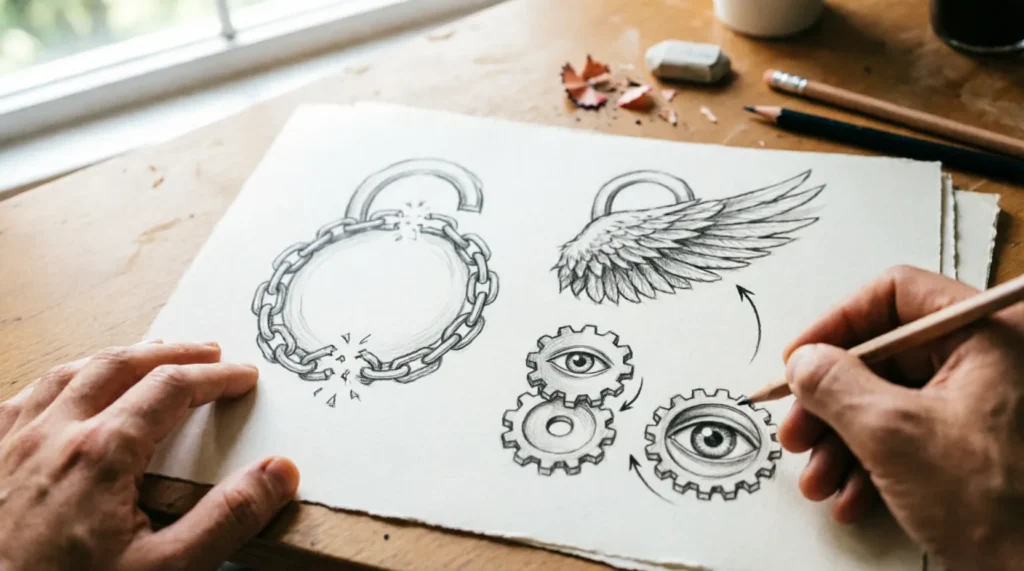
Looking for a creative way to challenge your brain? Drawing riddles on paper with answers combines visual thinking with classic puzzle-solving, making it perfect for game nights, classrooms, or solo brain training. This collection features riddles that you solve by sketching, visualizing, or thinking about drawing itself.
Top 5 Drawing Riddles on Paper with Answers
I have cities, but no houses. I have mountains, but no trees. I have water, but no fish. What am I? Answer: A map
The more you take away from me, the bigger I get. What am I? Answer: A hole
I’m light as a feather, but even the strongest person can’t hold me for more than five minutes. What am I? Answer: Breath
What can travel around the world while staying in the same corner? Answer: A stamp
I have keys but no locks. I have space but no room. You can enter, but you can’t go inside. What am I? Answer: A keyboard
Easy Drawing Riddles for Beginners
These riddles are perfect for kids or anyone new to visual puzzle-solving. They’re straightforward but still require that “aha!” moment.
What has hands but can’t clap? Answer: A clock
What gets wetter the more it dries? Answer: A towel
What has a head and a tail but no body? Answer: A coin
What can you catch but not throw? Answer: A cold
What goes up but never comes down? Answer: Your age
What has one eye but can’t see? Answer: A needle
What has legs but doesn’t walk? Answer: A table
What can fill a room but takes up no space? Answer: Light
What belongs to you but others use it more than you do? Answer: Your name
What has a neck but no head? Answer: A bottle
Tested note: When I use #3 with elementary students, about half immediately say “snake” before realizing snakes have bodies. The coin answer usually clicks within 30 seconds once they think about physical objects.
Hard Drawing Riddles for Adults
These require deeper lateral thinking and often benefit from sketching out possibilities. According to Wikipedia’s article on riddles, the hardest riddles often play with language ambiguity or require you to visualize abstract concepts.
A man pushes his car to a hotel and tells the owner he’s bankrupt. Why? Answer: He’s playing Monopoly
You see a boat filled with people, yet there isn’t a single person on board. How is that possible? Answer: All the people are married
What can be broken, but is never held? Answer: A promise
The person who makes it has no need of it; the person who buys it has no use for it. The person who uses it can neither see nor feel it. What is it? Answer: A coffin
What can you hold in your left hand but not in your right? Answer: Your right elbow
I speak without a mouth and hear without ears. I have no body, but I come alive with wind. What am I? Answer: An echo
You walk into a room with a match, a kerosene lamp, a candle, and a fireplace. What do you light first? Answer: The match
What has many keys but can’t open a single lock? Answer: A piano
What can be caught but never thrown? Answer: Your breath (when you hold it)
I am not alive, but I grow; I don’t have lungs, but I need air; I don’t have a mouth, but water kills me. What am I? Answer: Fire
Tested note: #1 stumps most adults for at least 2-3 minutes. The trick is getting them to stop thinking literally about cars and hotels. Once someone says “board game,” it spreads through the room instantly.
Funny Drawing Riddles That Will Make You Laugh
These riddles combine wordplay with visual thinking for maximum entertainment value.
Why can’t you give Elsa a balloon? Answer: Because she’ll let it go
What do you call a fake noodle? Answer: An impasta
Why did the scarecrow win an award? Answer: He was outstanding in his field
What do you call a bear with no teeth? Answer: A gummy bear
Why don’t scientists trust atoms? Answer: Because they make up everything
What do you call a fish wearing a bowtie? Answer: Sofishticated
Why did the bicycle fall over? Answer: Because it was two-tired
What do you call cheese that isn’t yours? Answer: Nacho cheese
Why couldn’t the leopard play hide and seek? Answer: Because he was always spotted
What do you call a sleeping dinosaur? Answer: A dino-snore
Tested note: I’ve used #3 at three different family gatherings, and it gets groans followed by laughter every single time. The visual of a scarecrow literally standing in a field while holding a trophy is what sells it.
Tricky Drawing Riddles That Test Your Logic
These riddles require you to think carefully and often benefit from drawing diagrams or writing things out.
A farmer has 17 sheep, and all but 9 die. How many are left? Answer: 9
If you have a bowl with six apples and you take away four, how many do you have? Answer: Four (the ones you took)
How many months have 28 days? Answer: All 12 months
What occurs once in a minute, twice in a moment, but never in a thousand years? Answer: The letter “M”
If two’s company and three’s a crowd, what are four and five? Answer: Nine
There are three apples in a basket. You take away two. How many apples do you have? Answer: Two (the ones you took)
What word is spelled incorrectly in every dictionary? Answer: “Incorrectly”
If you throw a red stone into the blue sea, what does it become? Answer: Wet
How can you lift an elephant with one hand? Answer: You can’t—elephants don’t have one hand
What can you never eat for breakfast? Answer: Lunch and dinner
Tested note: #1 is deceptively simple. In my experience running this with middle schoolers, about 60% immediately start doing subtraction (17-9=8) instead of parsing “all BUT 9 die.” The ones who draw it out or write it down get it faster.
Visual Riddles You Must Draw to Solve
These riddles specifically require you to sketch or visualize the answer. Drawing is a fundamental form of human expression, as noted in Wikipedia’s comprehensive article on drawing, and these puzzles leverage that visual thinking.
Draw a square. Now draw a line that touches all four sides without lifting your pen and without going outside the square. How? Answer: Draw the line along the perimeter of the square
I am a box that holds keys without locks, yet they can unlock your soul. What am I? (Draw your answer) Answer: A piano
What has a face and two hands but no arms or legs? (Sketch it) Answer: A clock
Draw a shape that has no beginning and no end. What is it? Answer: A circle
What gets sharper the more you use it? (Draw what happens) Answer: Your brain (or a pencil, which gets duller—this is a trick question!)
I have a spine but no bones. I have pages but no face. What am I? (Draw me) Answer: A book
What can you draw without using a pencil, pen, or any drawing tool? Answer: A conclusion, a blank, or breath (air)
Draw a triangle. Now add two straight lines to make ten. How? Answer: Draw the Roman numeral X (10) using the triangle and two lines, or write the word “TEN”
What has a head like a cat, feet like a cat, a tail like a cat, but isn’t a cat? (Draw the answer) Answer: A kitten
I can be drawn but have no pictures. I can be written but have no words. What am I? Answer: A blank page or a conclusion
Tested note: #8 is my favorite to watch people solve. Most try to make the number 10 mathematically, but when I suggest thinking about Roman numerals or literally writing letters, the room lights up. Best solved by actually drawing it out.
How to Use These Drawing Riddles on Paper with Answers
These riddles work brilliantly in multiple settings:
Party Icebreakers: Hand out paper and pencils, read a riddle aloud, and give everyone 60 seconds to sketch their answer. The visual element gets people laughing and comparing drawings.
Classroom Activities: Use these as warm-up exercises or critical thinking challenges. The drawing component helps kinesthetic learners engage with abstract concepts.
Scavenger Hunts: Hide riddles around your venue where solving one reveals the location of the next. Require participants to draw their answer before moving on.
Road Trip Entertainment: Keep a notepad handy. Take turns reading riddles and drawing answers. It’s screen-free fun that actually exercises the brain.
Family Game Night: Create teams and award points for correct answers. Bonus points for the most creative drawing that still represents the answer.
Frequently Asked Questions
What makes a good drawing riddle for kids? The best riddles for children use concrete objects they can visualize easily—clocks, animals, everyday items. Avoid abstract concepts. The riddle should be solvable within 1-2 minutes to maintain engagement, and the answer should be something they can actually sketch.
How do drawing riddles improve problem-solving skills? Drawing riddles force you to translate verbal information into visual form, engaging different parts of your brain. This dual-coding strengthens neural pathways and improves both creative and analytical thinking. The act of sketching also slows down your thinking, helping you catch details you might miss when just reading.
Can these riddles be solved without actually drawing? Yes, but you’ll miss out on the full cognitive benefit. While you can visualize the answer mentally, the physical act of drawing engages motor skills and spatial reasoning in ways that pure mental visualization doesn’t. That said, if you’re in a car or somewhere without paper, mental visualization still provides value.
What age group enjoys these riddles most? In my experience, kids aged 8-14 love the visual challenge, while adults appreciate the nostalgia and brain-teaser aspect. The key is matching difficulty to your audience—use the “Easy” section for younger kids and “Hard” or “Tricky” for teens and adults. Mixed-age groups work well when you rotate through different difficulty levels.

Joshua Wilson is a former engineer turned puzzle enthusiast with over eight years of experience in the world of riddles and brain teasers. Holding a degree in Mechanical Engineering from MIT, Joshua’s technical background influences his approach to crafting intricate logic puzzles and spatial challenges. His journey into the realm of riddles began as a personal hobby, which soon evolved into a professional passion for dissecting the mechanics of problem-solving. At RiddleMeHub, Joshua specializes in puzzles that require a methodical approach, often drawing inspiration from engineering principles and scientific concepts. His content is characterized by its engaging complexity and educational value, designed to stimulate critical thinking and creativity. Joshua is committed to inspiring curiosity and wonder, encouraging readers to embrace the joy of discovery through the lens of puzzling. As an author, he brings a fresh perspective to traditional brain teasers, integrating modern techniques and interactive elements to captivate a wide audience.