

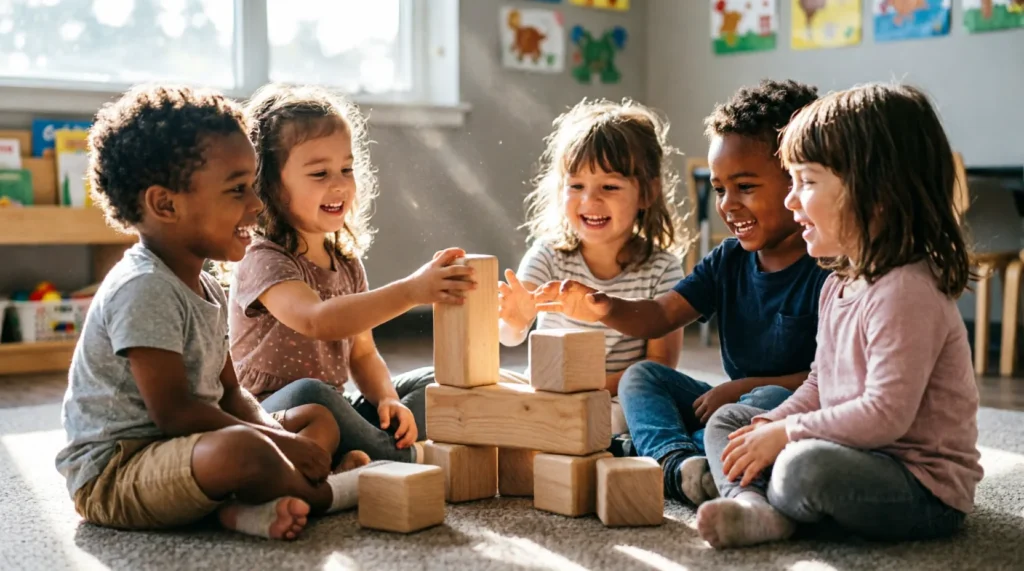
Teaching the ABCs doesn’t have to mean endless flashcards and repetitive songs. These alphabet riddles for kindergarten with answers turn letter recognition into a playful guessing game that keeps little minds engaged and giggling.
Top 5 Alphabet Riddles for Kindergarten
These are the absolute best icebreakers I use when introducing letters to a brand-new group of early learners. They rely on simple shapes and highly recognizable sounds.
I am the very first letter of the alphabet, and I start yummy words like “apple” and “apricot.” What am I? Answer: The letter A.
I look like a curvy snake and make a hissing sound. I am the first letter in “sun” and “sand.” What letter am I? Answer: The letter S. When I run this one with kids, the wrong guess is always the animal “snake” itself. I have to gently prompt them: “But what letter makes that hissing sound?”
I have two big round humps like a camel, and I start the word “ball.” Who am I? Answer: The letter B.
I look like a big, empty donut. I am the very first letter in “octopus” and “orange.” What am I? Answer: The letter O.
I stand tall and straight like a tree trunk, and I start the word “tiger.” What letter am I? Answer: The letter T.
Mastering the Alphabet is a major milestone for early readers, forming the standardized system of letters they will use to write and decode language for the rest of their lives. These first five riddles build immediate confidence.
Easy Alphabet Riddles
Once they have the top five down, I move to these slightly more descriptive shape-based clues.
I am the very last letter of the entire alphabet, and I start the word “zebra.” What am I? Answer: The letter Z.
I look like a tall ladder with one missing rung. I am the first letter in “monkey” and “moon.” Answer: The letter M. My 5-year-old nephew always shouts “Macaroni!” when I ask for M words. It usually takes him a solid minute of giggling to finally land on the right letter shape.
I am a circle with a straight line going down my right side. I start the word “pig” and “pizza.” Answer: The letter P.
I look like a little fishing hook, and I am the first letter in “jump” and “jelly.” Answer: The letter J.
I look like a cup that can hold water. I am the first letter in “umbrella” and “up.” Answer: The letter U.
I look like a zigzag or a bright lightning bolt in the sky. I start the word “zip.” Answer: The letter Z.
I look like an upside-down chair with four legs pointing up. I start the word “hat.” Answer: The lowercase letter h.
I am just a simple, perfect circle! I am the first letter in “octopus” and “owl.” Answer: The letter O.
Animal-Themed Alphabet Riddles
Kids love animals, so tying letters to their favorite creatures is a guaranteed win for holding their attention.
I am the first letter in “elephant” and “eagle,” and I have three horizontal lines. Answer: The letter E.
I start the word “kangaroo” and look like a person kicking their leg out. Answer: The letter K.
I am the first letter of “lion” and look like a backwards J standing tall. Answer: The letter L.
I start “penguin” and look like a balloon tied to a straight string. Answer: The lowercase letter p.
I start “whale” and look like three sharp mountain peaks next to each other. Answer: The letter W. This one looks hard to adults but isn’t. Kindergarteners solve it in ten seconds because they immediately start drawing the three mountains of a W in the air with their fingers while making whale noises.
I start “giraffe” and look like a little loop with a tail hanging down. Answer: The lowercase letter g.
I start “bear” and have one big round hump on the right side. Answer: The lowercase letter b.
I start “fox” and look like two crossing swords or a big plus sign. Answer: The letter X.
Funny Alphabet Riddles
These rely on puns and homophones. They are fantastic for developing phonological awareness, which is the ability to hear and manipulate sounds in words.
What letter is a buzzing, stinging insect? Answer: The letter B (sounds like “bee”). This is a classic pun, but the common wrong answer from kids is literally “a bug.” I always have to clarify that we are looking for a single letter that sounds like the bug’s name.
What letter is a massive body of salt water where fish live? Answer: The letter C (sounds like “sea”).
What letter is a hot, comforting drink made from steeping leaves? Answer: The letter T (sounds like “tea”).
What letter is a tiny, round, green vegetable? Answer: The letter P (sounds like “pea”).
What letter always asks a question when you say its name out loud? Answer: The letter Y (sounds like “why”).
What letter is the body part on your face that you use to see? Answer: The letter I (sounds like “eye”).
What letter points right back at yourself when you say it? Answer: The letter I (sounds like the pronoun “I”).
What letter sounds exactly like a pirate’s favorite growling word? Answer: The letter R (sounds like “ar”).
Short Alphabet Riddles
Sometimes you just need a rapid-fire round to keep the energy up. These short clues focus on beginning and ending sounds, which forces kids to listen all the way through a word.
I am the very first letter in the word “dog.” Answer: The letter D.
I am the very last letter in the word “cat.” Answer: The letter T.
I am the very first letter in the word “milk.” Answer: The letter M.
I am the very last letter in the word “shoe.” Answer: The letter E. This tests phonemic awareness at the end of the word, which is genuinely hard for early readers. Most kids blurt out “S” because that is the first, loudest sound they hear when the word is spoken.
I am the very first letter in the word “ball.” Answer: The letter B.
I am the very last letter in the word “sun.” Answer: The letter N.
I am the very first letter in the word “run.” Answer: The letter R.
I am the very last letter in the word “jump.” Answer: The letter P.
Tricky Alphabet Riddles
These require a bit more lateral thinking. I save these for the end of the week when the kids are feeling confident and ready for a slight challenge.
I am a letter that looks exactly like a number. I am the first letter in “Gorilla.” Answer: The letter G (looks like a 6).
I am a vowel, but I look like a tall flagpole. I start “igloo.” Answer: The lowercase letter i.
I have no straight lines at all, just curves. I start the word “snake.” Answer: The letter S.
I am the only letter that has a dot sitting all by itself above me. Answer: The lowercase letters i and j.
I look like a pair of open scissors pointing up. I start the word “violin.” Answer: The letter V.
I look like a table with only three legs. I start the word “frog.” Answer: The letter F.
I am made of two perfectly straight lines crossing each other. I start “xylophone.” Answer: The letter X.
I look like a coiled spring or a bouncy slinky. I start the word “queen.” Answer: The letter Q.
With a Twist Alphabet Riddles
These riddles play with spelling, silent letters, and word manipulation. They are brilliant for kids who are just starting to realize that letters combine to make entirely new sounds.
I am a letter you can find hiding twice in the word “apple.” Answer: The letter P.
I am a letter you can find hiding three times in the word “banana.” Answer: The letter A.
I am the letter you must remove from “smile” to leave a long distance. Answer: The letter S (smile becomes mile).
I am the silent letter at the very end of the word “knee.” Answer: The letter E.
I am the letter that makes the “shh” sound when paired with H in the word “shoe.” Answer: The letter S.
I am the letter you add to “cat” to make it mean more than one. Answer: The letter S.
I am the letter that makes the “ch” sound in the word “chair.” Answer: The letter C.
I am the letter that makes a hard sound in “goat” but a soft “J” sound in “giraffe.” Answer: The letter G.
How to use these riddles
You don’t just have to sit in a circle and read these off a piece of paper. Here is how I integrate them into different environments to keep things fresh.
- Party Icebreakers: Tape a single letter riddle to the back of each child’s chair at a birthday party. Before they can eat their cake, they have to solve their riddle and find the matching magnetic letter hidden somewhere in the room.
- Classroom Morning Meetings: According to Kindergarten, this early educational stage focuses heavily on social, physical, and cognitive development through play, making riddles a perfect, developmentally appropriate fit for the curriculum. I use one “Riddle of the Day” during calendar time to get their brains warmed up.
- Scavenger Hunts: Write the riddles on index cards and hide them around the house or playground. The answer to each riddle tells the kids which physical object they need to go find next (e.g., if the answer is B, they have to run and touch a “ball” or a “book”).
- Road Trip Sanity Savers: Forget the tablet for an hour. Take turns firing these off in the car. The short and funny riddles work best here, as they don’t require the kids to visualize complex letter shapes while looking out the window.
Frequently Asked Questions
What is a good riddle for kindergarteners? A good riddle for this age group focuses on highly concrete concepts. Stick to basic shapes (circles, lines, humps) and the most common phonetic sounds. Avoid abstract concepts or complex wordplay until they are confidently reading simple sight words.
How do these alphabet riddles work? They target two distinct early literacy skills simultaneously: visual discrimination (recognizing the physical shape of a letter) and phonemic awareness (hearing the sound a letter makes at the beginning or end of a word). By combining both, you create stronger neural pathways for reading.
Why are some answers lowercase and some uppercase? Early education introduces both cases, but they serve different purposes. I use uppercase riddles for letters that stand alone or start proper nouns, and lowercase riddles to describe the shapes kids actually see most often in books. Pointing out the “tall” versus “short” letters is a great way to naturally introduce the concept of the baseline and midline in handwriting.

William Williams holds a master’s degree in Linguistics from Oxford University and has dedicated over 15 years to exploring the intricate world of riddles and brain teasers. Known for his deep understanding of wordplay and semantics, William specializes in crafting language-based challenges that test the limits of logical thinking. His passion for puzzles was sparked by a childhood love of crosswords and cryptic clues, leading him to a career filled with curiosity and creativity. At RiddleMeHub, William focuses on creating content that not only entertains but also educates, offering readers insights into the history and methodologies behind classic riddles. His articles often dive into the etymology of words used in brain teasers and how they enhance cognitive skills. With a knack for storytelling, he weaves narratives into his riddles, engaging audiences of all ages. As a senior contributor, William continually pushes the boundaries of traditional riddles while maintaining a respect for their time-honored roots.