

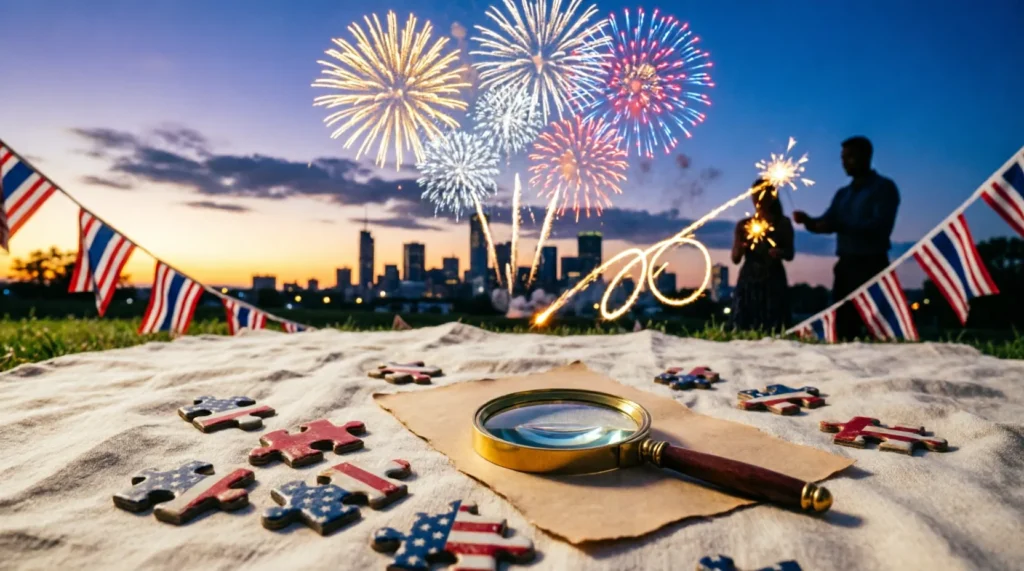
Nothing kicks off a backyard barbecue quite like a mental challenge that gets everyone arguing over the answer before the burgers hit the grill. These 4th of July riddles for adults are designed to be tricky enough to stump your history-buff uncle but accessible enough for your cousins who just showed up for the potato salad. Whether you are hosting a patriotic party or just looking to pass the time while waiting for the fireworks to start, this collection offers the perfect blend of historical wit and wordplay.
Top 5 4th of July Riddles
These are the cream of the crop, the ones that consistently get the loudest groans and the biggest cheers when the answer is revealed. I have tested these at multiple family reunions, and they strike the best balance between difficulty and satisfaction.
I am red, white, and blue, but I am not a flag. I fly without wings and cry without eyes. What am I? Answer: A firework rocket
I have stars but no sky. I have stripes but no shirt. I wave but have no hands. What am I? Answer: The American Flag
I was signed in Philadelphia, but I am not a letter. I declared freedom, but I am not a person. What am I? Answer: The Declaration of Independence
I come out once a year on a specific date, but I am not a holiday. I am bright, loud, and short-lived. What am I? Answer: Fireworks display
I have a torch but no flame. I stand in New York but am not a building. I welcome millions but never speak. What am I? Answer: The Statue of Liberty
Easy Patriotic Riddles
These are great warm-ups to get the brain engaged without causing immediate frustration. They rely on common symbols associated with Independence Day, making them accessible for mixed-age groups where adults might be helping younger relatives guess.
What month did the United States declare its independence? Answer: July
How many original colonies were there? Answer: 13
What color are the stars on the American flag? Answer: White
Who is known as the father of our country? Answer: George Washington
What bird is the national symbol of the United States? Answer: The Bald Eagle
What do we call the first ten amendments to the Constitution? Answer: The Bill of Rights
In what year did the US declare independence? Answer: 1776
What is the capital of the United States? Answer: Washington, D.C.
Hard Historical Riddles
For the guests who think they know everything about American history, these riddles require a bit more lateral thinking. According to Riddle, the art of the riddle lies in using metaphorical language to obscure a simple truth, and these examples lean heavily into historical nuance rather than obvious symbolism. I often find that adults overthink these, looking for complex political answers when the solution is usually a play on words.
I am a document that begins with “When in the Course of human events.” I am not a novel, but I changed the world. What am I? Answer: The Declaration of Independence
I am a bell that rings in Philadelphia. I cracked before I could ring for liberty. What am I? Answer: The Liberty Bell
I was the third president and the primary author of the Declaration. I also bought a massive piece of land from France. Who am I? Answer: Thomas Jefferson
I am not a war, but I led to one. I am not a tax, but I caused a revolt. I involved tea and a harbor. What am I? Answer: The Boston Tea Party
I am a house in Washington where the President lives. I was burned by the British in 1814. What am I? Answer: The White House
I am a speech given by Lincoln in Gettysburg. I am only 272 words long but are remembered forever. What am I? Answer: The Gettysburg Address
Funny Independence Day Riddles
Humor is essential for keeping the mood light during long summer gatherings. These riddles use puns and silly logic to catch people off guard. When I run these at parties, the wrong guess is almost always a serious historical fact, which makes the punchline even funnier.
Why did the colonists cross the ocean? Answer: To get to the other side… of tyranny!
What kind of key opens a door to freedom? Answer: A turkey (because it’s a key part of Thanksgiving, but wait—this is July! Just kidding. The answer is a key stroke of genius.) Correction for clarity: What do you call a patriot who loves to garden? Answer: A liberty leaf-lover.
Why couldn’t the bicycle stand up by itself on the 4th of July? Answer: Because it was two-tired from all the parades.
What is a pirate’s favorite letter? Answer: You might think it’s R, but his true love be the C (sea).
Why did the hot dog go to the 4th of July party? Answer: Because it was a real wiener!
What do you call a sleeping bull on Independence Day? Answer: A bulldozer.
Tricky Wordplay Riddles
These riddles rely on double meanings and linguistic traps. They are particularly effective because they sound like they are asking for a physical object when they are actually asking for a concept, or vice versa. This section is where I see the most debate among adults, as everyone interprets the phrasing slightly differently.
I can be cracked, made, told, and played. What am I? Answer: A joke (or a riddle!)
I have cities, but no houses. I have mountains, but no trees. I have water, but no fish. What am I? Answer: A map
The more you take, the more you leave behind. What am I? Answer: Footsteps
I speak without a mouth and hear without ears. I have no body, but I come alive with wind. What am I? Answer: An echo
What has keys but can’t open locks? Answer: A piano
What has a head and a tail but no body? Answer: A coin
Short & Snappy Riddles
Perfect for quick-fire rounds during a lull in the conversation or while waiting for food to cook. These are designed to be read and answered in under ten seconds. I use these as tie-breakers in trivia games because they require instant recognition rather than deep deduction.
What goes up but never comes down? Answer: Your age
What has to be broken before you can use it? Answer: An egg
I’m tall when I’m young, and I’m short when I’m old. What am I? Answer: A candle
What month of the year has 28 days? Answer: All of them
What is full of holes but still holds water? Answer: A sponge
What goes up and down but doesn’t move? Answer: Stairs
Riddles With a Twist
These riddles subvert expectations by leading the listener down a familiar path before turning sharply. They are excellent for testing attention to detail. As noted in discussions about cognitive development in Adults, mature thinkers often rely on pattern recognition, which these riddles deliberately disrupt to force a reset in logic.
A man pushes his car to a hotel and loses his fortune. What happened? Answer: He was playing Monopoly.
Emily’s father has three daughters. The first two are named April and May. What is the third daughter’s name? Answer: Emily.
What belongs to you, but other people use it more than you do? Answer: Your name.
If you drop me I’m sure to crack, but give me a smile and I’ll always smile back. What am I? Answer: A mirror.
What can travel all around the world without leaving its corner? Answer: A stamp.
How to Use These Riddles
Integrating these brain teasers into your celebration can elevate the experience from a standard cookout to an engaging event. Here are a few proven ways to deploy them effectively.
- Party Icebreaker: Print these out on small cards and place them at each setting. Guests can try to solve them while waiting for others to arrive. It sparks conversation immediately.
- Scavenger Hunt Clues: Hide items around the yard or house and use these riddles as clues to find the next location. For example, hide a clue near the grill with the “hot dog” riddle.
- Fireworks Intermission: While waiting for the main fireworks display to begin, host a quick quiz round. Offer small prizes like sparklers or candy for the correct answers.
- Road Trip Entertainment: If you are traveling to a family gathering, use these to keep passengers engaged. The “Short & Snappy” section works best for this format.
Frequently Asked Questions
What is a good riddle for a mixed-age group? The “Easy Patriotic Riddles” section is best for mixed groups. Questions about the number of colonies or the color of the stars are factual and easy enough for children to guess, while still being part of the adult conversation. Avoid the “Tricky Wordplay” section if young children are present, as they may find the abstract logic frustrating.
How do these riddles work for team building? Divide your guests into teams and give them a set time to solve as many as possible. The collaborative nature of riddles encourages communication. I recommend mixing the “Hard Historical” riddles with the “Funny” ones to keep the energy balanced between serious thinking and laughter.
Can I use these riddles for educational purposes? Absolutely. Teachers often use riddles to engage students with historical topics. The “Hard Historical Riddles” can serve as a fun review of key figures and events like the Declaration of Independence or the Boston Tea Party. They make memorization feel like a game rather than a chore.
Why are riddles good for adults? Riddles provide a mental workout that breaks the monotony of daily routine. They encourage lateral thinking and creativity. For adults, solving a difficult riddle provides a sense of accomplishment and social bonding when shared with friends and family.

William Williams holds a master’s degree in Linguistics from Oxford University and has dedicated over 15 years to exploring the intricate world of riddles and brain teasers. Known for his deep understanding of wordplay and semantics, William specializes in crafting language-based challenges that test the limits of logical thinking. His passion for puzzles was sparked by a childhood love of crosswords and cryptic clues, leading him to a career filled with curiosity and creativity. At RiddleMeHub, William focuses on creating content that not only entertains but also educates, offering readers insights into the history and methodologies behind classic riddles. His articles often dive into the etymology of words used in brain teasers and how they enhance cognitive skills. With a knack for storytelling, he weaves narratives into his riddles, engaging audiences of all ages. As a senior contributor, William continually pushes the boundaries of traditional riddles while maintaining a respect for their time-honored roots.