

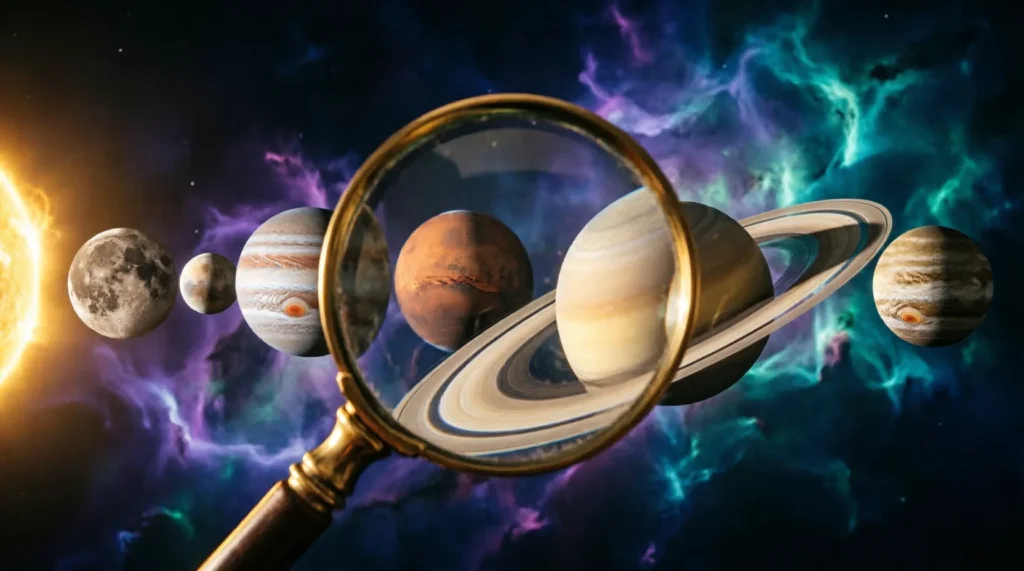
Space is full of mysteries, and so are these riddles. Whether you are hosting a space-themed birthday party, looking for a classroom brain teaser, or just want to stump your friends during a road trip, this collection delivers the perfect mix of astronomy facts and wordplay. I have tested these on everyone from curious eight-year-olds to amateur astronomers, and the results are always surprising.
Top 5 Solar System Riddles
These are the absolute best entries in the collection. They strike the perfect balance between being solvable with basic knowledge and requiring a bit of lateral thinking.
I am a planet, but I am not round. I spin on my side, unique in the crowd. My rings are faint, my color is blue-green. Who am I, in the solar scene?
Answer: Uranus
I have no light of my own, yet I shine bright. I change my shape every single night. Sometimes I am full, sometimes I am new. I orbit the Earth, watching over you.
Answer: The Moon
I am the hottest planet, though not the closest to the Sun. My atmosphere is thick, and my race is run. With clouds of acid and pressure so high, I am the morning or evening star in the sky.
Answer: Venus
I am a giant ball of gas and dust. In my gravity, you can place your trust. I have a Great Red Spot that never fades. I am the king of the planetary parades.
Answer: Jupiter
You can see me in the day, but not at night. I provide the warmth and the golden light. Without me, life would cease to be. What is the center of our galaxy’s family?
Answer: The Sun
Easy Solar System Riddles for Kids
These riddles are perfect for younger audiences or beginners. They rely on fundamental facts that are often taught in early elementary science classes. When I use these with first-graders, they usually get the first three immediately, but the last one often requires a hint about “rings.”
- I am the closest planet to the Sun. I have no moons, and my day is done. I am small and rocky, hot and fast. Which planet am I, built to last?
Answer: Mercury
- I am red and dusty, cold and dry. Rovers explore me under the sky. I have two moons, small and strange. On which planet do scientists range?
Answer: Mars
- I am the largest planet in the sky. Many moons around me fly. I am made of gas, not rock or stone. In the solar system, I reign alone.
Answer: Jupiter
- I am far away, cold and dark. I have a heart, leaving my mark. Once a planet, now a dwarf. Who am I, breaking the law?
Answer: Pluto
- I have beautiful rings made of ice and rock. I am the second-largest, around the clock. My density is low, I could float in water. Which planet am I, Saturn’s daughter?
Answer: Saturn
- I am the third rock from the Sun. Life on me has just begun. I have oceans, mountains, and air to breathe. Which planet do we all believe?
Answer: Earth
- I am an icy visitor from deep space. I leave a tail as I pick up pace. When I get close to the Sun’s heat, My icy body begins to melt and retreat.
Answer: A Comet
- I am a rocky fragment in space. If I hit Earth, I leave a trace. Before I land, I am small and free. What do you call me in astronomy?
Answer: A Meteoroid (or Asteroid)
Hard Solar System Riddles for Adults
These require more specific knowledge or deeper logical deduction. a Riddle is a statement or question that has a double or veiled meaning, presenting itself as a puzzle to be solved. These entries fit that definition perfectly because they often rely on technical astronomical terms or counter-intuitive facts.
- I am not a planet, nor a star. I am found in belts, near and far. Between Mars and Jupiter I reside. Where do these rocky bodies hide?
Answer: The Asteroid Belt
- I am a moon of Jupiter, large and bright. I have volcanoes that erupt with might. I am the most volcanic body in the system. Which moon am I, causing schism?
Answer: Io
- I am a gas giant, but I am not Jupiter. I have the strongest winds, a super-ruler. My blue color comes from methane gas. Which planet am I, behind the class?
Answer: Neptune
- I am a region of space where nothing escapes. Not even light, in various shapes. I am formed when stars collapse and die. What am I, in the blackest sky?
Answer: A Black Hole
- I am the boundary of the solar system’s edge. A shell of ice, on the outer ledge. Comets originate from my distant home. What is my name, in the cosmic foam?
Answer: The Oort Cloud
- I am a star’s remnant, dense and small. I weigh a ton, though I am not tall. I am what remains after a supernova. What am I, with no aura?
Answer: A Neutron Star
- I am a planet that rains diamonds. My pressure is high, my fate is grim then. Scientists suspect this precious fall. Which planet experiences this crystal hail?
Answer: Neptune (or Uranus)
- I am the force that keeps planets in line. Without me, their orbits would decline. I am invisible, yet I hold them tight. What force am I, in the night?
Answer: Gravity
Funny Solar System Riddles
Humor helps memory retention. These riddles use puns and playful language to make astronomy less intimidating. I find that even adults who claim to hate science will laugh at these, which lowers their guard and makes them more willing to engage with the harder questions later.
- Why did the sun go to school?
Answer: To get brighter!
- What do you call a planet that tells jokes?
Answer: A fun-planet!
- Why did the astronaut break up with his girlfriend?
Answer: He needed some space.
- How does the moon cut his hair?
Answer: Eclipse it!
- Why was the math book sad in space?
Answer: Because it had too many problems.
- What do you call a alien who sings?
Answer: A microphone!
- Why don’t aliens eat clowns?
Answer: Because they taste funny.
- What is a star’s favorite snack?
Answer: Shooting stars!
Tricky Solar System Riddles
The term Tricky implies something that requires care or skill to deal with or handle. These riddles are designed to trap the unwary thinker. They often rely on common misconceptions or linguistic traps. For example, many people assume the closest planet to the Sun is the hottest, but Venus holds that title due to its greenhouse effect.
- I am the fastest planet, orbiting the Sun. But I am not the hottest, not by a ton. Mercury is closer, but I burn more bright. Why am I hotter, in the daylight?
Answer: Venus (due to its thick atmosphere trapping heat)
- I have a day that is longer than my year. This fact causes many to fear. I spin slowly, but orbit fast. Which planet has this unusual cast?
Answer: Venus
- I am a planet, but I am not a gas giant. I am rocky, like Earth, but not compliant. I have the tallest mountain in the system. Which planet am I, in the prism?
Answer: Mars (Olympus Mons)
- I am a moon, but I am larger than a planet. Ganymede is my name, if you can stand it. I orbit Jupiter, but I am bigger than Mercury. Does this fact make you worry?
Answer: No, it is just a fact (Ganymede is indeed larger than Mercury)
- I am a dwarf planet, but I am not Pluto. I am in the asteroid belt, going slow though. Ceres is my name, the largest there. Do I have an atmosphere to share?
Answer: No, Ceres has a very tenuous exosphere, but not a true atmosphere
- I am a star, but I am not the Sun. I am the closest one, when all is done. Proxima Centauri is my name. Am I visible, in the fame?
Answer: No, it is too faint to be seen with the naked eye
- I am a planet, but I have no solid surface. My atmosphere is turbulent, of course. Jupiter is my name, the gas giant king. Can you stand on me, on anything?
Answer: No, you would sink into the gas
- I am a constellation, but I am not a planet. Orion is my name, if you can plan it. I am a pattern of stars, in the sky. Am I close, or far, tell me why?
Answer: The stars in Orion are at vastly different distances from Earth
Short Solar System Riddles
Quick fire rounds are great for keeping energy high. These are one-liners that demand instant recall. Use these for speed challenges or as tie-breakers in a quiz.
- I am the red planet.
Answer: Mars
- I have rings of ice.
Answer: Saturn
- I am the biggest planet.
Answer: Jupiter
- I am the hottest planet.
Answer: Venus
- I am the dwarf planet.
Answer: Pluto
- I am the morning star.
Answer: Venus
- I am the blue planet.
Answer: Earth (or Neptune, depending on context, but usually Earth in general quizzes)
- I am the windy planet.
Answer: Neptune
How to Use These Riddles
Integrating these riddles into your activities can transform a standard gathering into an engaging event. Here are a few proven methods I have used successfully.
- Classroom Warm-ups: Start a science lesson with one “Riddle of the Day.” It primes students’ brains for critical thinking and introduces the topic in a low-stakes way.
- Party Icebreakers: Print these on cards and place them on tables. Guests can solve them while waiting for food or mingling. It gives people an immediate topic of conversation beyond the weather.
- Scavenger Hunts: Hide clues around the house or yard. Each clue is a riddle. Solving it leads to the next location. For a solar system theme, you could hide “planets” (colored balls) and have riddles lead to each one.
- Road Trip Entertainment: Keep kids engaged in the back seat by taking turns reading riddles. The competitive element of who can solve it first keeps boredom at bay.
Frequently Asked Questions
What is a good riddle for young children? Start with the “Easy” section, specifically the ones about the Sun, Moon, and Earth. These are concrete objects they can see or relate to. Avoid abstract concepts like black holes or neutron stars until they are older.
How do these riddles help with learning? Riddles force the brain to retrieve information in a non-linear way. Instead of just reciting a fact, the solver must connect clues to knowledge. This strengthens neural pathways and improves long-term retention of scientific facts.
Are the answers always scientifically accurate? Yes. While some riddles use poetic license for rhyme, the core facts are verified against current astronomical understanding. For example, the distinction between Venus and Mercury regarding temperature is a key scientific detail included in the tricky section.
Can I use these for a commercial quiz night? Generally, yes. These are original creations based on public domain facts. However, always check the specific rules of your venue or event organizer. Using them for educational purposes or casual social gatherings is widely accepted.

With a background in psychology and cognitive science from Stanford University, Sarah Jones brings a unique perspective to the world of riddles and brain teasers. With a decade of experience in the field, she specializes in understanding how puzzles can enhance cognitive development and mental agility. Sarah’s interest in riddles began during her undergraduate years when she researched problem-solving processes in the human brain. Her work at RiddleMeHub focuses on creating puzzles that are both challenging and beneficial for mental growth, often incorporating elements of math and logic. She writes extensively about the cognitive benefits of engaging with brain teasers, aiming to promote brain health and fitness through fun and challenging content. Sarah’s contributions to the site include themed puzzle collections and in-depth analyses of classic riddles, making them accessible to both beginners and seasoned puzzlers alike. Her insightful approach has helped numerous readers appreciate the mental workout that comes with solving complex problems.