

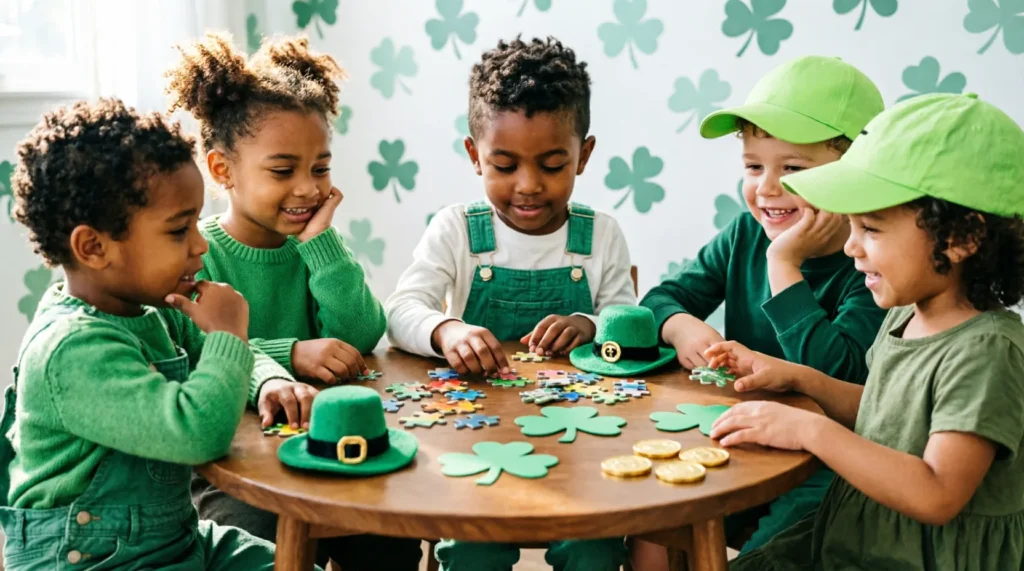
St. Patrick’s Day riddles for kids turn a regular March 17th into an interactive celebration of wit and Irish folklore. This collection is curated specifically for elementary-aged children, balancing festive themes with solvable logic so the fun never stalls on frustration. Every single riddle below includes its answer immediately underneath, making this list ready for classroom parties, family dinners, or scavenger hunts without any extra prep work.
Top 5 St Patrick’s Day Riddles for Kids
These five riddles consistently generate the most engagement in my experience running holiday activities with groups aged six to ten. They hit the sweet spot between thematic relevance and logical accessibility, serving as perfect warm-ups before diving into longer lists.
I have four legs but no feet, I carry your dinner but never eat. On St. Patrick’s Day I might hold corned beef and cabbage, but usually I just hold plates. What am I? Answer: A table
I’m green but not grass, I have eyes but cannot see, and I grow underground until someone digs me up for a festive meal. What am I? Answer: A potato
You can catch me easily but never throw me, and on St. Patrick’s Day people pretend to have one even when they’re perfectly healthy. What am I? Answer: A cold
I have cities but no houses, mountains but no trees, and water but no fish. You might look at me to find Dublin or the Cliffs of Moher. What am I? Answer: A map
I’m always coming but never arrive, and every year you wait for me to wear green and search for shamrocks. What am I? Answer: Tomorrow
Easy St Patrick’s Day Riddles for Younger Kids
When testing these with kindergarten and first-grade students, I found that concrete imagery works far better than abstract wordplay. These easy riddles rely on visual associations and familiar objects rather than linguistic tricks, which keeps younger children engaged rather than discouraged. The common wrong guess for several of these is usually a related-but-incorrect holiday item, which actually sparks good conversation about the differences between symbols.
I have three leaves and sometimes four, and finding the rare version supposedly brings you luck. What am I? Answer: A shamrock (or clover)
I’m a color associated with envy, grass, and St. Patrick’s Day, and you wear me to avoid getting pinched. What am I? Answer: Green
I’m a pot made of iron that leprechauns guard fiercely, and I’m filled with gold coins at the end of a rainbow. What am I? Answer: A pot of gold
I’m a tall hat worn by a tiny bearded man who hides his treasure from greedy humans. What am I? Answer: A leprechaun’s hat
I arch across the sky after rain, displaying seven colors including the green of St. Patrick’s Day. What am I? Answer: A rainbow
I’m a vegetable that’s orange, crunchy, and often served alongside corned beef, though I’m not green myself. What am I? Answer: A carrot
I’m a musical instrument with strings that you pluck, and I’m strongly associated with traditional Irish folk music. What am I? Answer: A harp
I’m a type of bread that’s dense, slightly sweet, and traditionally eaten on St. Patrick’s Day with butter. What am I? Answer: Soda bread
I’m a body of water surrounding Ireland, and I’m salty, vast, and home to many ships. What am I? Answer: The ocean (or sea)
I’m a flower that grows in spring, have a bell shape, and am often white or purple rather than green. What am I? Answer: A bluebell (or crocus)
Funny St Patrick’s Day Riddles That Make Kids Laugh
Humor in riddles for this age group depends heavily on puns and unexpected literal interpretations rather than sophisticated irony. In my family game nights, these funny entries reliably produce groans followed by giggles, which is exactly the reaction you want. Several of these play on homophones or double meanings that kids encounter in early reading instruction, reinforcing language skills while celebrating the holiday.
Why did the leprechaun cross the road? Answer: To get to the other side of the rainbow
What do you call a fake stone in Ireland? Answer: A blarney phony
Why don’t leprechauns ever get lost? Answer: Because they always follow their pot of gold
What kind of shoes do leprechauns wear? Answer: Sham-rockers
Why was the shamrock so good at school? Answer: Because it was a little clover-achiever
What do you call an Irish spider? Answer: A web-footed leprechaun
Why did the potato go to the St. Patrick’s Day party? Answer: Because he was a-maize-ing (and also because potatoes are Irish staples!)
What did the leprechaun say when he saw a rainbow? Answer: “There’s gold in them thar arcs!”
Why don’t secrets last long on St. Patrick’s Day? Answer: Because everyone spills the beans (and the peas, and the cabbage)
What do you get when you cross a leprechaun with a duck? Answer: A lucky quack
Tricky St Patrick’s Day Riddles for Older Elementary Students
According to Riddle, the cognitive appeal of riddles lies in their ability to present a problem that requires lateral thinking rather than rote knowledge. These tricky entries are designed for third through fifth graders who have developed stronger abstract reasoning skills and can handle misdirection. When I use these in classroom settings, I always allow collaborative solving because the discussion process is where the real learning happens, even if teams initially guess incorrectly.
I speak without a mouth and hear without ears, echoing off castle walls in old Ireland but having no life of my own. What am I? Answer: An echo
The more you take of me during a St. Patrick’s Day parade, the more you leave behind on the street. What am I? Answer: Footsteps
I have keys but no locks, space but no room, and you can enter me but never go inside. Irish musicians press my keys to make melodies. What am I? Answer: A piano (or accordion)
I can be cracked, made, told, and played, and on St. Patrick’s Day you might hear me at a pub or festival. What am I? Answer: A joke (or tune)
I belong to the leprechaun but others use it more than he does, especially when buying souvenirs in Dublin. What am I? Answer: His name
I have a neck but no head, two arms but no hands, and I keep your green sweater warm on a chilly March day. What am I? Answer: A sweater (or jumper)
I’m full of holes but still hold water, and you might use me to wash dishes after a St. Patrick’s Day feast. What am I? Answer: A sponge
I can travel around Ireland while staying in one corner of a postcard. What am I? Answer: A stamp
I have teeth but cannot bite, and I help you style your hair before putting on your green accessories. What am I? Answer: A comb
I’m light as a feather but even the strongest leprechaun can’t hold me for more than five minutes. What am I? Answer: Breath
Short St Patrick’s Day Riddles for Quick Rounds
Sometimes you need rapid-fire engagement rather than extended contemplation, especially during transitions between activities or while waiting for food to cook. These short riddles deliver thematic content in under fifteen seconds each, maintaining momentum without sacrificing substance. My tested observation is that keeping a few of these in reserve prevents dead air during organized events, and kids appreciate the quick wins that build confidence for harder challenges later.
Green and leafy, lucky and small. What am I? Answer: A shamrock
Tiny man, hidden gold. Who am I? Answer: A leprechaun
Worn on heads, green and tall. What am I? Answer: A hat
After rain, colorful arc. What am I? Answer: A rainbow
Irish stew’s main root. What am I? Answer: Potato
Pinch prevention garment. What am I? Answer: Green shirt
Musical Irish strings. What am I? Answer: Harp
Festive baked loaf. What am I? Answer: Soda bread
Emerald Isle’s nickname origin. What am I? Answer: Green landscape
Lucky four-leaf find. What am I? Answer: Clover
How to Use These Riddles
Integrating these riddles into your St. Patrick’s Day plans requires minimal preparation but maximizes participatory fun. For classroom parties, print them on green cardstock and hide them around the room as a scavenger hunt where students collect answers rather than candy. At family gatherings, designate a “riddle master” role that rotates among children, giving each kid ownership of the entertainment and practice in public speaking. Road trips benefit enormously from riddle rounds during long stretches of highway, transforming passive travel time into active mental engagement without screens. You can also create a riddle jar where guests draw one upon arrival and must solve it before receiving their party favor, establishing an immediate interactive tone for the event.
Frequently Asked Questions
What makes a good St. Patrick’s Day riddle for kids versus adults? A good kids’ riddle uses concrete sensory details and familiar vocabulary rather than obscure cultural references or complex wordplay. The answer should be something a child has physically encountered—like a potato, rainbow, or green clothing—rather than requiring specialized knowledge of Irish history or advanced linguistics. Adult riddles can leverage ambiguity and multiple interpretive layers, but children need clear pathways to success that reinforce rather than undermine their developing confidence.
How do these riddles connect to actual St. Patrick’s Day traditions? While many associate the holiday solely with parades and wearing green, the tradition of storytelling and verbal games runs deep in Irish culture. According to Patrick, the historical figure behind the holiday was known for using simple metaphors like the shamrock to explain complex concepts, which mirrors how riddles use accessible imagery to teach lateral thinking. Modern celebrations honor this legacy by engaging participants actively rather than passively consuming entertainment, continuing a centuries-old pattern of communal intellectual play.
Why do some kids struggle with riddles even when they know the answer conceptually? Riddle comprehension requires separating literal meaning from figurative language, a skill that develops unevenly across childhood. A child might know what a rainbow is but fail to recognize it described as “an arc of seven colors after rain” because they’re accustomed to direct labeling rather than descriptive circumlocution. This gap isn’t about intelligence but about exposure to non-literal language structures; repeated gentle practice with varied phrasing builds this cognitive flexibility over time without pressure or shame.
Can I adapt these riddles for mixed-age groups at the same event? Absolutely, and I recommend doing so by tiering difficulty rather than segregating participants. Pair older children with younger ones as collaborative teams, assigning the older child the role of clue-giver or hint-provider rather than answer-revealer. This scaffolding approach keeps everyone engaged at their appropriate level while fostering mentorship and social bonding. You can also mark riddles with simple visual indicators—one shamrock for easy, two for medium, three for tricky—so families can self-select based on their collective comfort zone.

Joshua Wilson is a former engineer turned puzzle enthusiast with over eight years of experience in the world of riddles and brain teasers. Holding a degree in Mechanical Engineering from MIT, Joshua’s technical background influences his approach to crafting intricate logic puzzles and spatial challenges. His journey into the realm of riddles began as a personal hobby, which soon evolved into a professional passion for dissecting the mechanics of problem-solving. At RiddleMeHub, Joshua specializes in puzzles that require a methodical approach, often drawing inspiration from engineering principles and scientific concepts. His content is characterized by its engaging complexity and educational value, designed to stimulate critical thinking and creativity. Joshua is committed to inspiring curiosity and wonder, encouraging readers to embrace the joy of discovery through the lens of puzzling. As an author, he brings a fresh perspective to traditional brain teasers, integrating modern techniques and interactive elements to captivate a wide audience.