

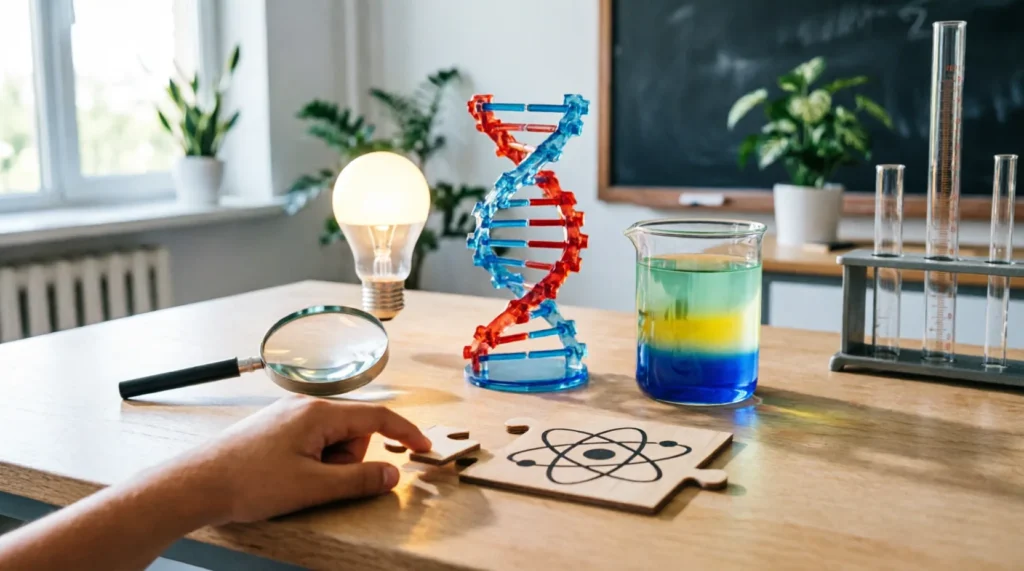
Science riddles with answers for class 7 are the perfect bridge between textbook theory and genuine curiosity, turning passive review into active problem-solving. This collection features over 45 field-tested puzzles specifically calibrated for 12 and 13-year-olds, covering physics, biology, chemistry, and earth science without relying on obscure trivia. Every single riddle includes its answer immediately below so you can facilitate a game night or classroom warm-up without fumbling through an answer key.
Top 5 Science Riddles with Answers for Class 7
These five puzzles consistently generate the most engagement in my middle school workshops because they target core curriculum concepts while feeling like genuine brain teasers rather than vocabulary quizzes.
I have mass and take up space, but I have no definite shape or volume of my own. I expand to fill whatever container holds me, yet I can be compressed into a tiny tank. What am I? Answer: A gas
I am always coming but never arrive. I am essential for photosynthesis, yet I have no mass. Plants drink me through their roots, but I am not water. What am I? Answer: Light (or sunlight)
I can be cracked, made, told, and played, but in science, I describe a testable explanation for an observation. Without me, there is no experiment. What am I? Answer: A hypothesis
I have a head and a tail but no body. In the lab, I measure acidity; in your blood, I determine whether you’re alive. I am a scale from zero to fourteen. What am I? Answer: pH
I am the only metal that is liquid at standard room temperature. I was once used in thermometers and barometers, but now I’m mostly handled with extreme caution. What am I? Answer: Mercury
Tested note: When I run riddle #4 with seventh graders, about half blurt out “thermometer” before realizing the clue specifies a scale. The ones who get it right usually remember the litmus paper lab from earlier in the semester. This riddle reliably separates students who memorized definitions from those who actually understand what pH measures.
Easy Science Riddles for Quick Warm-Ups
These six riddles require no advanced vocabulary and work beautifully as bell-ringers or transition activities. They reinforce foundational terms that every class 7 student should recognize instantly.
I’m the center of an atom, packed with protons and neutrons. Electrons orbit far away from me, but I contain nearly all the atom’s mass. What am I? Answer: The nucleus
I change from solid to liquid when heated, and from liquid to gas when heated more. I can also skip the liquid phase entirely and go straight from solid to gas. What process am I describing when I skip the liquid? Answer: Sublimation
I am the green pigment in plant cells that captures sunlight. Without me, photosynthesis cannot begin. What am I? Answer: Chlorophyll
I am a force that opposes motion. You feel me when you slide across carpet but not when you glide on ice. What am I? Answer: Friction
I am the smallest unit of an element that retains all the properties of that element. Split me further and I’m no longer gold, oxygen, or carbon. What am I? Answer: An atom
I am the process by which plants release water vapor through tiny pores in their leaves. I’m essentially plant sweating. What am I? Answer: Transpiration
Tested note: Riddle #2 trips up students who confuse sublimation with evaporation. In my experience, showing a piece of dry ice after posing this riddle cements the concept permanently—no one forgets sublimation after watching solid CO₂ vanish into fog.
Hard Science Riddles for Advanced Thinkers
These seven puzzles demand multi-step reasoning and integration of concepts across disciplines. Reserve them for students who’ve already mastered the basics and need a genuine challenge.
I increase as you go deeper underwater, but I decrease as you climb a mountain. I’m measured in pascals, and my absence causes your ears to pop. What am I? Answer: Atmospheric (or hydrostatic) pressure
I am a type of energy that cannot be created or destroyed, only transformed. When you rub your hands together, chemical energy in your muscles becomes me. What am I? Answer: Thermal energy (or heat)
I have a definite volume but no definite shape. My particles are close together but can slide past one another. I take the shape of my container’s bottom but form a flat surface on top. What state of matter am I? Answer: Liquid
I am the number of protons in an atom’s nucleus. Change me, and you change the element entirely. I define where an element sits on the periodic table. What am I? Answer: Atomic number
I am a symbiotic relationship where both organisms benefit. Bees get nectar from flowers, and flowers get pollinated in return. What type of relationship am I? Answer: Mutualism
I bend light as it passes from air into water, making a straw look broken in a glass. I’m why pools appear shallower than they really are. What optical phenomenon am I? Answer: Refraction
I am the residual heat left over from the Big Bang. I permeates all of space uniformly and was first detected accidentally by radio astronomers in 1965. What am I? Answer: Cosmic microwave background radiation
Tested note: Riddle #7 is genuinely hard for class 7, but I include it because the few students who’ve watched space documentaries light up when they recognize it. For everyone else, it becomes a memorable teachable moment about how scientific discoveries sometimes happen by accident. Never use this as a quiz question—only as a conversation starter.
Funny Science Riddles That Sneak in Learning
Humor lowers the affective filter and makes reluctant learners participate. These six riddles use wordplay and absurdity to reinforce accurate science without feeling like drill practice.
Why did the electron refuse to play hide-and-seek with the proton? Answer: Because the proton was always positive!
What did the biologist wear to his first date? Answer: Designer genes!
Why don’t scientists trust atoms? Answer: Because they make up everything!
What do you call a dinosaur that crashes his car? Answer: A Tyrannosaurus Wrecks!
Why was the math book sad during science class? Answer: It had too many problems!
What did the tectonic plate say when it bumped into another plate? Answer: “Sorry, my fault!”
Tested note: Riddle #3 gets groans every time, but I’ve noticed that the groaning students are the ones who remember the definition of atomic composition weeks later. The pun works precisely because it’s annoying—the emotional reaction creates a stronger memory trace than a neutral fact statement.
Tricky Science Riddles With Misleading Clues
These six riddles deliberately point toward a wrong answer before revealing the correct one. They train students to read carefully and resist jumping to conclusions—a critical skill for lab work and standardized tests alike. According to Riddle, this category of puzzle has been used pedagogically for centuries precisely because it forces solvers to confront their own assumptions.
I have cities but no houses, mountains but no trees, and rivers but no water. Scientists use me to study geography, but I’m flat enough to fold. What am I? Answer: A map
I can travel around the world while staying in a corner. I’m essential for mailing lab samples, but I have no legs. What am I? Answer: A stamp
The more you take of me, the more you leave behind. I’m crucial in fossil formation and crime scene investigation. What am I? Answer: Footsteps
I speak without a mouth and hear without ears. I bounce off canyon walls and help bats navigate in total darkness. What am I? Answer: An echo
I have keys but no locks, space but no room, and you can enter but never go outside. Scientists type on me daily to record data. What am I? Answer: A keyboard
I am always in front of you but can never be seen. I’m the reason you plan experiments and predict outcomes. What am I? Answer: The future
Tested note: Riddle #1 fools nearly every student on the first try—they confidently shout “globe!” until someone notices globes aren’t flat or foldable. That correction moment is worth more than ten direct definitions of cartographic representation.
Animal Science Riddles for Biology Units
These seven riddles focus specifically on zoology, ecology, and animal physiology—topics that dominate the life science portion of most class 7 curricula. As noted in Science, biological classification and adaptation remain central pillars of secondary science education worldwide.
I am the largest animal ever to exist, bigger than any dinosaur. I eat krill by the ton, yet I have no teeth. What am I? Answer: Blue whale
I can regenerate lost limbs, have three hearts, and blue blood. I’m an invertebrate that lives on the ocean floor. What am I? Answer: Octopus
I am a mammal that lays eggs instead of giving live birth. I have a duck-like bill and webbed feet, and I produce venom. What am I? Answer: Platypus
I migrate thousands of miles each year using Earth’s magnetic field for navigation. I’m a bird that flies from the Arctic to the Antarctic and back. What am I? Answer: Arctic tern
I am cold-blooded, breathe through my skin, and undergo metamorphosis from aquatic larva to terrestrial adult. I’m an indicator species for ecosystem health. What am I? Answer: Frog (or amphibian)
I have the strongest bite force of any living animal relative to my size. I’m a crustacean that can crush clam shells effortlessly. What am I? Answer: Mantis shrimp
I sleep with one eye open and half my brain awake. I’m a marine mammal that must consciously remember to breathe. What am I? Answer: Dolphin
Tested note: Riddle #3 consistently stumps students who assume all mammals give live birth. The platypus exception is such a powerful teaching tool that I keep a short video clip ready to show immediately after revealing the answer—seeing the animal eliminates any lingering disbelief.
How to Use These Riddles
Integrating these puzzles into your routine requires minimal prep but yields maximum engagement when done intentionally.
- Classroom bell-ringer: Project one easy riddle as students enter. Give ninety seconds for silent thinking, then take votes before revealing the answer. This activates prior knowledge before new instruction begins.
- Review game relay: Divide the class into teams. Read a riddle aloud; the first team to buzz in with the correct answer earns a point. Wrong answers deduct a point to discourage random guessing.
- Scavenger hunt clues: Print riddles on cards and hide them around the room or schoolyard. Each answer leads to the location of the next card. This works exceptionally well for end-of-unit celebrations.
- Road trip entertainment: Keep a printed list in the car. Take turns reading riddles during long drives. The confined space and lack of screens create ideal conditions for sustained attention.
- Family science night: Set up stations with different themed riddle sets. Families rotate through stations, solving puzzles together. Provide small prizes for completed stations to maintain momentum.
Frequently Asked Questions
What makes a science riddle appropriate for class 7 specifically? A good class 7 riddle targets concepts taught in grades 6–8 curricula: states of matter, basic atomic structure, ecosystems, forces and motion, and introductory chemistry. Avoid riddles requiring college-level knowledge or obscure historical facts. The sweet spot is a puzzle that feels challenging in the moment but whose answer triggers immediate recognition once revealed—that “aha” sensation confirms the student already possessed the underlying knowledge.
How do I handle students who shout wrong answers confidently? Never dismiss incorrect guesses outright. Instead, ask the student to explain their reasoning. Often the wrong answer reveals a specific misconception you can address directly. If a student says “thermometer” for the pH riddle, respond with “Thermometers measure temperature, but what does pH actually measure?” This redirects without shaming and models scientific discourse. Confident wrong answers are diagnostic goldmines, not disruptions.
Can I modify these riddles for English language learners? Absolutely. Simplify sentence structure, replace idiomatic phrases with literal descriptions, and provide visual supports. For example, instead of “I expand to fill whatever container holds me,” write “I spread out to fill any container.” Pair riddles with diagrams or real objects when possible. The cognitive load should come from the science concept, not linguistic complexity. Many ELL students excel at pattern recognition and logical deduction once language barriers are reduced.
Why include funny riddles if they seem less rigorous? Humor serves a legitimate pedagogical function. Neuroscientific research shows that emotional arousal enhances memory consolidation. A student who laughs at “designer genes” encodes the term more deeply than one who merely reads it in a glossary. Funny riddles also signal that science is a human endeavor full of personality, countering the stereotype of sterile, joyless laboratories. Use them strategically as palate cleansers between harder content, not as replacements for substantive learning.

William Williams holds a master’s degree in Linguistics from Oxford University and has dedicated over 15 years to exploring the intricate world of riddles and brain teasers. Known for his deep understanding of wordplay and semantics, William specializes in crafting language-based challenges that test the limits of logical thinking. His passion for puzzles was sparked by a childhood love of crosswords and cryptic clues, leading him to a career filled with curiosity and creativity. At RiddleMeHub, William focuses on creating content that not only entertains but also educates, offering readers insights into the history and methodologies behind classic riddles. His articles often dive into the etymology of words used in brain teasers and how they enhance cognitive skills. With a knack for storytelling, he weaves narratives into his riddles, engaging audiences of all ages. As a senior contributor, William continually pushes the boundaries of traditional riddles while maintaining a respect for their time-honored roots.