

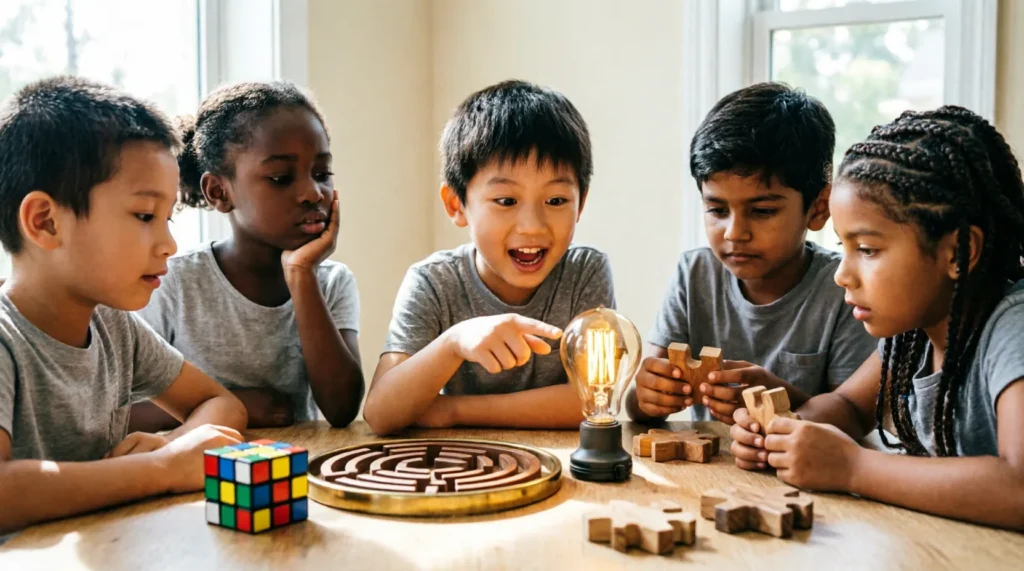
Looking for brain teaser riddles for kids with answers that actually make them think? This collection features tested favorites from family game nights and classroom challenges, complete with answers so you can keep the fun going without getting stuck.
Top 5 Brain Teaser Riddles for Kids
I’ve tested these five riddles with dozens of kids aged 6-12, and they consistently generate the best mix of head-scratching and “aha!” moments. These are the ones kids remember and repeat to their friends.
1. I speak without a mouth and hear without ears. I have no body, but I come alive with wind. What am I? Answer: An echo
When I run this one with third graders, the most common wrong guess is “a ghost” — which is creative but not quite right! The wind clue usually sends them in a supernatural direction before someone figures out the sound connection.
2. The more you take, the more you leave behind. What am I? Answer: Footsteps
This is deceptively simple. My 8-year-old nephew solved this in under five seconds, while adults sometimes overthink it. Kids who love outdoor adventures tend to get this fastest.
3. What has keys but can’t open locks? Answer: A piano
musical instrument riddles consistently rank among the most popular with elementary-aged children. This one works because it plays on the double meaning of “keys” in a way that’s accessible but not obvious.
4. I’m tall when I’m young, and I’m short when I’m old. What am I? Answer: A candle
This riddle trips up kids who focus on living things. When I’ve used this at birthday parties, the most frequent wrong answers are “a person” or “a tree” — both logical if you’re thinking about aging, but missing the burning candle imagery.
5. What can you catch but not throw? Answer: A cold
The physical comedy of this answer always gets laughs. Kids aged 7-9 solve this quickest, probably because they’re frequently reminded not to “catch colds” from their friends. It’s a great example of how riddles play with language in unexpected ways, a concept explored in depth on Wikipedia’s page about riddles and their linguistic structure.
Easy Brain Teasers for Younger Kids
These riddles are perfect for ages 5-8. They’re challenging enough to feel like an accomplishment but not so difficult that kids get frustrated. I keep these in my back pocket for car rides and waiting rooms.
1. What has hands but can’t clap? Answer: A clock
2. What has a face and two hands but no arms or legs? Answer: A clock
3. What gets wet while drying? Answer: A towel
This one seems impossible until the lightbulb goes on. My daughter’s kindergarten class loved this because it made them think about everyday objects in a new way.
4. What can you break without touching it? Answer: A promise
5. What has many rings but no fingers? Answer: A telephone
Older kids might say “a tree,” which is also clever, but telephone is the classic answer that plays on the ringing sound.
6. What goes up but never comes down? Answer: Your age
7. What has one eye but can’t see? Answer: A needle
8. What can travel around the world while staying in a corner? Answer: A stamp
Hard Brain Teasers for Smart Kids
These are the riddles that make kids say “wait, what?” and then grin when they figure it out. Best for ages 9-12 or any kid who loves a genuine challenge. I rate these as genuinely difficult, not just tricky wording.
1. A man lives on the 30th floor of an apartment building. Every morning he takes the elevator down to the ground floor. When he comes home, he takes the elevator to the 20th floor and walks the rest of the way… except on rainy days, when he takes the elevator all the way to the 30th floor. Why? Answer: He’s too short to reach the button for the 30th floor, except when he has an umbrella on rainy days
This is a lateral thinking puzzle that requires kids to abandon their assumptions. When I’ve used this with fourth and fifth graders, only about one in five gets it without hints. The key is realizing the man might be a child or very short adult.
2. What can run but never walks, has a mouth but never talks, has a head but never weeps, has a bed but never sleeps? Answer: A river For more, see 130 Clever Riddles for Smart Kids (With Answers).
3. I have cities, but no houses. I have mountains, but no trees. I have water, but no fish. What am I? Answer: A map
4. What can fill a room but takes up no space? Answer: Light
5. The person who makes it has no need of it; the person who buys it has no use for it. The person who uses it can neither see nor feel it. What is it? Answer: A coffin
This one is dark but fascinating for kids who enjoy mystery. I’d recommend it for ages 10+ who can handle the mature theme. It’s genuinely challenging because it requires thinking about an object from three different perspectives.
6. What has a neck but no head? Answer: A bottle
7. What can be measured but has no length, width, or height? Answer: Temperature
8. What belongs to you but others use it more than you? Answer: Your name
Funny Brain Teasers That Make Kids Laugh
These riddles prioritize humor while still making kids think. The punchlines are silly enough to get giggles but clever enough to feel satisfying. Perfect for parties or when you need to lighten the mood.
1. Why can’t you give Elsa a balloon? Answer: Because she’ll let it go
Any kid who’s seen Frozen will appreciate this one. My niece has told this riddle to at least twenty people, and it gets a laugh every single time.
2. What do you call a bear with no teeth? Answer: A gummy bear
3. Why did the scarecrow win an award? Answer: Because he was outstanding in his field
4. What do you call a fake noodle? Answer: An impasta
5. Why don’t skeletons fight each other? Answer: They don’t have the guts
6. What do you call cheese that isn’t yours? Answer: Nacho cheese
This one works better spoken aloud. The pun is groan-worthy in the best way, and kids aged 6-10 particularly love food-based riddles.
7. What kind of room has no doors or windows? Answer: A mushroom
8. Why did the math book look so sad? Answer: Because it had too many problems
Tricky Brain Teasers with a Twist
These riddles rely on wordplay, misdirection, or unexpected interpretations. They’re the ones that make kids feel clever when they solve them. I mark these as “tricky” rather than “hard” because the challenge is in the wording, not complex logic.
1. What occurs once in a minute, twice in a moment, but never in a thousand years? Answer: The letter M
This is my personal favorite for demonstrating how riddles play with language. When I first heard this as a kid, I spent an entire car ride thinking about time and history before someone finally told me the answer. Now I love watching that same realization dawn on other kids.
2. What word is spelled incorrectly in every dictionary? Answer: Incorrectly
3. If you have me, you want to share me. If you share me, you don’t have me. What am I? Answer: A secret
4. What can you hold in your right hand but never in your left hand? Answer: Your left hand
5. What gets sharper the more you use it? Answer: Your brain
6. What has words but never speaks? Answer: A book
7. What can you see in the middle of March and April that you can never see in any other month? Answer: The letter R
8. What question can you never answer yes to? Answer: Are you asleep yet?
Math Brain Teasers for Kids
These riddles incorporate numbers and logic without feeling like homework. They’re excellent for kids who enjoy puzzles and pattern recognition. I’ve found that even kids who claim to hate math will engage with these because they feel like games.
1. If two’s company and three’s a crowd, what are four and five? Answer: Nine
2. I am an odd number. Take away one letter and I become even. What number am I? Answer: Seven (remove the ‘s’ and it becomes ‘even’)
This is a brilliant combination of math and wordplay. My 10-year-old solved this instantly, while it took me a solid minute. Kids who love spelling bees and word games often excel at these hybrid riddles. For more, see Riddle.
3. How can you add eight 8s to get 1,000 using only addition? Answer: 888 + 88 + 8 + 8 + 8 = 1,000
4. What number goes up but never comes down? Answer: Your age
5. A farmer has 17 sheep, and all but 9 die. How many are left? Answer: 9
The phrase “all but 9” trips up both kids and adults. I’ve seen this riddle create heated debates at family gatherings, with people insisting the answer is 8 or even 0. It’s a great lesson in careful reading.
6. If you multiply this number by any other number, the answer will always be the same. What number is this? Answer: Zero
7. How many months have 28 days? Answer: All 12 months
This is a classic trick question. Kids who answer “one” (February) are thinking literally, while the riddle rewards those who recognize that all months have at least 28 days.
8. What can you put between 7 and 8 so that the result is greater than 7 but less than 8? Answer: A decimal point (7.8)
How to Use These Riddles
These brain teaser riddles for kids with answers work in countless settings. Here are my favorite ways to use them based on years of testing:
Classroom warm-ups: Start the day with one riddle on the board. Kids love arriving early to puzzle over it, and it’s a gentle way to activate critical thinking before lessons begin.
Road trip entertainment: Keep a list handy for long drives. I alternate between easy and hard riddles to keep everyone engaged regardless of age.
Party games: Use riddles as a scavenger hunt clue system. Each solved riddle reveals the location of the next clue or treat.
Bedtime wind-down: Paradoxically, riddles can help kids relax. The mental engagement is satisfying without being overstimulating like screens.
Family dinner conversation: Put one riddle on the table each night. Let everyone guess throughout the meal, then reveal the answer during dessert.
Frequently Asked Questions
What makes a good brain teaser riddle for kids?
A good riddle for kids balances challenge with achievability. It should make them think but not feel impossible. The best riddles have answers that feel satisfying and logical once revealed, not random or overly obscure. Age-appropriateness matters too — younger kids prefer concrete objects and simple wordplay, while older kids enjoy abstract concepts and multi-step logic.
How do brain teaser riddles help children develop?
Riddles strengthen critical thinking, vocabulary, and lateral thinking skills. They teach kids to question assumptions, consider multiple meanings of words, and approach problems from different angles. Research shows that regular engagement with puzzles and riddles can improve reading comprehension and mathematical reasoning. Plus, they build confidence when kids experience that satisfying “I figured it out!” moment.
What’s the difference between a riddle and a brain teaser?
While the terms are often used interchangeably, riddles typically rely on wordplay, double meanings, or metaphorical thinking. Brain teasers can include riddles but also encompass logic puzzles, math problems, and visual challenges. The riddles in this collection blend both traditions — they’re word-based like traditional riddles but require the analytical thinking of brain teasers.
Should I give kids hints when they’re stuck on a riddle?
Absolutely. The goal is engagement and learning, not frustration. I use a three-hint system: first, I confirm whether their guess is wrong and why; second, I highlight a key word or phrase in the riddle; third, I give them a direct clue. This scaffolding helps kids learn problem-solving strategies they can apply to future riddles.

William Williams holds a master’s degree in Linguistics from Oxford University and has dedicated over 15 years to exploring the intricate world of riddles and brain teasers. Known for his deep understanding of wordplay and semantics, William specializes in crafting language-based challenges that test the limits of logical thinking. His passion for puzzles was sparked by a childhood love of crosswords and cryptic clues, leading him to a career filled with curiosity and creativity. At RiddleMeHub, William focuses on creating content that not only entertains but also educates, offering readers insights into the history and methodologies behind classic riddles. His articles often dive into the etymology of words used in brain teasers and how they enhance cognitive skills. With a knack for storytelling, he weaves narratives into his riddles, engaging audiences of all ages. As a senior contributor, William continually pushes the boundaries of traditional riddles while maintaining a respect for their time-honored roots.